Quantifiable results from hull coatings
The problem with such claims is how to prove their validity. It is not difficult to prove that, after drydocking and recoating with a new product, fuel consumption is lowered; that is almost inevitable. But ship operators need to know that the superior performance is being maintained.
Norwegian manufacturer Jotun announced earlier this year (see The Motorship, May 2011) that it was prepared to guarantee its HPS system by offering to refund the extra cost if the savings were not maintained within agreed limits throughout a 60-month period. This, according to Jotun, can be proved by analysis of vessel speed, wind, draught and shaft power.
Demonstrable improvements
Jotun has been joined in providing a method of quantifying claimed improvements by International Paints. International was joined forces with BMT Argoss to, as the company puts it, “deliver demonstrable and transparent improvements in performance, efficiency and environmental emissions for the global shipping fleet.”
The partnership is based in International’s fouling control coatings in conjunction with the BMT SmartServices system, to provide a measurable reduction in energy use and CO2 emissions. The BMT system is intended to independently monitor and report the performance of vessels. It is based on BMT’s SmartPower onboard, real-time performance monitoring and reporting system which acquires and records data automatically from ship sensors and provides ship performance information to the crew and shore based management.
The package combines the BMT system with either International Intersmooth SPC, which is a self-polishing copolymer biocidal antifouling, claimed to be unique in its formulation and benefits, or Intersleek, International’s latest fluoropolymer foul release coating. These benefits include, for Intersmooth SPC, a 4% saving based on observations on some 5,000 drydockings of 50 ships, and for Intersleek, fuel and emission savings of up to 9%, based on an analysis by Energy & Environmental Research Associates.
Han Wensink, managing director of BMT Argoss says: “BMT SmartServices will clearly and transparently demonstrate any in-service performance changes when International Paint’s hull coatings have been used. Equipped with a user friendly Web based interface and drawing on BMT’s 24/7 access to high quality metocean data, the new system can play a major role in improving operational efficiency of the global shipping fleet.”
Paul Robbins, worldwide marine marketing director at International Paint adds: “We are confident that our high performance biocidal antifoulings and foul release coatings when used in conjunction with BMT Smartservices will deliver quantifiable added value for ship owner and operators. One of the reasons we partnered with BMT is that the new system can accurately determine total performance levels by recording over 30,000 readings per day, providing complete transparency and evidence to owners and operators of the performance improvements our advanced hull coatings technology can deliver. The BMT system can be installed at newbuilding or as a retro-fit and by utilising International Paint’s and BMT’s global networks, in-service support will be provided at every stage throughout the life of the coating and the monitoring system.”
Low friction for future ships
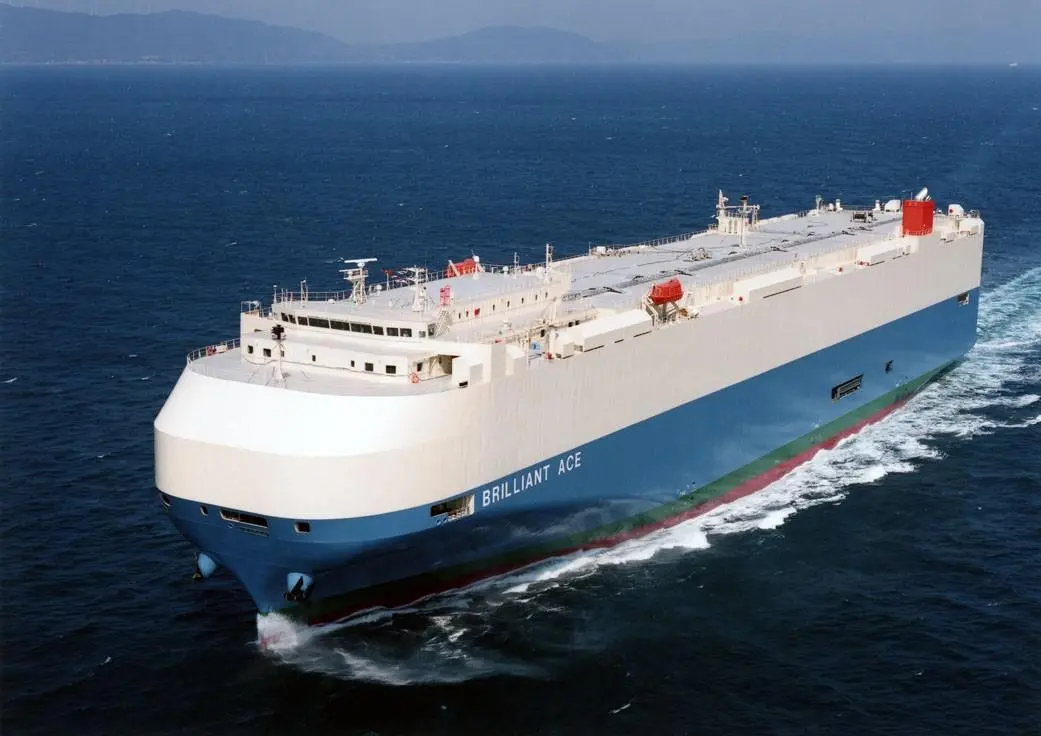
Similar, or even greater, benefits are claimed by Japanese company Chugoku Marine Paint for its low-friction Seaflo Neo hull paint. The claims have been confirmed by ship operator Mitsui OSK Lines which has analysed the results of an onboard test of the paint applied to a newbuilding vessel, and confirmed that the new paint offers improvements in fuel efficiency compared to other paints. MOL is adopting Seaflo Neo for its environmentally-friendly shipbuilding programme, known as the Sempaku Ishin next-generation vessel concept. . It is initially being used on two car carrier newbuildings.
MOL says that the paint will contribute to the reduction of CO2 emissions from its vessels. As friction between the hull and the water accounts for the majority of resistance, reducing friction drag can be shown to be effective in reducing CO2 emissions during vessel operation. The two newbuildings adopting the new paint are a pair of car carriers, both of 6,400 standard passenger car unit capacity, built by Minaminippori Shipbuilding. The Brilliant Ace was completed in March 2011, and the Eternal Ace four months later.
The main characteristic of Seaflo Neo is said to be the high smoothness of their paint film surface, the result of a newly developed low-viscosity hydrolysed polymer. The ultra-smooth finish is intended to minimise friction drag, improving fuel efficiency by 3% to 5% compared to an identical vessel with a conventional hull coating. Seaflo Neo is claimed to be very low in volatile organic compounds (VOCs), a major source of air pollution.
Antifouling for conversions
Danish company Hempel is currently supplying 150,000 litres of its third generation fouling release coating, Hempasil X3, as part of a five-vessel conversion project for Brazilian mining giant Vale.
Five of Vale’s VLCCs are being converted to very large ore carriers (VLOCs) at the Yulian and Huraung Dan Dong shipyards in China. The first Ore Itaquia, was completed in October at Yulian while the second was completed at the same yard in November.
“The shipping industry is facing increasing pressure from governments and legislative authorities to reduce greenhouse gas emissions,” says Torben Rasmussen, group product manager at Hempel. “In response, many shipowners have set their own environmental targets in an effort to reduce CO2 emissions. But, finding effective ways to meet these targets can be a challenge, and that’s where Hempel’s complete fouling control concept can help.”
At a previous drydocking, the five VLCCs were coated with a standard fouling release silicone product. During the current conversion, Hempasil Nexus X-Tend, a tiecoat for repair and touch-up, will be an integrated part of the new paint system. “Nexus X-Tend makes using Hempasil X3 as simple as using a conventional antifouling coating,” says Rasmussen. “In the past, spot repair was time consuming and complex and often led to substandard results, such as poor adhesion between coats.”
Ten year coating warranty
Another hull coating with a warranty comes from the Belgian brand Ecospeed. In this case, it is durability that is guaranteed, with a 10-year period covered, though Ecospeed believes the paint should last the lifetime of the ship.
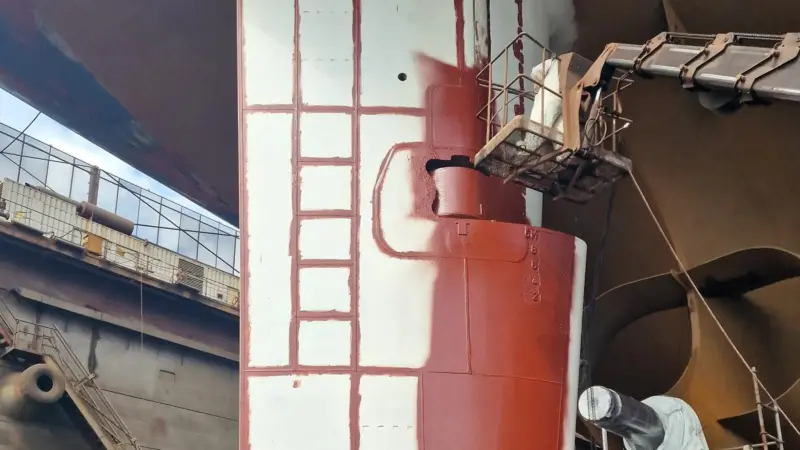
The paint is often applied to rudders as well as hull surfaces, and Ecospeed claims a reference list of over 70 full underwater hulls and 135 rudders. The paint is described as an environmentally safe underwater hull coating system which improves a ship’s performance and provides it with long-term protection. The company says it is easy to apply, provides superior protection, offers a smooth surface for hydrodynamic optimisation and minimizes long term maintenance of the underwater surfaces. Ecospeed’s improved hydrodynamic characteristics result in increased fuel efficiency. This has been shown in several cruise vessel applications, where the Ecospeed-coated ships are able to run at normal speeds with reduced propulsion power.
Among the successful case studies reported by the company is the Antactic research ship RRS Ernest Shackleton, to which Ecospeed hull coating was applied in October 2009. A 2011 drydocking showed that, despite having operated in 2.5m ice on several occasions, the coating was mostly intact with only small areas of touch-up required. Some parts of the underwater surfaces, including the rudder, had been painted with traditional coatings rather than Ecospeed, and the drydocking showed these areas to have suffered severe corrosion and mechanical damage.
Hamburg-based operator Ernst Russ has a fleet of five 1999-built ro-ro ships, on which the rudders had a history of cavitation damage, said to result from higher than average propeller speeds. Standard epoxy coatings proved inadequate, and exhibited damage in the first intermediate docking, two or three years after launch.
One of the ships, the Elisabeth Russ, received Ecospeed coating on her rudder as an experiment during a 2004 docking. Despite receiving only two coats, and less preparation than recommended, the trial is reported to have been entirely successful, with the coating holding firm in 2007, and still intact when the ship was docked again in 2011. All five ships now have Ecospeed applied to the rudder blades, with highly satisfactory results.
Grzegorz Girjat, superintendent at Ernst Russ, reports: “I would say for me it is quite clear. Had we not applied Ecospeed on the rudders, we would certainly have extensive work to do in drydock.”
Among other users of Ecospeed is the Belgian Navy, which has found the paint to last well with only a few touch-ups needed at drydocking. Among the Belgian Navy vessels using Ecospeed are the mine hunter M915 Lobelia, which was coated in 2006, and three tugs, two of which were also coated in 2006 and a third, A950 Valcke, which has now been sailing with Ecospeed for over five years. The company points out that Naval ships can spend long idle periods between operations, allowing fouling to build up. As Ecospeed’s properties prevent fouling from penetrating the surface, and allow easy cleaning, the optimum average hull roughness will be regained after each cleaning because surface integrity is maintained.
Traditional antifouling
For owners looking for a traditional antifouling, PPG Protective & Marine Coatings has launched its high-activity Sigma Nexeon 750 antifouling product, which is claimed to deliver optimum protection against hard fouling and whitening, with good performance characteristics and reduced environmental impact.
Nexeon 750 is said to provide a solution to the challenge of keeping a ship’s underwater hull clean from discoloration and/or fouling pick-ups while it is stationary in seawater. With prolonged outfitting periods for newbuildings such as LNG carriers, FPSOs, offshore support ships and drill ships, there is an increasing demand for vessels to look clean and not incur extensive costs on cleaning the underwater hull before delivery. Nexeon 750 is a copper-free, high-activity antifouling based on self-polishing binder technology. It is said to be particularly suitable for static and low-activity vessels, both at new build and providing consistent polishing even in stationary service conditions.
Nexeon 750 is usually recommended in combination with the existing Sigma Coatings antifouling product range, as a final antifouling coat.