Large capacity systems still causing doubts
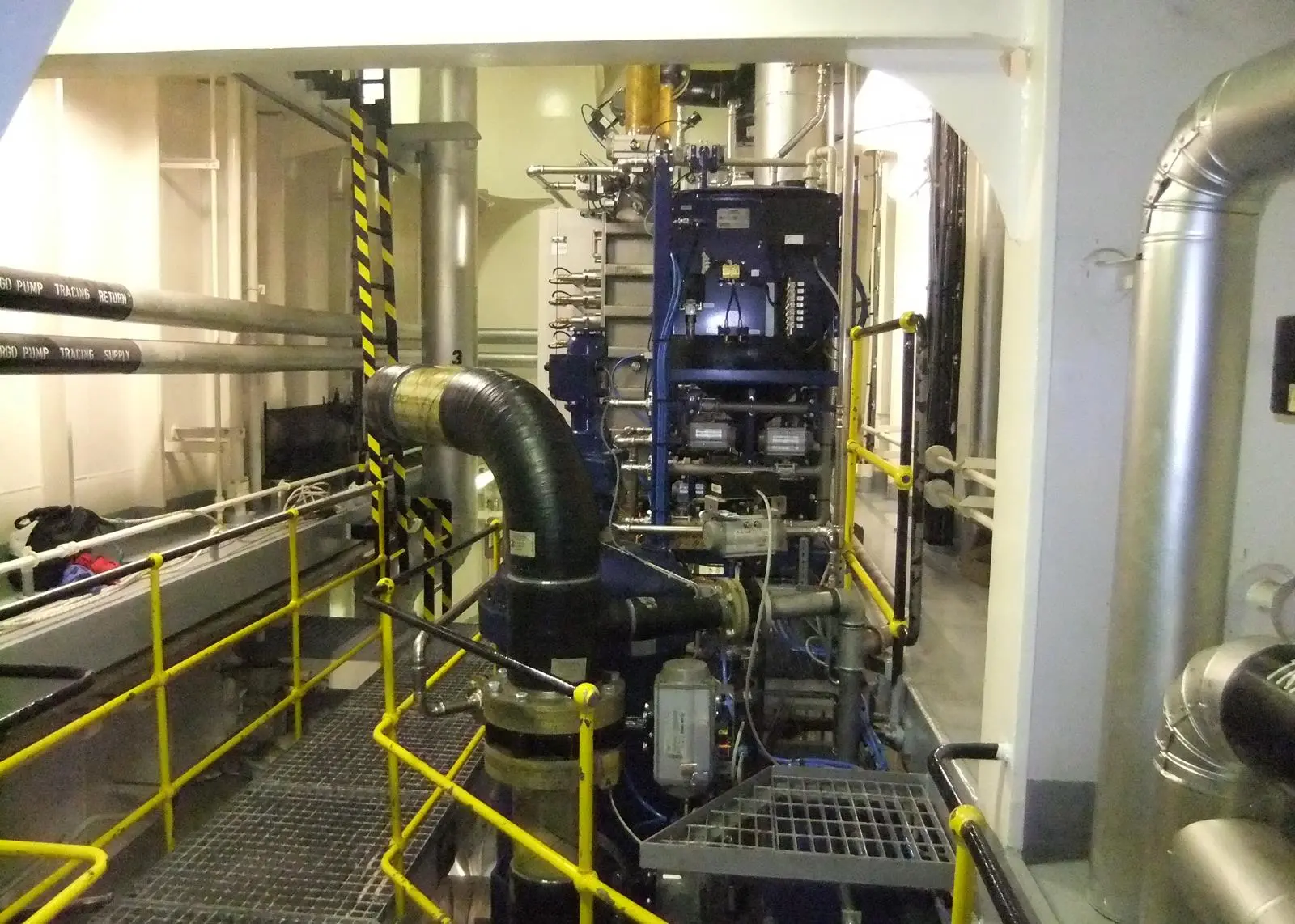
Manufacturers offering treatment systems for large vessels generally offer solutions that link multiple smaller capacity systems together. “This can mean that type approval of the system in this larger configuration has not been gained other than in principle,” says Anna Orchard, independent marine consultant. “Therefore efficacy of the system remains unproven.” The industry remains divided on whether or not this is a concern. For Orchard, CAPEX, OPEX, power and space are still likely to be the most important considerations for owners retrofitting systems.
MESAB, specialising in the installation of Alfa Laval’s system, contends that practical issues can be important. A larger system requires much more time for installation purely due to its size. However logistics should not differ much unless the system is installed during voyaging. In this case careful planning is needed to ensure that, for example, lifting capacity in the loading port is adequate and that there is enough temporary storage space for the equipment on board.
For some manufacturers such as Coldharbour Marine which employs an in-tank inerting system and Ecochlor whose chlorine dioxide dosing system is easily scaled up with minimal footprint changes, the issue of scaled up systems is easily resolved. For Severn Trent de Nora’s Balpure system it is a matter of increasing the size and number of electrolyser units and adding additional DC current. A tenfold increase in capacity can be achieved in 2.5 times the space required.
Scalability was a key concern during type approval of the Balpure system which was granted by the German Administration (BSH) after extensive computational fluid dynamics (CFD) modelling to prove the scale-up concepts from the 250m3/h unit tested. Severn Trent de Nora now offers systems to treat flow rates of up to 20,000 m³/h. “Ballast water treatment system vendors with equipment tested with fractions of the type approval certificate capacities should be able to provide to owners the detailed results and methods to ensure their equipment offered actually will function in the same way as the smaller, actually tested articles,” says Jim McGillivray, Balpure general manager at Severn Trent de Nora. “This should be a key investigative effort by each owner buying a ballast water treatment system.”
Manufacturer Hamworthy contends that no one solution is available across the full range of ship types, size and operating conditions. According to Hamworthy, ballast water treatment solutions appear to be polarising around two main technology choices: filtration with UV and filtration with electro-chlorination. UV is considered by many to be more suited in small to medium capacity applications (< 1,500m³/h) and electro-chlorination for higher capacities, says Hamworthy. The UV solution is generally less complex and more space efficient which makes it cost competitive in the small to medium size range. At higher capacities electro-chlorination gains from the benefit of scale and this can reduce the overall cost.
System manufacturer Hyde Marine also believes the scaling issue is easily solved but is concerned that due to the impracticability and cost of conducting tests on large treatment systems on board ships, some owners may feel compelled to purchase systems that have many units in parallel to the detriment of the system’s performance and reliability. A 6,000 m3/hr system, for example, may have 12 to 24 units in parallel, which adds considerably to the complexity, piping, pressure drop, and cost. It may also compromise the reliability of operation with an increased likelihood that something will fail. This is in addition to the difficulty of fitting the system in a very tight space and balancing the flow to multiple units to ensure full treatment of all ballast water.
The company believes that modern methods of scaling filters by surface area and of scaling UV units using CFD modelling are adequate and has expressed significant concerns with recent proposals by member states at IMO to impose additional testing requirements for systems scaled in accordance with the IMO G8 guidelines for land based testing. The requirement for additional testing goes beyond the requirements of the G8 guidelines where scale-up is permitted without the need for further land based or shipboard tests. “We believe that it was recognized at the time of the framing of the convention and the G8 guidelines that land or shipboard tests on very large systems is not practical and therefore provided for downscaling of systems to a minimum of 200m³/hr,” says Hyde Marine chairman, Tom Mackey.
For type approval of a UV treatment system, DNV requires that a CFD study is done based on the base unit and the model is then tested for units of other capacities. For systems using electrolysis or ozone, scaling is accepted if the total residual oxidant levels are as high as the approved model.
The greatest concern is with filters, says Jad Mouawad, senior engineer at DNV. “Almost all filter manufacturers claim modularity by building additional candles or disks to their filters and thus increasing the flow. The theory is nice but real life shows that there are a lot of challenges involved in getting them to perform satisfactorily.”
IMO is reviewing the issue of scaling and a paper is expected to be presented by South Korea, Germany and Norway at the next BLG meeting in February 2013.