Ballast and bilge form integrated treatment solution
According to Joakim Thölin, vice president, Alfa Laval marine and diesel equipment: “Long service at sea has given us a deep understanding of the marine environment and demands on the industry. We are committed to efficient solutions that save energy and support ship owners and operators in meeting environmental regulations.”
Alfa Laval’s PureBilge system is claimed to be the first with DNV 5ppm type approval, as required by the DNV Clean Design class notation. Although MARPOL regulations still stipulate 15ppm, future legislation is expected to further reduce the limit. Additionally, the company claims that PureBilge is the only system on the market that provides 5ppm oil content cleaning performance in real life conditions without chemicals, adsorption filter or membranes. This performance is said to be unaffected by sea heave, oil shocks or high solids loading, and no backflushing is required.
PureBilge is automated and can be remotely controlled, making it suitable for unmanned engine room applications, and includes the tamper-proof BlueBox bilge data recorder to ensure compliance with current and future legislation.
PureBilge can be used in combination with the PureDry system, which recovers reusable fuel from the waste fuel oil tank, to provide an integrated waste oil/bilge water treatment solution to dry up all onboard oily waste.
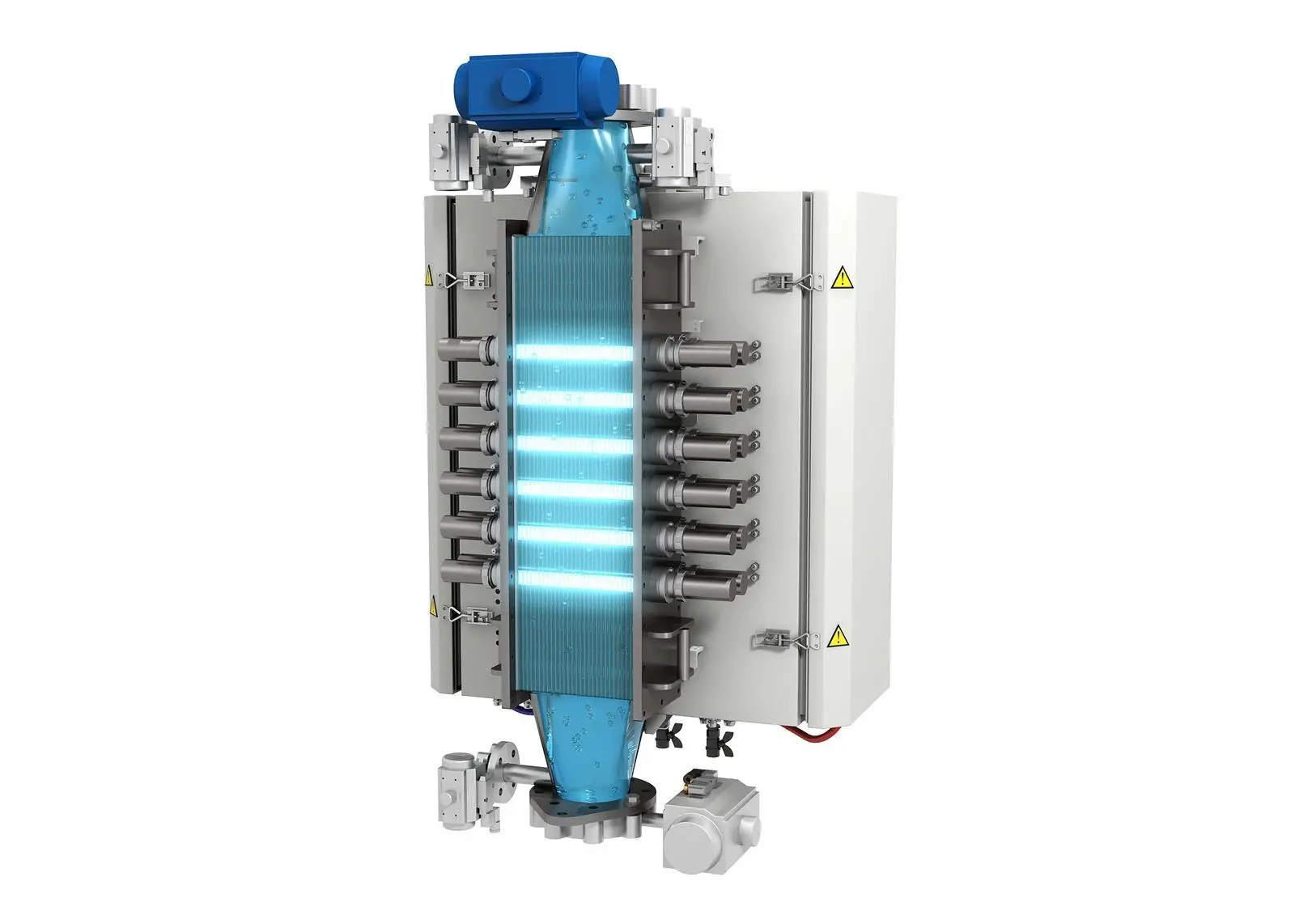
The second generation of the PureBallast ballast water treatment system comes with full type approval and a track record of operation at sea. It works without chemicals, toxic residue or other hazards, to neutralise the microscopic organisms that are generally taken in with ballast water. This eliminates the threat of biological invasions when water from one area is released elsewhere.
Improvements in PureBallast 2.0, which is available in an Ex version for operation on vessels carrying hazardous cargoes, include power consumption reduced by around 40%, which the company says makes it easier for shipyards to work with the designed power on board. Installation is further simplified by the use of fewer electrical cabinets and a higher degree of integration, with Modbus communication. A pause function allows ballast water treatment to be suspended briefly, such as during heeling, while the control system has been improved with a graphical colour touchscreen.