Taking trainees to the edge (without dropping them over)
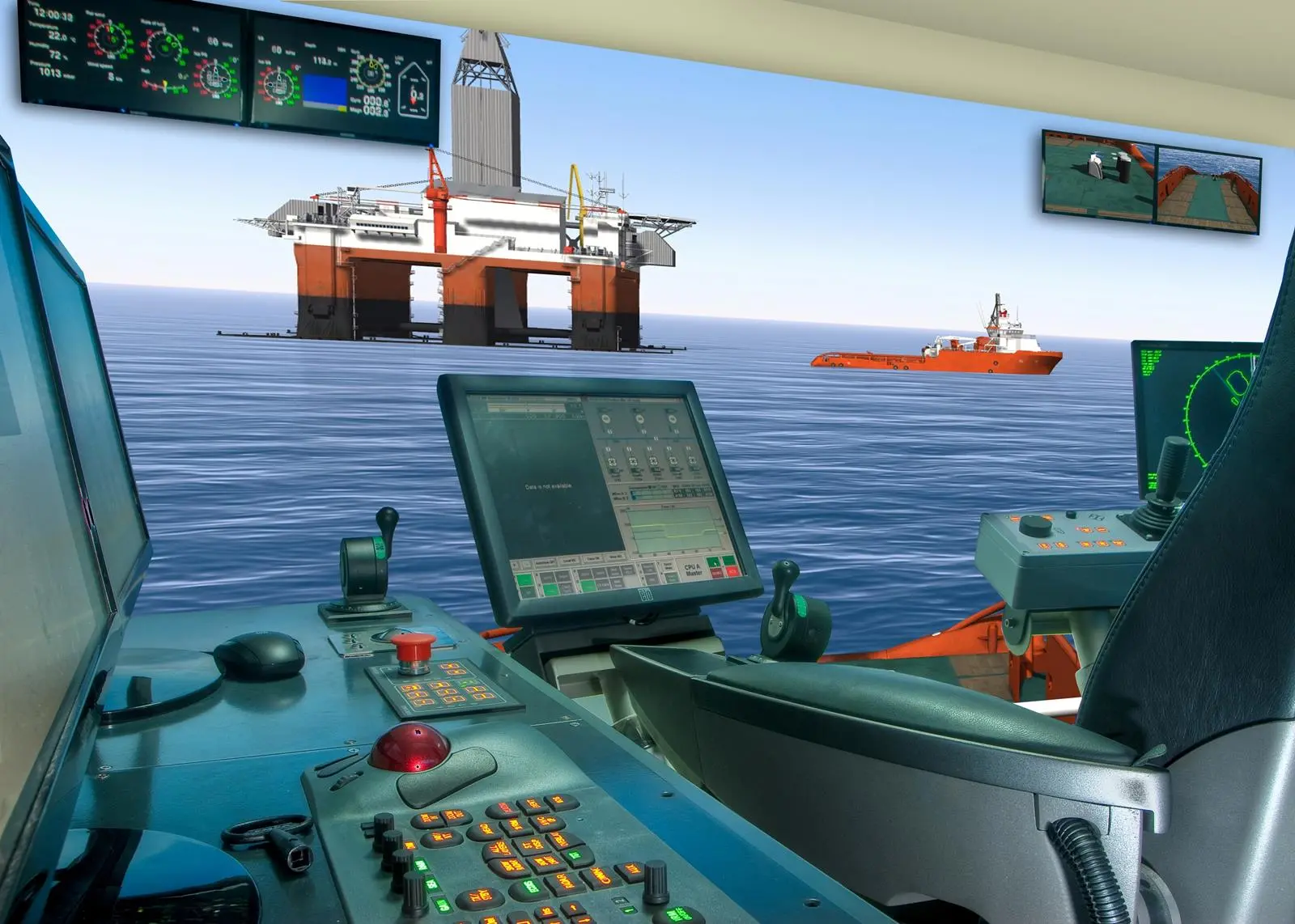
So, the latest Transas NTPro Offshore simulator being installed at PanArab E-Navigation (PAEN) in Alexandria, Egypt gives crew the experience of performing vital operations in very challenging weather, that is, the sort of conditions you really might not want a trainee to take over in explains Johan Ekvall of Transas: “This way, you don’t risk any equipment or human lives.”
The Offshore and Dynamic Positioning training solution gives the feel of a modern AHTS vessel bridge. Mr Ekvall points out that training, especially for challenging or even dangerous situations, really has to stick: “It’s very important that the whole situation is believable, you have to have enough realism for the trainee to trust it.”
This, he explains, is why it includes third party elements that you actually have onboard, such as physical controls for all thrusters, winches, pins and shark jaws system, control systems such as NAVIS DP2 and, of course, the sophisticated Seagull 6000 visual system. The visualisation comes from the merging of three projectors to give a 120° horizontal field of view (FOV) and a 35° vertical FOV. From a try out at its sister plant in Portsmouth, I can say the handling is remarkably realistic with elements such as drag calculated in, and you do find yourself balancing against the swell.
The scenarios take in a number of topics including moves such as anchor and pennant transfer by crane; deck anchor deployment using a permanent chaser or bridge system; anchor retrieval with grapnel or buoy; J-hook operations; wire and synthetic line inserts; cargo transfers and organisation of equipment such as the AHF on deck, and last but not least, advanced DP training, accredited by The Nautical Institute. Its one way of gaining valuable experience of critical situations without scaring the pants off the crew.
By Stevie Knight