Tug and barge alternative
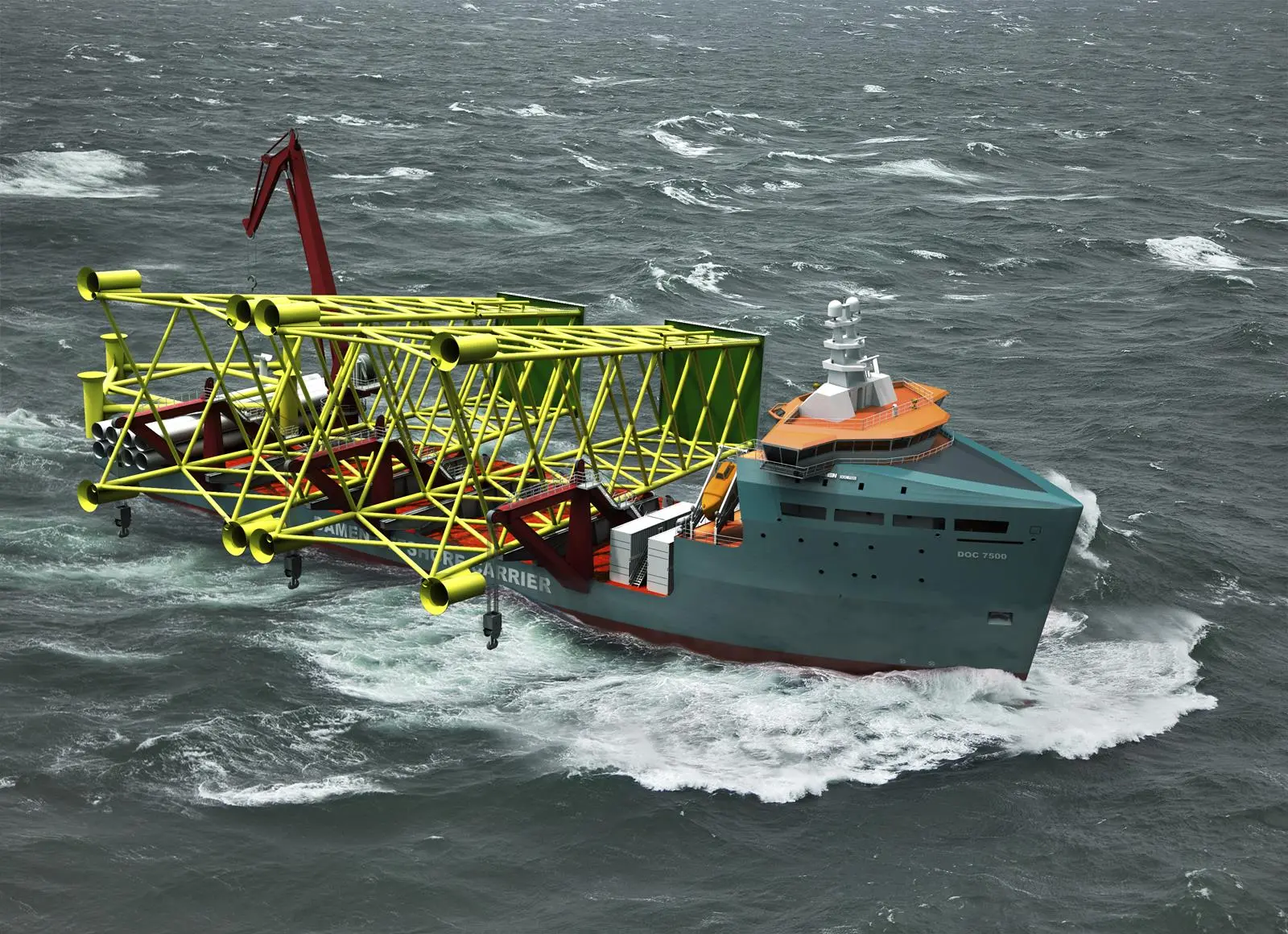
The market Damen is looking at is the one normally filled by a 300ft barge and tug, so many aspects of the Damen Offshore Carrier 7500 is directly comparable with this kind of set up.
But it is aiming to do it all that much better. Firstly, as project cargoes are transported over longer distances, the operational weather windows are being pinched. Tug and barge combinations often have to deviate from their course or to stay in shelter to avoid difficult conditions and as they only reach an average speed of approximately 7 knots. “These course deviations, shelter time and reduced speeds can have great impact on the schedule,” says Mr Bouma and of course the resulting delays add to the costs.
On the other hand the DOC, with a diesel-electric propulsion system and two 1,600kW azimuth thrusters does about 12 knots in good weather, only falling back to an average of 10.5 knots in higher sea states. This is due to a sharp bow and slender hull designed to be able to sustain speed in head seas while easing the acceleration forces that result in slamming: despite their size many offshore modules can be really rather sensitive to sudden jarring, “and of course with the DOC you can travel in a relatively straight line because you don’t always have to deviate from course for weather reasons”, says Mr Bouma.
Developed with input from Hans van Mameren, owner of Ha-Ce Engineering, the carrier has an endurance of 65 days at sea, and Damen’s extensive model test programme shows that the carrier reduces fuel cost by 50% to 75% compared to a tug-barge combination, and it helps costs that the DOC is able to run on both MGO and HFO.
Again similar to a 300ft barge, the DOC has a large deck of 2,300 sq metres which has been designed to take a pressure of 20 tonnes per metre. Importantly, unlike most barges and many other deck carriers the area is completely unobstructed. “When it comes to loading this kind of ro-ro cargo, you don’t want a chimney, brace or manhole in the way. Likewise when it comes to lashing large, heavy and expensive pieces, you also want as much clear space as possible,” says Mr Bouma.
Another point that’s been addressed by the 7500 is ballasting. Whereas normal barges are rather limited in this sense, this carrier has the ability to take on further ballast offshore, settling lower into the water and gaining an extra margin of stability which is a great advantage for offshore loading/unloading operations. On top of this the ability to handle ro-ro cargo over the stern and sides gives the vessel another important advantage.
Obviously, equipping the DOC with DP2 will meet present offshore market demands while DP3 can also be implemented if need be. Further the vessel is optional suited for a number of roles, bunkering, replenishment and crew exchanges: the DOC can comfortably accommodate 30 people in transit and this can be expanded when in installation mode. So, it seems the new vessel may well be looking at blurring the boundary between the traditional OCV and PSV focus.
It doesn’t stop there, however, as the craft, having this wide, flat area on deck, can actually be fitted with a self compensating platform for instance such as a Barge Master for special jobs that need a motion compensated access platform. This gives it extra flexibility both for offshore logistics within oil and gas project and for windfarm support purposes. The Barge Master is also demountable, “so if you have a transport logistics requirement for a year you can use it for that project and then take it off again”.
Mr Bouma also has a novel idea for its place in the windfarm sector: The DOC could be used as a multifunctional platform, transporting a lot of items to feeder vessels so the installation platforms can remain stationary at sea. “They don’t have to put back to harbour for pick ups,” he explains, adding: “This really is an ideal platform for a wide range of solutions, we have made the DOC as versatile as possible… The whole idea is to maximise uptime while reducing cost.”
Currently the DOC is 27.5 metres wide. Already Damen is considering a larger version, measuring 32.5 metres in beam. For the eco-requirement side, it’s useful that the vessel has a Green Passport and a Zero Dumping certification and the fuel tanks are protected with cofferdams.
Given the interest that this vessel will probably generate, the first DOC 7500 could be delivered as early as 2014.
By Stevie Knight