Fire safety for support vessels
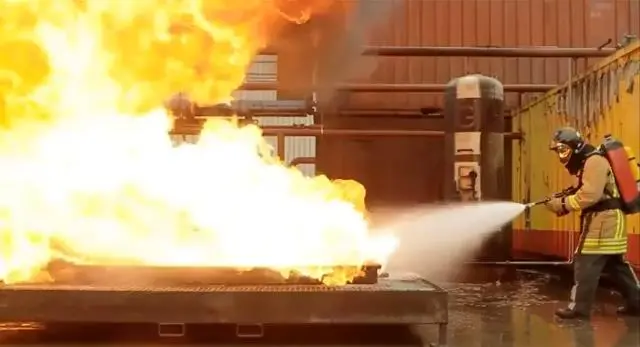
Carrying fire equipment around them is no easy task, points out Olaf Hempel of Advanced Firefighting Technology (AFT), especially when you consider that the distances between fire hazards and fire fighting equipment can range from 20 to 100 metres.
Another issue particular to PSV and OCVs is the dramatic variation in height running through the ship, often accompanied by a number of staircases and sudden drops.
Further, fixed applications such as fire hydrants and semi-fixed traditional fire extinguishers have a “number of limitations” in this environment, the first being that they must be kept in the same place when not in action.
His point is that in many instances it would be preferable to bring safety equipment closer to the areas of the ship that are currently in operation, rather than risk having to move between levels and negotiate heavy machinery.
However, he admits that the reality of day to day support vessel operation means there will sometimes be obstacles partially blocking a path, “in which case mobile applications that are light and ergonomically designed” give the crew a better chance of controlling a blaze, he says.
The second issue is that while misting technology is well established in large systems, older mobile applications still tend to use traditional water or water-and-foam agents. Mist, on the other hand, allows for dual mode and low-pressure flow rates. It’s very useful for those who aren’t familiar with firefighting equipment as normal high pressure systems “can literally knock the unwary over backwards”, says Mr Hempel. Portable extinguishers such as AFT’s are easier to control and can be used at varying distances – spray mode for close-up firefighting and jet mode for lancing distances of around 16 metres.
But it’s tricky technology to get right. If the spray drops are too large you get less impact for the volume of water, and if they are too small, it doesn’t have the blanketing effect.
Further, flammable cargo along with an abundance of oil means a foaming agent will more than likely be needed. To complicate matters, there isn’t yet an agreed industry standard for these agents. So, some older portable technology releases foam less than efficiently.
However, portable mist development, refined to discharge an optimum droplet size, also comes into its own with foam as it can also release a precise mixture of air and agent, leading to a very effective ‘blanket’ which suppresses oil fires in seconds. Mr Hempel also points out that the misting technology does help to keep the secondary damage to a minimum: once the fire is out you don’t want to be confronted by expensive repairs to salt water or chemical-soaked items. And as an added extra, stainless steel units can be used with seawater.
By Stevie Knight