New technologies improve safety risks
Martek Marine claims to have solved the problem of deaths in enclosed spaces caused by faulty portable gas detectors. The company has developed a system for its portable gas detectors that calibrates and certifies them automatically while the batteries are being recharged. This is intended to save ship operators the expense and logistics challenges of sending portable detectors ashore for calibration or bringing specialists on board to do the job.
The automatic system will adjust the device back to the manufacturer’s settings as would previously have been done manually. Additionally, the Always Be Calibrated (ABC) station automatically creates a tamper-proof certificate that can be stored electronically on USB stick or a ship’s computer. In the event of a port state control or SIRE inspection, the electronic records will contain a calibration certificate identified by serial number for each detector.
“If you look at a lot of the deaths in confined spaces, they’ve either been O2 deficiency or hydrogen sulphide, or occasionally carbon monoxide, so if any of those sensors wasn’t calibrated properly or for example the sensor had naturally expired, they could blissfully read zero and completely fail to detect any gas,” says Paul Luen, CEO of Martek. “The only true way to get peace of mind is to bump test before you use the detector and to ensure that you cannot use it without it being certified and calibrated. If that approach was adopted throughout the world, then the number of deaths in confined spaces will be drastically reduced.”
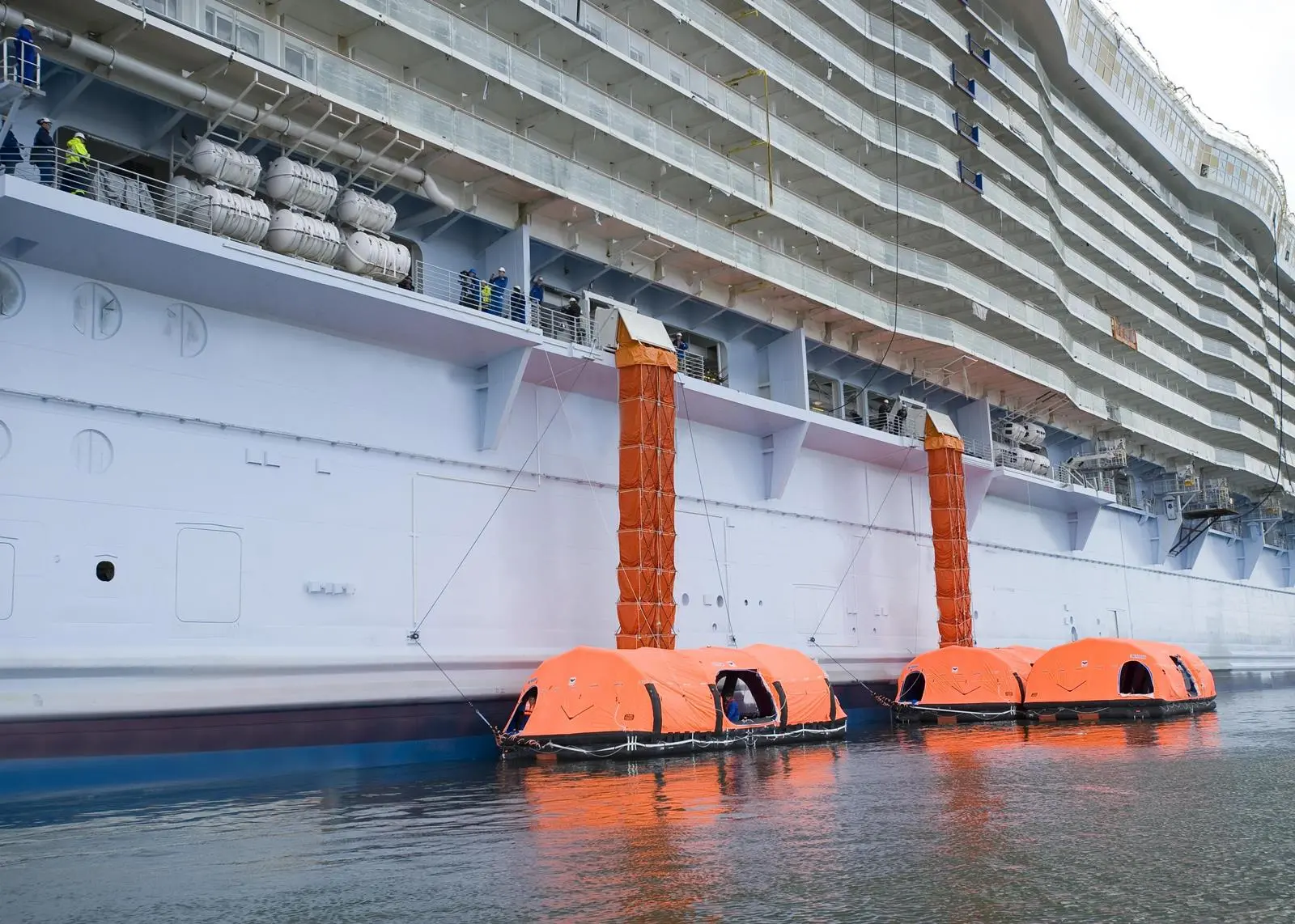
In another development aimed at saving lives at sea, Viking Life-saving Equipment has upgraded its double evacuation chutes so that now 908 passengers can be transferred to liferafts in 30 minutes, claimed to be the highest rate on the market. Previously, during an evacuation, passengers were required to approach the chute entrance, get seated and in position to evacuate, then slide down the chute. On safe arrival at the liferaft waiting below, a signal would be given for the next passenger to begin descent. The new system has a double seating arrangement that enables the next passenger in line to get seated and ready while the previous passenger is sliding through the chute, without risk of early release. This makes the evacuation process more efficient without causing safety issues.
Additionally the chute is sectioned so that descent can be better controlled, and a new light-based tracking system enables crew members managing the evacuation to easily follow the progress of individual passengers within the chute. Crew are able to detach sections of the chute if needed due to heavy listing of the vessel.
The new system is currently being installed on Oasis of the Seas and Allure of the Seas as an upgrade to existing equipment. Viking’s passenger segment director Niels Fraende says it provides such vessels with very high redundancy of capacity and therefore excellent safety margins when performing evacuations which need to be performed within 30 minutes according to SOLAS requirements. “This redundancy of capacity, when considered in an evacuation scenario, puts a lot of other important elements into place,” he says. “Such as crowd management and ensuring that you get people from muster points to evacuation points in an orderly manner, avoiding panic.” Mr Fraende says that many cruise lines are performing safety assessments at present and are also installing more compact design life jackets at muster points so that passengers do not need to go back down to the cabins to get the lifejackets allocated to them.
A fire in the engine room of cruise ship Nordlysa in September 2012 once again brought into focus the role of CO2 in fire fighting onboard ship. As it was reported in Norwegian media, the master chose not to release the CO2 system, because he was not certain that the space which was on fire was evacuated. The use of CO2 in an occupied space would have presented a critical risk to crew. The Norwegian Maritime Directorate, after pressure from the Norwegian seamen’s union, promised to consider the future use of CO2 as a fire fighting medium. Norway is not the first maritime authority to question the use of CO2 systems because of concerns about its suitability and reliability as a fire fighting solution.
IMO has undertaken a complete review of the FSS Code and revised Chapter 6 of the Code to include alternatives to CO2. The chapter has been amended and will allow for various types of outside and inside air high expansion foam systems for machinery spaces. The revised code was adopted by Resolution MSC.327(90) in May 2012 and will apply to ships constructed on or after 1 January 2014.
In response, Wilhelmsen Technical Solutions (WTS) has retested all its foam systems to meet the new standard. The Unitor High Expansion Foam Fire Extinguishing System (Unitor HiFoam System) uses high expansion foam consisting of synthetic foam concentrate water and air. The system is designed as a total flooding system for machinery spaces of Category A, cargo pump rooms and other spaces onboard vessels or on offshore installations needing fire protection. The system can be installed as total flooding for the entire main machinery room or for individual compartments. Zoning provides an option for selective and sequential release, which gives optimised protection of equipment and reduces water capacity needs. The expansion ration of 1:666 using internal air eliminates the need for extensive air ducting and fans, unlike traditional systems which utilise external air to create the air/foam mix.
In 2012, WTS acquired Novenco Fire Fighting to strengthen its portfolio of water mist based technology. Unitor 1230 Clean Agent Fire Extinguishing System (Unitor 1230 System) has been industrialised and adjusted based on the Sevo Novec 1230 System for the offshore and maritime industry. The Unitor 1230 System uses Novec 1230 fluid and is designed as a total flooding system for machinery spaces, pump rooms, and compressor rooms. It has the largest nozzle coverage designed specifically for the offshore and marine industry with a unique nozzle discharge pattern, says George W Dicker, commercial director for safety at WTS. “All components of the system are designed for optimum system performance. The system has small pipe dimensions, saving installation space, weight and lowering total installed cost.” With the system’s stored pressure of 34.5 bar, existing piping arrangements can be used for halon retrofits.
Autronica offers water based and gaseous systems. Water based systems are divided into various types such as water mist, deluge, foam deluge and sprinkler systems. Among the gas based gaseous systems, there are CO2, NOVEC 1230, FM200 and Argonite. The use of water mist is increasing, with FlexiFOG being chosen to replace CO2 systems on supply vessels and passenger vessels. For large cargo vessels and tankers, Autronica still recommends CO2 as the best option for cargo hold protection.
FlexiFOG low pressure water mist is mainly used to replace CO2 in machinery spaces. FlexiFOG is Autronica’s newest low pressure water mist system and the company has got the pressure down from 10.7 bar to 8 bar at the nozzle, reducing the requirement for emergency power even further when compared to high pressure systems. The latest system has a new dry chemical system for gas bunkering stations on vessels that use natural gas fuelled engines. This is in accordance with IMO Resolution MSC 285(86).
Autronica recently introduced the AutroFlame IR Flame Detector (BG-201). This point flame detector for detection of fires involving combustion of carbonaceous materials is suited for the engine room environment of any ship or public spaces aboard cruise and passenger vessels. The company claims the advanced digital signal processing algorithms (implemented in an ARM Cortex M3 processing unit) used in AutroFlame ensures fast detection of real fire scenarios combined with high immunity against nuisance (false) alarms caused by sources including vibrating hot bodies (engines, exhaust-pipes, pumps etc.), sunlight (direct and reflected), arc welding and lightning.
AutroFlame uses dual IR flame detectors to detect fires within 8-10 seconds at 25m (EN54-10 testfire). If the detector is mounted closer to the object of interest, the fire will be reported within 1-2 seconds. AutroFlame detectors can be used in two different modes; for integration with Autronica’s established AutroSafe and Autroprime fire detection systems already installed on thousands of vessels worldwide or for connection to conventional panels.
In an effort to reduce the risks involved in flooding accidents, the pan-European SuSy (Surfacing System for Ship Recovery) consortium has recently completed a successful set of sea trials at Chalkis shipyard in Greece. Led by design, engineering and risk management consultancy BMT Group, the SuSy project has developed a rescue system to be used for merchant ships in emergency situations. Application scenarios include preventive installation on ships with hazardous cargo, rapid stabilisation of capsized ships by coast guard and other rescue squads and recovery of sunken ships.
SuSy uses Kevlar reinforced balloons that can be rapidly deployed and inflated to provide extra buoyancy. The consortium successfully tested two modes of deployment. Firstly, internal, where balloons installed in protective covers within the double-bottomed test compartment were inflated to keep it afloat until repairs or other emergency measures are implemented. Secondly, salvage where external balloons and gas generator packs were attached, providing support sub-surface and allowing the test compartment to be recovered to the surface.
The consortium has developed a third concept using rapidly deployable internal balloons to create curtains which prevent capsize of roll on roll off passenger vessels by sub-dividing the car deck to stop water movement. Simulations have been conducted but this system has not yet been subject to live tests.