Tougher standards driving change in water treatment
Wärtsilä has been granted Alternate Management System acceptance for its Aquarius UV ballast water management system by the US Coast Guard. This allows all US and foreign flag ships fitted with the system to operate in US territorial waters and to discharge treated ballast water for an interim period of up to five years from the ship specific implementation date. Alternate Management System (AMS) acceptance is the first stage towards obtaining full US Coast Guard (USCG) type approval which Wärtsilä anticipates completing within the five year interim period.
Based on an evaluation of the Aquarius UV system test data by the USCG, acceptance has been granted for use over the full range of water salinities. As one of only a few systems accepted without salinity restrictions, the Wärtsilä solution permits ships fitted with the system to operate in the Great Lakes region.
Wärtsilä has already delivered the Wärtsilä Aquarius UV system to four new platform supply vessels currently being built for US based Tidewater Marine. In addition, the system has been retrofitted to two LPG carriers for Chemgas and is being installed on an LPG carrier owned by Carbofin currently trading in US waters. Additionally, the company received type approval for its Aquarius EC electro-chlorination system in December 2013.
Hyde’s new Guardian Gold is a significant evolution from its existing range as it offers a 50% smaller footprint as well as performance and operational improvements including a 30% reduction in power usage. The new model is the result of a large investment and product development effort that Hyde has made over the last two years.
“The new system incorporates an advanced screen filter technology that is impressively compact in size but more importantly demonstrated excellent performance during extensive side by side testing in extremely challenging conditions. The filter has a unique internal design, which provides high efficiency removal of organisms and sediment while maintaining high throughput. The filter is cleaned automatically during operation as needed without stopping flow to the UV,” said Jim Mackey, marketing manager for Hyde.
The Guardian Gold allows for one-touch operation capability with an upgraded PLC controller that has increased speed and memory capacity as well as improved controls for tank stripping, gravity ballasting, internal transfer, emergency ballasting and maintenance. Other improvements include the addition of UV reactor level and moisture sensors for increased safety and relocation of the UV cooling valve to the top of the UV reactor chamber for improved air removal.
Lloyd’s Register observed the filter testing and the new design has been added to the company’s IMO G8 type approval for the full range of flow from 60 m³/hr to 6,000 m³/hr. Hyde also has AMS acceptance by the USCG. The company is confident that it can now serve all types and sizes of vessels and meet the challenges of retrofitting ballast water treatment systems on existing vessels. Hyde has already made over 200 system deliveries including 30 retrofit projects with earlier models of the system.
Like Hyde, the other major manufacturers continue to expand their delivery credentials. OceanSaver secured over 50 orders for its modular Mark II system in 2013 spanning a diverse array of ship types. This pushes its total order book above 100 with 30 units already installed. Recent contracts include LNG and LPG carriers, and the OceanSaver system was recently awarded AMS acceptance by the USCG.
As of November 2013, Techcross had received orders for over 534 sets of its Electro-Cleen system and delivered more than 280 sets. Techcross has recently made a number of enhancements to the system. The safety features of the software and hardware were completely reviewed and verified by third parties including ABS and DNV. As a result of software upgrades, real time monitoring and safety checking of the ballasting operation is possible. To help avoid any mistakes being made by crew members, the company has set up the system so that one control PC acts as a controller and another is just for viewing.
Techcross has also included more safety features in the hardware including a ballast signal check module in the power distributor equipment to stop the supply of current in case of malfunctions. A pressure switch and gauge have been installed to prevent over pressure in the treatment unit. If the pressure in the chamber exceeds the setting pressure, the system will shut down automatically.
Siemens Water technologies has been granted a US patent for a system and method to control biofouling of the filters used as a first stage of treating ballast water in its SeaCure ballast water management system. The patent, entitled “Method and System for Biofouling Control of Shipboard Components” (U.S. patent no. 8,591,740 B2), involves injection of biocide into ballast seawater before it reaches the large surface filter intakes to reduce the growth of marine organisms that can clog the filters.
The technology is already incorporated in the SeaCure system which uses filters to remove or break larger organisms using a 40-micron weave-wire screen. The biofouling control provided to the filter assures reliable function and minimises maintenance requirements. The SeaCure system can be used to treat ballast water and also onboard cooling water circuits.
In April 2013, Alfa Laval launched the third generation of its ballast water treatment system, Alfa Laval PureBallast 3.0. The system uses up to 60% less energy, and although it is 50% smaller than its predecessors, it will be able to handle flows of up to 6000m³/h.
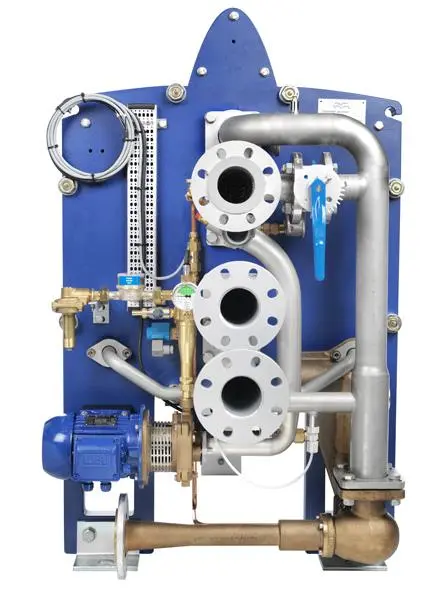
Alfa Laval has since released its latest fresh water generator technology, Aqua Blue. The system uses the same proven, energy-efficient desalination process as its predecessor, but it incorporates a wide range of enhancements that simplify operation and installation.
“The Aqua technology was a revolution in freshwater generation, because it cut energy use and changed the way we look at a very well-known application,” says Alex Jönsson, Alfa Laval’s regional marketing manager. “But innovation is one side of the Alfa Laval coin and continuous development is the other. Aqua Blue takes this pioneering technology and builds on its already substantial advantages.”
The foundation of the Aqua technology, and therefore of Aqua Blue, is a unique type of titanium plate. Although plate-based freshwater generators have existed for half a century, the plates themselves have always been a modification of heat exchanger designs, says Mr Jönsson. Alfa Laval’s Aqua plate was the first to be specifically designed for desalination work.
The Aqua plate has a 3-in-1 construction so that evaporation, separation and condensation all occur within the same plate pack. Feed water passes through the lower section where it is evaporated in a vacuum. As the vapour rises, it then passes through the separator section with brine falling back into the sump at the bottom of the freshwater generator. Only the clean vapour reaches the top section where it is condensed into high-quality fresh water. A maximum of 2ppm salinity is achieved in all conditions.
“With one plate pack instead of two, the freshwater generator needs just half the seawater flow, so only half the pumping capacity has to be installed,” says Jönsson. A focus on energy efficiency is also seen in the use of an IE3 motor. The system’s plate pack slides open for easy inspection and maintenance, and because the Aqua technology maintains the vacuum within the plate pack, there is no outer shell to be opened and no service area needed beyond the frame.
British based Salt Separation Services has recently signed a contract with German ship builder Meyer Werft for the design, manufacture and commissioning of reverse osmosis desalination plants for fresh water production on two new cruise ships. The ships will be fitted with three systems, each capable of producing 800 m³/day of desalinated fresh water from seawater for the 4,200 passengers on board.
The solution includes two pass reverse osmosis technology to produce permeate to a very high specification as well as isobaric energy recovery technology which dramatically reduces power requirements. The contract is Salt Separation Services’s largest single export order to date.
SLCE of France has recently installed its reverse osmosis desalination system on two cruise ships for AIDA, another two for MSC cruise ships and one for a Happag Lloyd cruise ship. The company’s most recent commercial installation was for a mixed cargo vessel.
New effluent standards for sewage treatment plants will enter into force for systems installed after 1 January 2016. The new requirements in MEPC 227(64) differentiate between passenger ships and other ships and call for tighter nitrogen and phosphorous limits in the Special Area of the Baltic Sea. Passenger ships are prohibited from discharging in this area unless they have a sewage treatment plant approved to the new standard.
One of the manufacturers aiming to get type approval for MEPC 277(64) is Headhunter. Meanwhile, the company’s Tidalwave HMX 6001 LP sewage treatment plant has been installed on two of the four 36m, 70-passenger aluminium crew boats built by Cheoy Lee Shipyard. “We are pleased to have supplied the Tidalwave HMX sewage system on the crew boats Swissco Cheetah and Swissco Puma which have the ability to transport up to 70 passengers and 10 crew members,” said vice president, Mark Mellinger. “The installation of our waste treatment system for Cheoy Lee and Swissco Offshore is testimony to the quality of our products and the reliability of our services. All of our waste treatment systems are certified for worldwide compliance under MARPOL.”
The Tidal Wave HMX systems are USCG-certified and Bureau Veritas-approved to the MEPC 159(55) standard that entered into force in 2010. They can process up to 50,000 gallons of effluent per day and use flocculants, chemical oxidation, hydro-maceration and patented cross flow separation techniques to destroy influent biomass. The six-stage process provides trouble-free treatment of black and grey water and a sterile effluent for disposal, says Mellinger. The PLC controller allows treatment techniques to be customised after installation for varying hydraulic and organic loading conditions or to meet varying performance standards in different parts of the world.
ACO Marine warns that galley fats, oils and greases should be removed otherwise they can cause biological overloading and blockages in downstream treatment systems. There are currently no IMO rules regarding this other than the waste water MEPC 159(55) requirement for sewage discharge which does not allow the discharge of any oils.
Discussions are continuing in various legislative quarters to bring in requirements for the treatment standards of galley water that is directly discharged overboard, so simply bypassing the treatment system will not be a solution in the long term, says Mark Beavis, managing director of ACO. “Pre-conceived notions that grease traps were sufficient have since been proven incorrect,” he says.
Traditional in-line, entrapment boxes have a weir to hold back floating grease and oils, but take no account of neutrally buoyant substances or more dense solids. They require manual emptying and cleaning on a daily basis. Therefore, says Mr Beavis, the best solution is to fit a fully automated self-cleaning grease separation system in a vessel’s machinery space where it can be maintained by ships’ engineers.
Part of the US$1 billion German ACO Group, ACO Marine has a range of patented grease separators and now claims a 75% share of the cruise market. With other products including bespoke piping systems, tanks and scupper/channel drainage components, the company provides turnkey newbuild and retrofit solutions for all marine applications.