Brazil drives fibre forward
The development of fibre ropes has proved a tricky game, with everyone hanging onto tried and trusted metal wires, and not too many companies willing to stick their necks out and be first to take on the issues inherent in fibre: “All of the parties involved – lifting system manufacturers, vessel builders and rope producers – are lining up to be second,” says Erik Van der Woude of Royal IHC.
However, times change, and “development in Brazil has become a strong market driver, possibly the biggest market driver, for fibre rope”, he says.
Mr Van der Woude points to the country’s push to bring up annual production from 2million barrels to over 4million barrels per day, borne out by Brazilian orders for 10 pipelayers, plus another 10 well intervention and module handling vessels from Royal IHC. So, he says despite a few delays on the schedule, “it’s not ‘if’ the equipment will be needed, but when”.
The practical reasons for development of fibre beyond its normal, static mooring line uses are simply that the figures don’t stack up particularly well for metal wire. “Steel cable gets to the point where it really isn’t feasible somewhere around the 2,000m depth,” explains Mr Van der Woude: lifting 125 tonnes at 1m/s in 2,500m water depth requires 240 tonnes of pull and around 3,000kW of installed power to cope with the line. This weight to power ratio reaches a staggering 1:3 at 3,500m depths: in other words the kind of waters that Brazilian construction will be faced with.
Fibre rope with its near neutral buoyancy means the winch only has to have the capacity to deal with the payload and in the above case, a fibre rope would only need 1,600kW of installed power.
However, there are few big challenges that have needed some careful thought. While fibre has a lower axial stiffness, which you might on first glance think rather useful when it comes to spooling, it comes with lower heat resistance, and this is a big issue, explains Mr Van der Woude.
Basically, fibre rope is more sensitive to both wear and temperature, and demonstrates a very different, quite dramatic, failure mechanism. Not only does fibre rope tend to lose its capacity as low as 65°C, it can suffer catastrophic failure at 130°C, much lower than metal cable.
Mr Van der Woude describes these troubles as being rooted in the “Three T’s” of time, tension and temperature. This last isn’t as easy to deal with as one might think: fibre has a lower heat-transfer coefficient and doesn’t cool easily. A ‘vicious circle’ results in an unacceptable degree of visco-elastic and visco-plastic behaviour: a common traction winch will step up tension from a simple storage drum to the main drum, but as this starts to happen fibre rope will elongate and the rope will slip, which creates more friction and increases the rope temperature yet again.
Further, while the heat from friction can be reduced as this tends to be located on the external layers of the rope and therefore easier to dissipate, the internal layers of the rope suffer from a slow, inexorable temperature build up resulting from one part of the yarn rubbing against another.
This element becomes more troublesome with cyclic bending over sheave (CBOS), a particular feature of active heave compensation (AHC) technology. “The winch and rope has to accelerate with each wave, speeding up and slowing down maybe with a 10s wave period. With a constant tension operation you get the same length of rope running over the winch for half an hour or an hour,” he says. Therefore CBOS performance dominates the agenda with any AHC application, despite rope manufacturers’ introduction of internal, low friction sheathing.
What it means is that fibre rope needs to be ‘managed’ on the winch.
While one answer is to use individual sheaves to step up tension and mitigate against the inevitable elongation, this results in a very complex system often needing several sheaves, individually driven with sophisticated software. The problem with this solution, says Mr Van der Woude, “is that offshore, everything that moves has a lot of stress on it and in an exposed area the engineering has to be kept simple with as few moving parts as possible”.
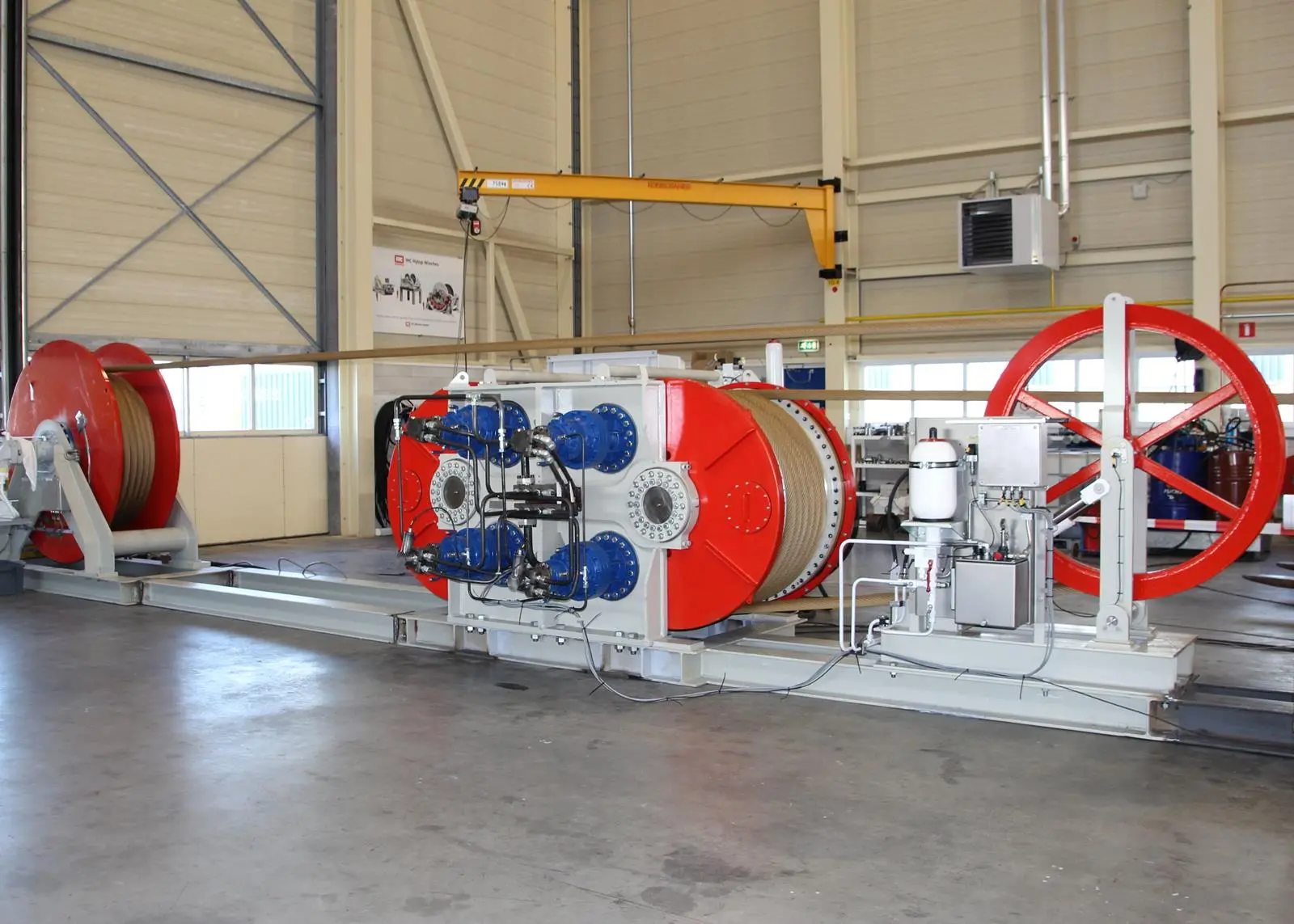
So, Royal IHC has come up with a ‘middle way’, one drum with two individually driven segments with a software algorithm that controls both torque and speed, combined with a tensioner sitting in between. This gives enough separation to compensate for the elongation, an optimum between slippage and getting a system that’s still not too complex.
However, depth provides other issues to deal with and 2,000m of line can easily put a spring in the system, even a few percent flex resulting in an oscillation of the load which can build up, “the waves reinforcing each other till something breaks”, explains Mr Van der Woude.
So Royal IHC has developed an oscillation damping solution: it works by moving the crane’s lifting line motion in time with the anti-phase, similar to the way you can stop a pendulum swing by moving a stick and weighted line back and forth to counter the motion.
Obviously this is easier for a human than for a machine, but the winch system still manages it: “The trick is to read the various rumples in the system through ring-pull readings and then drive the trolley the right way,” he explains.
Mr Van der Woude’s best guess is that Brazil will soon be driving a substantial amount of innovation as the sheer scale of the arena makes a huge difference to progress: “If the only need is a single lifting job every few years, then the operators will probably just mitigate against the depth or other issues by taking things very slowly and working with existing equipment. However, a continuing series of major lifts like those facing Brazil means there’s enormous potential to advance the technology.”