Emphasis on efficiency as tank technology evolves
Boil-off gas (BOG) is the result of complex interactions between the containment and handling systems, the LNG and its vapour base, and environmental factors such as air and sea temperatures, sea conditions and atmospheric pressure. Insulation systems and the materials used in LNG carrier containment have to be capable of operating effectively and safely at cryogenic temperatures through a vessel lifetime of typically 40 years.
Reducing the guaranteed daily boil-off rate (BOR) of LNG during a voyage is key to maximising delivered cargo and supporting operational flexibility. Seemingly minuscule incremental gains in performance have a considerable cumulative effect as a consequence of the transport volumes and cargo values involved.
The BOR of only 0.08% attributed to a number of ships that have entered service since 2014 is a significant development relative even to the 0.10-0.12% attained by fleet additions in recent years. The latter was itself a major enhancement on the typical 0.15% level first reached with 1980s-built LNG carriers. By comparison, tonnage dating from the 1970s had a representative BOR of 0.25%. Now, as 2016 unfolds, systems that promise rates below 0.08% will become available.
The dominant force in the market, the French engineering company Gaz Transport & Technigaz (GTT), has ramped-up research into BOR optimisation and reduction, and this attention is reflected in the imminent release of new containment solutions. GTT is reckoned to account for around 80% of the current orderbook for integral tank systems in LNG carriers, met through the most recent versions of its NO96 and Mark III membrane design series. In the next stage of the design evolutionary process, further derivatives of these systems are being prepared for marketing.
Expanded choice
While GTT is investing to consolidate its market position and membrane technology’s modern-day pre-eminence, the established Moss spherical and IHI SPB prismatic (independent) cargo tank designs also figure in a number of recent initiatives and projects.
Furthermore, these endeavours are complemented by a host of new solutions from cryogenic specialists and other industry stakeholders, with competition sharpened by the commercial emergence of an indigenous South Korean membrane system. Never before has the choice available to operators and yards been so extensive.
A range of factors determine which type of containment is to be embodied in an LNG carrier newbuild. Production issues, familiarity and operational experience have a signal bearing on selection in this necessarily conservative sector. But cargo BOR is of vital, common importance because it has a fundamental bearing on overall ship and transportation efficiency. BOR influences competitiveness across-the-board, from system manufacturer and shipbuilder to shipowner and charterer.
Furthermore, the introduction of more efficient propulsion systems in LNG tankers over recent years has meant that the engines require less cargo BOG as fuel, as has long been employed in LNGCs, which has consequently placed increased onus on the efficacy of the cargo containment installation.
While conventional practice in modelling BOG has been to calculate a design BOR that is valid under normative conditions, the resulting figure may be substantially different from BOR in actual operation, with the loaded ship at sea. GTT has addressed this issue, to enable the prediction of BOG generated in operation, taking into account complex phenomena such as heat transfer through the containment media, LNG thermodynamics, sea state, cargo sloshing and LNG ageing.
GTT is targeting a BOR lower than 0.075% with its soon-to-be-released Mark V membrane containment solution, an optimisation of the ubiquitous Mark III system and companion Mark III Flex, but enhanced by a new, metallic secondary barrier. During the autumn of 2015, general approvals for the technology were granted by DNV GL, Lloyd’s Register and Bureau Veritas.
GTT makes its Mark V
Mock-ups have been assembled at the GTT laboratories in France, and also in South Korea at Hyundai Heavy Industries’ shipyard, to validate the erectability of the containment system, while a test campaign to evaluate behaviour under the worst conditions at sea has been initiated in a large-scale mock-up at the Samsung yard.
The Mark V design employs the same 304L stainless steel, corrugated primary membrane and reinforced polyurethane foam (R-PUF) insulation of the Mark III, but with a new nickel-steel alloy (Fe-36%Ni) corrugated secondary membrane and increased insulation thickness.
Further steps were taken towards the industrialisation of the technology through agreements with Hyundai and Samsung. This phase includes the development and qualification of an innovative welding robot for the primary stainless steel and Invar secondary membranes.
One of the world’s leading purchasers of LNG, Korea Gas Corporation (KOGAS), initiated development of a new membrane containment system in 2004. The move was mainly motivated by national industrial considerations, as a bid to reduce reliance on foreign technology and the associated royalties reckoned to amount to some 4-5% of the price of each Korean-built LNGCs.
These efforts have come to fruition in the nomination of the home-grown KC-1 system for two 174,000m3 newbuilds booked with Samsung Heavy Industries by SK Shipping of Seoul. The joint ABS/KRS-classed vessels are scheduled to begin charters with KOGAS in 2017, bringing shale gas-derived LNG from the US Gulf. KC-1 employs 1.5mm corrugated stainless steel membrane as the primary and secondary barriers, and polyurethane foam with a density of 115kg/m3 as the insulating material, an arrangement adopted in shore-based storage.
South Korean shipbuilding is the paramount force in LNG carrier construction and its leading lights Daewoo, Hyundai and Samsung developed KC-1 in collaboration with KOGAS. A joint venture LNG tank design company is mooted, formed by the four parties, with KOGAS holding the controlling stake.
Korea moves
It is interesting to note, and significant for potential shipowning customers, that Korean yards are providing solid practical support to GTT in the French company’s roll-out of new-generation Mark V and NO96 membrane systems while also being encouraged to promote indigenous KC-1 technology. Furthermore, each of the three builders has in recent years devised its own alternatives to the established foreign designs, giving added dimension to the technological drive and possible commercial offering.
Signifying recourse to a Japanese technology used only once before, for two LNG carriers built more than 22 years ago, Japan Marine United is employing the IHI-developed SPB independent tank system in five 165,000m3 vessels ordered by a consortium of domestic owners. The vessel programme is backed by Tokyo Gas shipment contracts. The rationale for the selection of the IHI-SPB system is its in-service reliability, proven immunity to sloshing problems, and design advantage in allowing the hull space to be optimised. Moreover, the updated versions promises a BOR of 0.08% per day.
One of the most recent deliveries into the deepsea LNGC fleet, the 164,700m3 Bishu Maru, provides a new reference for the Moss spherical system, and is credited by operator K Line with a BOR of 0.08% per day.
Constructed at the Sakaide yard of Kawasaki Heavy Industries, Bishu Maru has entered long-term charter to Chubu Electric, and will be mainly employed transporting Australian LNG to Japan. However, her beam of 48.9m, allowing for transits through the new Panama Canal locks, confers increased flexibility in sourcing energy supplies for Japan in the coming years.
Mitsubishi Heavy Industries has given a fillip both to Japan’s cryogenic tanker workload and to the Moss system through consecutive Sayaendo and Sayaringo STaGE designs of post-Panamax LNG carrier. Following eight orders for the 155,000m3 Sayaendo type, given first form in the 2014-completed Seishu Maru, contracts for six examples of the Sayaringo STaGE series were logged through 2015, specified with cargo capacities ranging from 165,000m3 to 180,000m3.
Whereas the Sayaendo has a continuous cover over four pea-shaped tanks, based on the highly reliable Moss type, the cargo tanks in the Sayaringo STaGE are apple-shaped, whereby the upper half of each sphere has more of a bulge than the lower half, affording extra revenue-earning volume than the Sayaendo ships. In both types, the adoption of a tank cover integrated with the tanks, developed by MHI in concert with Aker Arctic Technology, yields weight reductions without comprising overall structural strength. The innovative STaGE propulsion system comprises a Mitsubishi ultra steam turbine (UST), a dual-fuel diesel engine, and an electric propulsion motor.
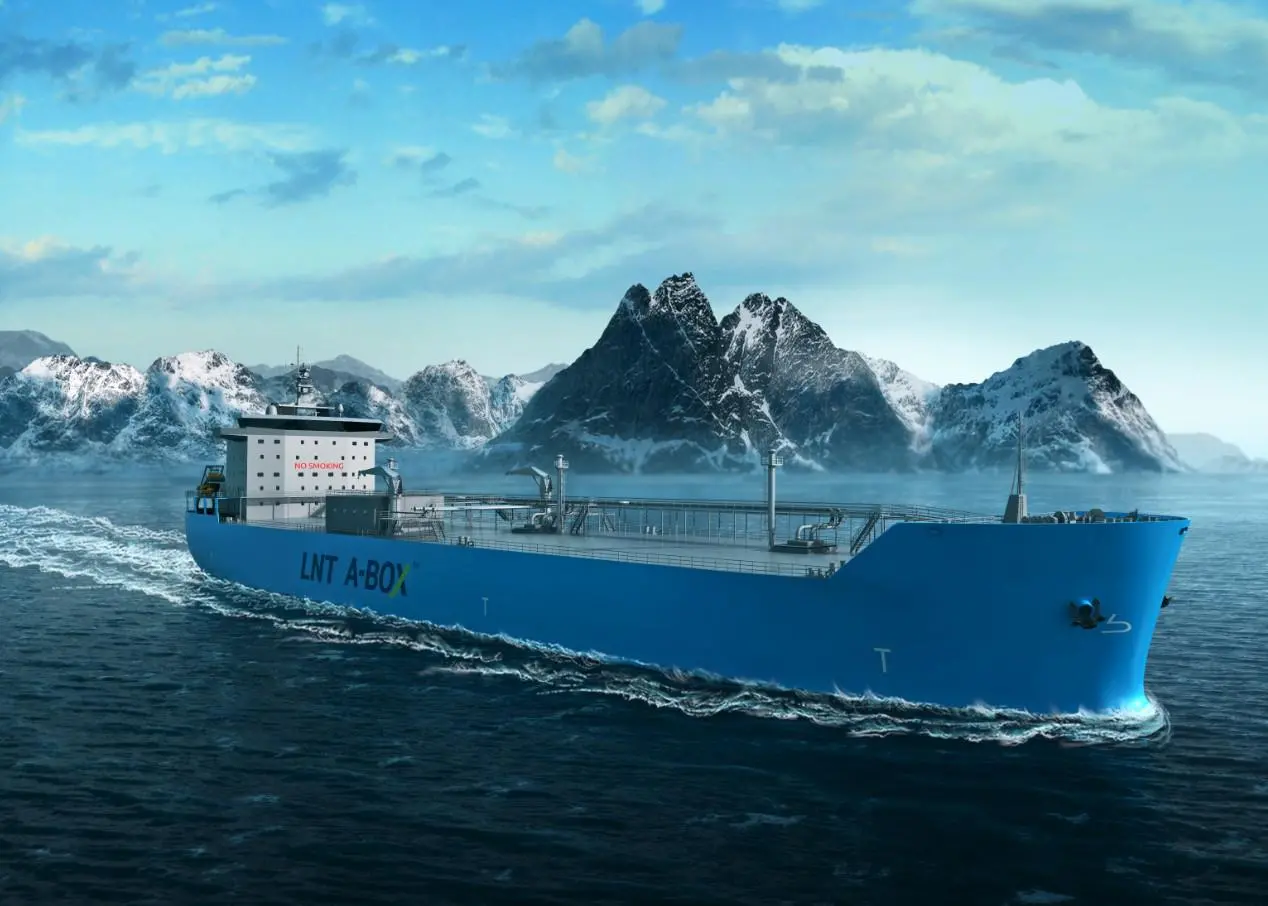
A cost-effective, new containment option known as the LNT A-Box system will have its opening reference in a 45,000m3 LNG carrier due to be delivered in 2018. Developed by LNG New Technologies of Singapore and Norway in collaboration with FKAB Marine Design of Sweden, the LNT A-Box configuration consists of IMO Type A independent tanks placed in an insulated hold space, with a full, independent secondary barrier.
The prismatic shape of the cargo tanks promotes good utilisation of the underdeck hull volume and makes for a flush, uncluttered main deck. As the sloshing risk is mitigated, there is no limitation on tank filling levels. The design also allows access to both barriers for inspection and maintenance.
Low entry threshold
The fabrication process is said to present no undue challenges, affording a lower entry threshold into the LNGC field for aspiring shipbuilders. In fact, the first vessel specified with the system is under construction at China Merchant Heavy Industry’s Haimen shipyard. The contract is backed by Landmark Capital, hitherto mainly associated with the offshore business.
The new ship will have a dual-fuel main engine and has been designed for worldwide operation, but with special consideration having been given to cargo reloading and local and regional trading. Besides a comprehensive propulsion package, Wartsila is supplying the LNG cargo handling system with an integrated fuel system utilising both compressors and forced vaporising.
As LNG demand evolves, increasing opportunities are arising for vessels to serve small-scale trades and/or intra-regional and short-sea distributive operations. A recently unveiled, novel multi-gas carrier design embodies a containment concept devised by Brevik Technology of Norway. Using independent, cylindrical Type B tanks, the system has been approved by ABS for application in a 31,000m3 gas carrier.