Containerships ready for take off
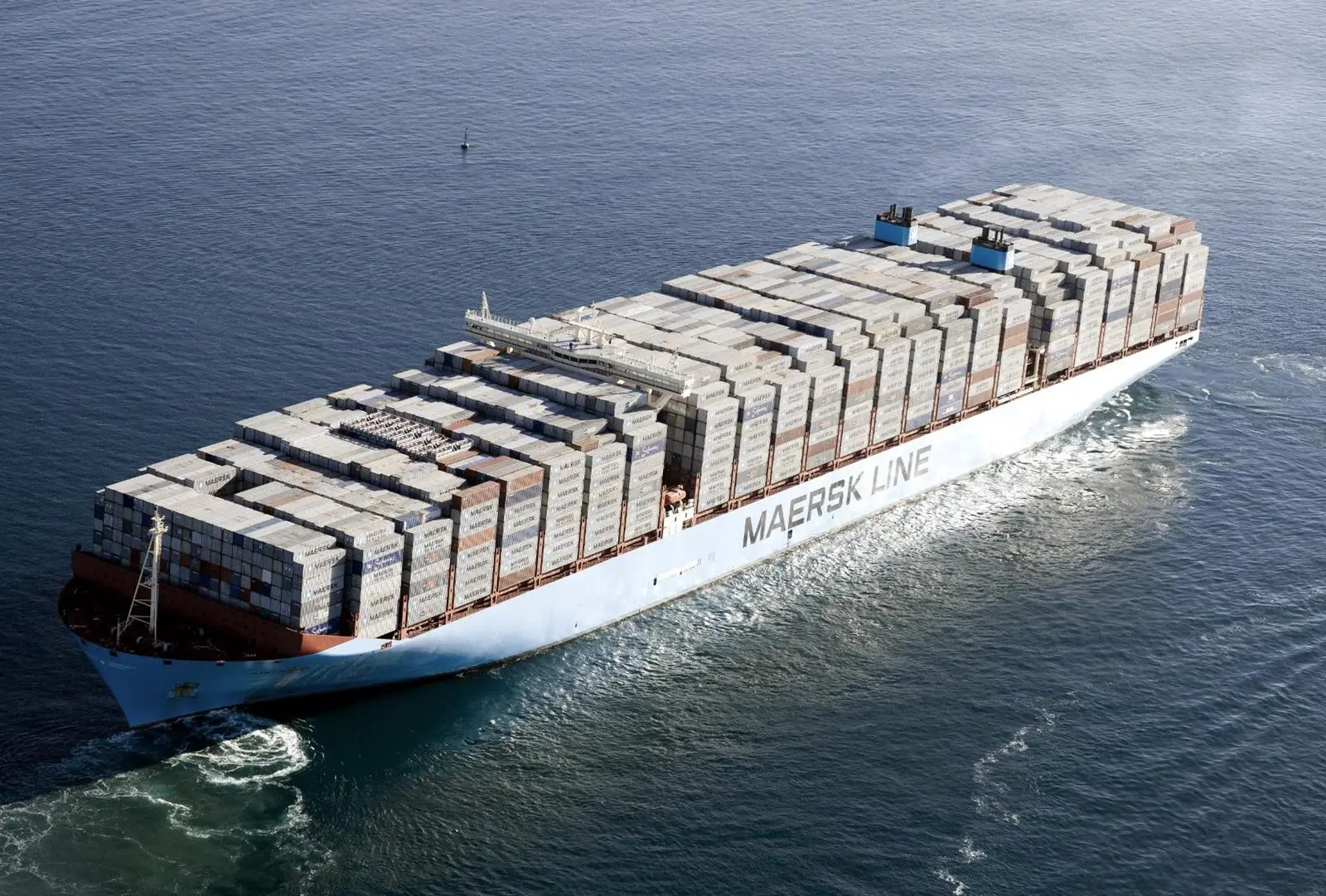
Last month the supplier announced that eleven second-generation Triple-E containerships under construction at Daewoo Shipbuilding & Marine Engineering will feature PTO/PTI systems – each including two induction motors, two active front-end drives and a power management system (PMS). It is an important deal both for GE and for the uptake of a well proven efficiency technology.
With a cargo capacity of 19,630teu and at around 400m in length, Maersk’s new Triple E vessels will be among the biggest containership vessels in the industry when they are delivered in April 2017 and May 2018. They will also be among the highest profile ships, following on from the initial series introduced by Maersk – the last of which were delivered last year – to address shipping’s three E-shaped challenges: efficiency, economy of scale and environmental improvement.
According to Jean-Philippe Chaignot, merchant marine business leader at GE Marine Solutions, the new PTI/PTO system will help the vessels achieve two of those ambitions. The company expects that the systems will be responsible for reducing fuel consumption on the ships by around 10%, with an equivalent impact on emissions.
“The system will work in both directions,” he confirms, “either taking energy from shaft to the power network for reefers (for example), or taking energy from the waste heat recovery system and supplying that energy to the shaft. The objective is to optimise load required for propulsion as well as for the network.”
Although GE has been supplying PTO/PTI systems to other marine segments for several years – including cruiseships, LNG carriers and naval vessels – the deal represents the first time GE has supplied PTO/PTI systems to the containership segment. There are systems installed on a small number of ships, and Maersk has been using the technology for a few years already, but uptake has been slow given proven benefits in other sectors.
“There is always balance when designing a vessel between capex and opex,” explains Chaignot. “This solution brings opex advantages, but I think the industry sometimes take time to recognise added value. Maersk is a pioneer. They are one of the companies driving innovation in the segment and we have been engaging with them for a couple of years to design and define the right solution for their vessels.”
The GE solution for PTO/PTI is an interesting one, with some important points of difference to conventional systems. First, the shaft generator is not a synchronous machine as usual, but an induction motor. Whereas synchronous motors require active rotating parts on the shaft line (such as diodes or excitors) to supply a current to the rotor, induction motors do not. This reduces the complexity of the motor dramatically, with benefits to reliability and maintenance demands as well as efficiency.
Chaignot says: “The rotor is made out of the shaft, steel and copper. There is not a single active or rotating part and for that reason the solution is much simpler. GE has been working on this for several years, with the first commercial application in 2002. It is now equipped on all our LNG vessels for more than eight years, and we are now bringing it into the containership market.
Another point of difference is that no transformers are required in the GE system. Historically the ship’s medium voltage network was connected to a transformer and then a converter that supplied the energy to the shaft generator or motor. But the GE system instead makes use of an active front end transformer-less converter.
“By doing so again we are taking out some components, so it is a simpler system that requires less space on board, less difficult installation, less maintenance, and also bringing benefits to efficiency,” Chaignot explains.
The shaft generator, however simple, still adds complexity to the ship’s power supply. For example Maersk’s twin-screw set up will generate power from two shaftline generators, as well as the main two-stroke engine, auxiliary generators and a waste heat recovery system. To manage that complexity, a power management system acts as a ‘brain’ for the power generators, sitting between the sources of energy. Its function is to ensure the correct switching on and off sequence so that each prime mover is working at optimal load.
The major purchase from a key operator is likely to stimulate further interest in PTO/PTI technology among ship owners, and Chaignot believes that the time is right for containerships to look at the solution.
“The industry is facing a downturn in terms of overcapacity, so they are looking for a solutions to optimise both capex and opex. We strongly believe that PTO/PTI is one of the ways in which the shipowner can have a more effective solution onboard. There are also more emissions regulations that ship owners have to comply with, and reducing fuel consumption is one of the ways to cope with more stringent regulations.”
Despite the downturn, GE sees potential in the containership in particular. “It’s an important segment, one that we have been targeting and we are now in. We expect it to become a very important part of our activity,” Chaignot concludes. “We believe that despite the situation today the container segment has a long-term business that will grow.”