Waste: the merits of fidelity
The problem, according to Jari Jokela of Evac is that piecemeal optimisation of waste disposal devices can actually undermine the effectiveness of the total system: at best, it adds to the engine load; worst-case, it can force the ship into non-compliance.
This is because waste treatment is a “highly coordinated” dance he explains: organic waste solids go to a dewatering press to make a dry cake for disposal while the wet stream will be fed into the wastewater treatment plant.
It may then meet a dissolved air flotation (DAF) plant which bubbles up some of the larger remaining particles for skimming off the surface before being carried into the heart of the system.
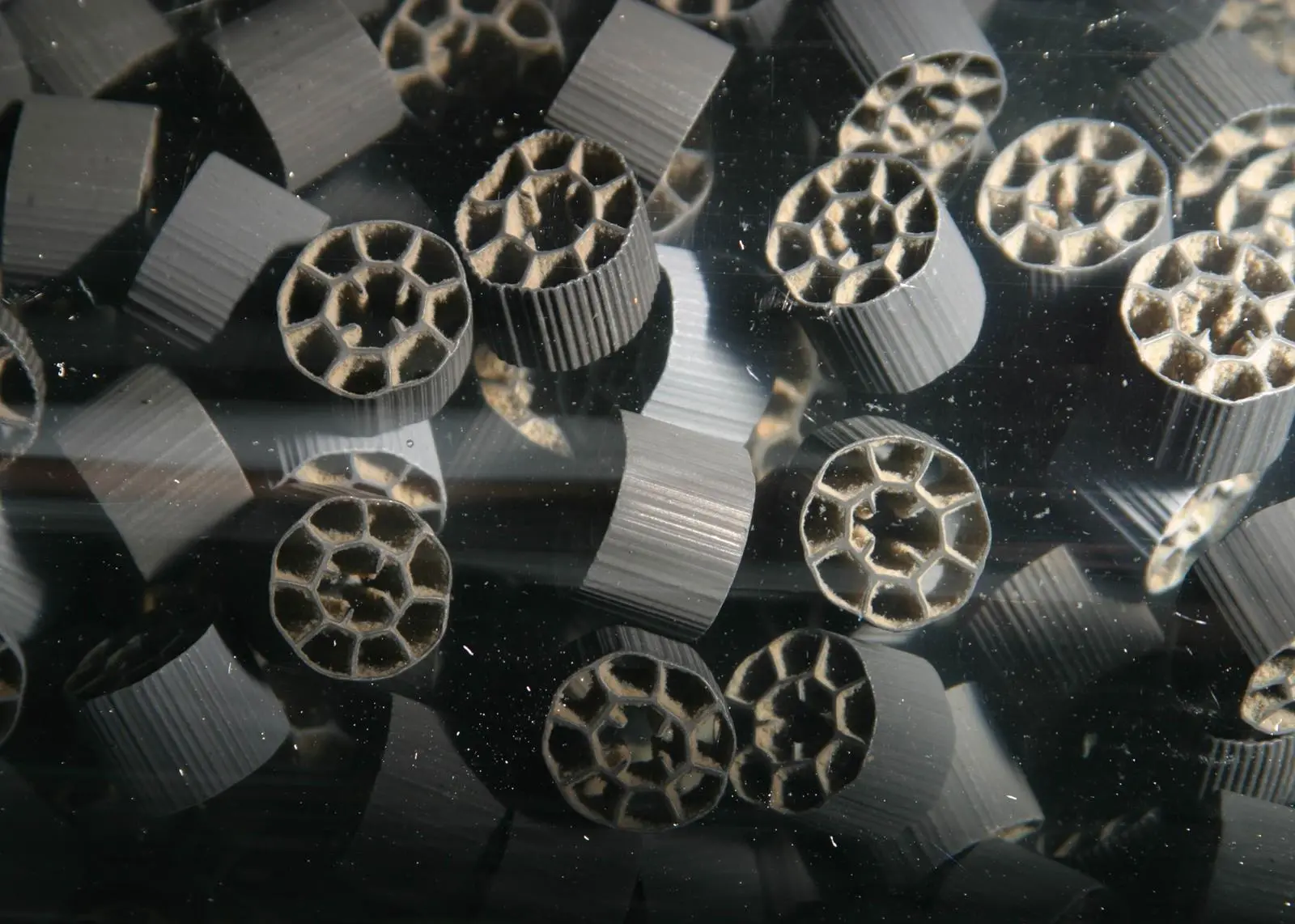
A Moving Bed Bioreactor (MBBR) – which Evac says tends to be a better choice for larger, 1,500-plus passenger ships – has thousands of small plastic bacteria ‘carrier’ blocks circulating inside an aerated tank, the bubbles agitate the blocks to provide a natural scour while also keeping the dissolved oxygen at the 2.5 to 3 mg/L level necessary for healthy biofilm. However high tech, it should be thought of as more ‘garden’ than straightforward mechanics.
From there, the waste stream will often be carried on to various flocculation and filtration devices before non-chemical disinfection by high intensity ultraviolet lamps.
So it’s a multi-phase process and one, Jokela underlines, that’s “tailored” at every point to get the discharges inside the limits of the various regimes for the least amount of initial outlay.
It’s this ‘tailoring’ that needs careful analysis especially if you have different suppliers: “As you can imagine if you are responsible for only the wastewater that’s where your focus is: you want to minimise the size as it keeps down costs and adds to your competitiveness when it comes to the yard.”
On the other hand, “the dewatering press supplier is also doing its best and trying to get the resulting ‘cake’ as dry as possible” he says. Unfortunately this means that the extra organic load from the cake press is going to the wastewater treatment.
Counter-intuitively it’s the galley and not the blackwater from the toilets that is the biggest contributor to the problem; after all, the stuff from the toilets has been ‘pre-processed’ by humans. In fact the galley waste is usually responsible for around 60% of the organic load he explains “so if everyone is simply trying to get the maximum performance out of their own system the result is that the organic loading of the waste stream is often much higher than anticipated”.
This, he says, “can become a real issue” because the excess slops will create biomass growth within the bioreactor, all of it being circled round the process again as the system attempts to clean up.
Not only does it require more power, but as the recycled stream is added to the oncoming wash from current waste it can result in a gigantic game of ‘pass-the-parcel’ with a growing bag – and with a system that’s designed around tight margins, “there’s the potential for the bioreactor to get completely overloaded – putting the whole of the ship’s operation into difficulties”.
Unfortunately the resulting mess doesn’t necessarily come back to haunt the manufacturers as they can quite legitimately point out they’ve kept within specifications: “Sadly it’s almost always the customer who loses out here,” he adds.
Jokela is not alone in arguing for the advantages a single supplier can bring to the table, even though this approach seems to step away from the usual corrective of market competition. For example, Brandy Nussbaum of Veolia says that while some customers might be wary of handing themselves over to a single source “when it comes to smaller, complex systems with specific needs such as footprint and energy, on balance it’s probably better to go with just one supplier who can better target these areas”.
It is an issue: apparently ship owners have become sensitive to the power draw and are even “writing in the contract that new vessels need to be a certain percentage more efficient than their older fleet” says Jokela. He goes on to explain that the energy consumption of a MBBR bioreactor in marine wastewater treatment units “is generally a lot higher than on the municipal plants”: after all, land-based systems can rely on some gravity feed rather than pumps. Additionally, the organic loading values of mixed wastewater onboard a modern cruise ship is more than double the municipal organic loading per person. “Putting all this together, the energy consumption of a cruise ship wastewater system is in the range of 1.0 to 4.0 kWh/m3,” he says, adding: “With our modern MBBR-plants, the energy consumption is around 1 kWh/m3.”
Therefore both Ms Nussbaum and Jokela say that the optimisation offered by a single supplier can be very attractive: “We have been able to halve the total amount of equipment and reduce the power by streamlining the technology, taking out anything that has been doubled up,” explains Jokela.
Finally, although the tight tailoring necessary for shipboard applications throws up “certain challenges that need to be well understood” Ms Nussbaum says there are still a number of manufacturers who can provide an entire, integrated system. So according to her it’s worthwhile doing the homework and evaluating these complete packages, though she admits that at the end of the day “you might not exactly be comparing apples with apples”.
Other developments
There are other reactor technologies under development which may make straightforward comparisons even harder in the future: for example rotational bioreactors (RBCs) pin the biofilm housing to a drum. As the slowly spinning plates alternately submerge and expose the bacteria the system is self-aerating and doesn’t rely on pumps to get the oxygen through the liquid. Therefore the approach could yield distinct energy savings: RBCs, according to some literature, could drop the energy demand by as much as 80%.
On the other hand, the high, uneven shaft and bearing loads present an issue for the engineering; although a kind of hybrid version uses pumps to spin the plates (contained in a jacket) rather than turning them on an axle, these may not be suitable for the kind of dynamic environment found onboard a ship.
There’s also the very new AnoxKaldnes Z-MBBR development from Veolia: like the more usual MBBR it has free-floating carriers, but interestingly these are more ‘Pringle’ than ‘block’ in shape; a grid that is tailored for a specific depth of biofilm which protects the surface by just so much; any growth over this amount will be dealt with by the scouring action of carrier on carrier.
While the Z-MBBR “is really targeting more niche, specialised applications” as it favours certain kinds of bacteria colonies says Ms Nussbaum, it could – possibly – reduce the main bioreactor footprint.
Dry waste pace
Waste isn’t limited to the wet streams: there’s also a highly complex dry waste output which includes everything from individual water bottles to bulk packaging from both the hotel and ‘supermarket’ elements of the cruise. Evac has therefore invested in three years of R&D which started by analysing the loads coming from the various contributors onboard a number of different ships.
“We emptied everything from the garbage room and put it through various sorting tests and chemical analysis in order to get details on the composition,” he says. Based on this rather mucky, hands-on research the company developed recycling, compacting and briquetting equipment which brings down loose bulk to just a tenth of its original volume.
Why all the emphasis on size? “On these ships it’s always a matter of pace through the system,” explains Jokela; briquetting technology buys time, “especially in more sensitive areas where waste burning is limited or outright prohibited”.
This is backed up by high performance cyclone incinerators which minimise emissions – and there’s the potential to include a waste heat recovery system, an obvious pairing which he believes “is going to gain ground in the future”.