MTU places pure gas marker
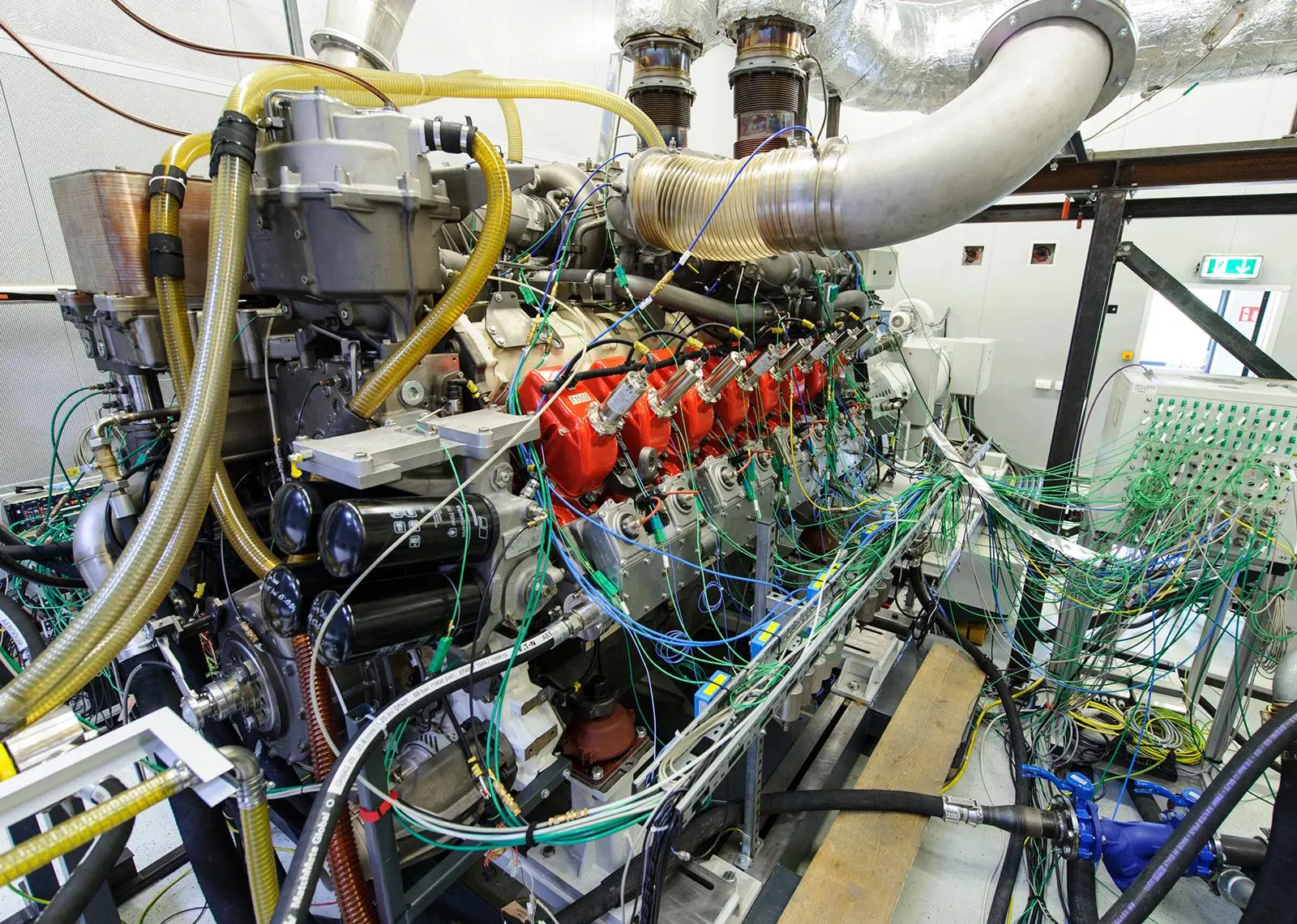
Around five years ago, a pre-development team at MTU began sketching the preliminary concept for it first pure gas marine engine. At the time it must have seemed like quite a gamble – even today there are those who doubt the impact that LNG will have on the marine market. Udo Sander is not one of them.
“For MTU, our engines mostly operate on vessels in costal or near coastal operation, and it is only a question of time before LNG dominates,” he argues. “Along the coast of Germany and inland, in North America and even in Asia, LNG bunkering stations are sprouting like mushrooms.”
The company’s established 4000 series diesel engines, of which 36,000 units have been sold and more than 180 million operating hours logged across marine and land-based applications since their launch 18 years ago, provided the perfect framework from which to develop the new engine. The result is that MTU has already amassed 3,000 test bench hours – and, crucially, its first commercial orders – for its first pure gas engine dedicated to the marine market.
The first sixteen-cylinder engines will begin series production in 2018. Before that, in late 2017, the engines will be used to power a tug built by Damen Shipyards for towage and salvage company Svitzer, who have entered into collaboration with MTU to jointly put the world‘s first tug powered by high-speed gas engines into service. And from 2019 the eight-cylinder version will provide propulsion for a new Lake Constance ferry operated by the local public utility, Stadtwerke Konstanz, which will sail between the towns of Constance and Meersburg.
The sixteen-cylinder engine covers a power range of 1,500-2,000kW, while the forthcoming eight-cylinder version will cover the 750-1,000kW inland vessel market. Both will feature spark ignition, Otto cycle gas combustion, allowing them to comply with IMO Tier III NOx limits without exhaust after treatment; a critical consideration given the space and cost restraints of MTU’s target vessel market.
CONTROL IS KEY
Several engine elements are common to the MTU 4000 M63 base engine, but many – from the fuel injection system to the turbocharging set-up – are either modified or entirely new. But the heart of the pure-gas engines is undoubtedly the sophisticated new control system.
Sander explains: ““We have introduced a system based on cylinder pressure control. This means the control system can respond very quickly to the in-cylinder combustion behaviour. Direct information about the pressure in the combustion chamber helps us to design many things.”
The in-cylinder pressure sensor and corresponding control system are particularly useful in ensuring optimal engine running. The pressure in gas engines can vary widely from cylinder to cylinder and from cycle to cycle. Without pressure sensors, the former approach was to run the engine to the demands of the worst-performing cylinder. With the new control system, pressure sensors can determine for each cylinder whether the air/fuel mix is too rich (potentially causing knocking) or too lean (potentially causing misfiring), and the balance can be adjusted through individual gas injection for each cylinder. The closed-loop control setup activates the gas admission valves and the gas regulating unit in order to deliver the correct mixture to each cylinder over the entire performance map.
Load acceptance and fuel consumption are further improved by map-based turbocharger control. This involves incorporating a waste gate and a bypass in the two MTU ZR175 exhaust turbochargers on the turbine and compressor sides. These controllable components regulate turbocharging to ensure that the charge-air pressure consistently matches the demand for power.
The control system also features a high-energy ignition controller with which ignition timing,
duration and power parameters can be configured. The flexibility of the ignition system, combined with the high-performance ignition capabilities of the pre-chamber spark plugs, ensure that the mixture is ignited reliably at all times.
The sensor technology also enhances the safety of the engine. If the pressure sensor detects that combustion has stopped, the gas admission valve is automatically closed, preventing the potentially dangerous build-up of unburnt gas in the cylinder. The problematic cylinder can then be skipped and engine operation continued using the remaining 15 or seven cylinders.
BROAD APPLICATION
The control system helps to enable a dynamic acceleration behaviour that is very similar to the corresponding single-fuel diesel engine, notes Sander. Combined with the reliability and economy of the system – the 16V4000 prototype registered gas consumption of 9-561kJ/kWh at nominal power – these attributes make the engine suitable for a wide range of vessels including tugboats, ferries, push boats and research ships.
A perennial challenge in the development of pure gas engines – and perhaps a reason why more engine designers have not crowded the market – is the lifetime of spark plugs. Sander acknowledges the challenge, and notes that the company has set a target of 3,000 hours between replacements for pure gas engines in marine operation. In land-based applications, with a more constant engine load, spark plugs have reached up to 8,000 hours between overhauls depending on load conditions. But the wide operating profile of marine engines is expected to be a much greater test. The first feedback will come from the Lake Constance ferry, around six months after it goes into service.
While the established MTU 4000 series provided the base for the development of the new gas engine, it is not the only source of inspiration. Bergen Engines, MTU’s medium-speed stablemate under the Rolls-Royce Power Systems umbrella, has been developing pure gas engines for many years. Sander explains that the dialogue flowed both ways during the inaugural high-speed project.
“Bergen has had gas engines for a long time, and we are a newcomer for marine applications,” says Sander. “They are much bigger than MTU’s, more than double the bore of our units and with an output of up to 10MW compared to our maximum of 2MW. But we worked closely and had a lot of discussion, especially regarding gas injection and control systems.”
If MTU’s timing is right – and the proliferation of LNG projects across Europe in particular suggests it could be – Rolls-Royce could be set to carve its niche as the leading supplier of both medium-speed, and now high-speed, pure gas engines for marine applications.
ENGINE PARTICULARS – MTU 16V4000M65-N
Engine speed: 600-1,800rpm
Power per cylinder: 125kW
Bore: 170mm
Stroke: 210mm
Cylinder V-angle: 90°
Cylinder displacement: 4.77l
No. of cylinders 16, 8
TBO: 30,000 hours
Emission compliance: IMO Tier III and EPA T4