First purpose built LNG bunker vessel
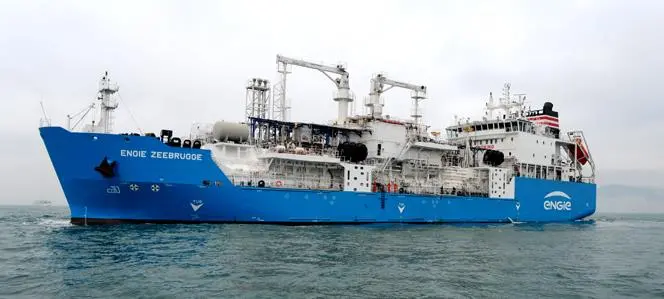
ENGIE Zeebrugge, built at Yeongdo shipyard in Busan, Korea will operate out of its home port Zeebrugge in Belgium. From there, the 5,000 m3 LNG capacity LBV will supply LNG as a marine fuel to ships operating in Northern Europe.
The vessel will load LNG at Fluxys’ LNG terminal where small carriers with capacities from 2 000 m3 can dock at the recently commissioned second jetty.
Its first customers will be the two LNG-fuelled pure car and truck carriers (PCTC) operated by United European Car Carriers.
With LNG becoming an increasingly important alternative fuel for the maritime industry, the challenge in making LNG grow in the bunker market is to develop sufficient supply infrastructure to support the increasing number of LNG-fuelled ships expected to come into operation.
ENGIE said that its new LBV will play its part to help move the bunkering supply chain forward. While LNG-fuelled ships up to now have been largely dependent on fixed bunker locations or the limited bunkering capacity of LNG trailers, the new LBV will be able to service a variety of LNG-fuelled ships.
In September 2016, ENGIE, Mitsubishi Corporation and NYK launched Gas4Sea, a brand name for marketing ship-to-ship LNG bunkering services worldwide.
Under this brand, the three partners intend to support the development of LNG as a marine fuel, thus contributing to an environmentally-friendly maritime industry.