An evolution in quality
While some may balk at that bleak assessment of a major machinery item’s raison d’etre, ship owners will appreciate the analogy. For Granitto and the maker of the SeaCure system, the attitude underlines a drive to add value to a product type that could easily be dismissed as a commodity.
There was already inherent value in Evoqua’s system given its dual functionality: SeaCure was based on side-stream electrolysis technology created by Evouqua’s predecessor in the 1960s as a marine growth prevention solution (marketed as Chloropac) and retains that function, keeping ballast water and seawater cooling tanks fouling-free while enabling compliance with ballast water management regulations. But the US-headquartered company, which produces its ballast water management systems (BWMS) in the Welsh town of Caldicot, has been working to enhance the attractiveness of SeaCure on several fronts.
When SeaCure was launched in 2012 it was, the company admits, both late to the market and relatively uncompetitive. The system was high quality and effective, says Ian Stentiford, global vice-president, electro-catalytic business, Evoqua Water Technologies. But a lack of development focus on the core element – the cathode – meant it remained pricey.
That changed when oil prices plummeted. The predominantly oil and gas customers of Evoqua’s marine growth prevention system demanded cheaper solutions to cut their capital expenditure. Working on its cell technology – a ‘concentric tubes’ cathode configuration whereby seawater passed through an inner pipe is chlorinated, as opposed to the more common plate or symmetrical arrangements – the company was able to dramatically increase hydrochloride output. This was coupled with design changes that, over five years, reduced the weight of the SeaCure system by around 85% and the footprint by 75% – regardless of power requirement.
The modern SeaCure incarnation occupies a similar footprint for any flow rate. Only the number of cathode tubes, stacked on a 5.6×3.2m skid, changes depending on the volume of water to be treated, to a maximum of 20 tubes that Stentiford says accommodates a greater flow requirement than any from the marine sector.
“We’ve drastically improved the life of the system, which is now one of the smallest electrochlorination-based ballast water units on the market. We have adapted it as a modular system, reducing components and installation time and complexity,” adds Granitto.
Those capex improvements are supplemented by low operational expenses. Filtration maintenance is minimised by the system’s capability in preventing marine growth. Evoqua’s long experience in cathodes also comes into play in the system’s control logic, notably the obligatory monitoring of cathodes. While the IMO’s convention stipulates total residual oxidisation (TRO) monitors, Evoqua had previously developed its own alternative, an oxidisation reduction potential (ORP) monitor. Unlike the TRO, the ORP requires only factory calibration and does not need regular internal cleansing. It also functions accurately in turbid waters. The company worked with flag administrators to gain an exemption from the TRO requirement during IMO type approval certification.
Cutting lead times
As ship owners will be aware, there is also a crucial logistical element to a successful BWMS installation, requiring coordination between owner, vendor, yard and flag administration. This adds time and complexity to a project, and the time pressure is set to be compounded as an anticipated 30,000-plus vessels scramble to have systems installed under the BWM Convention’s five-year installation timeframe. One of the key ways any supplier can support ship owners is therefore to reduce the lead times for delivering systems.
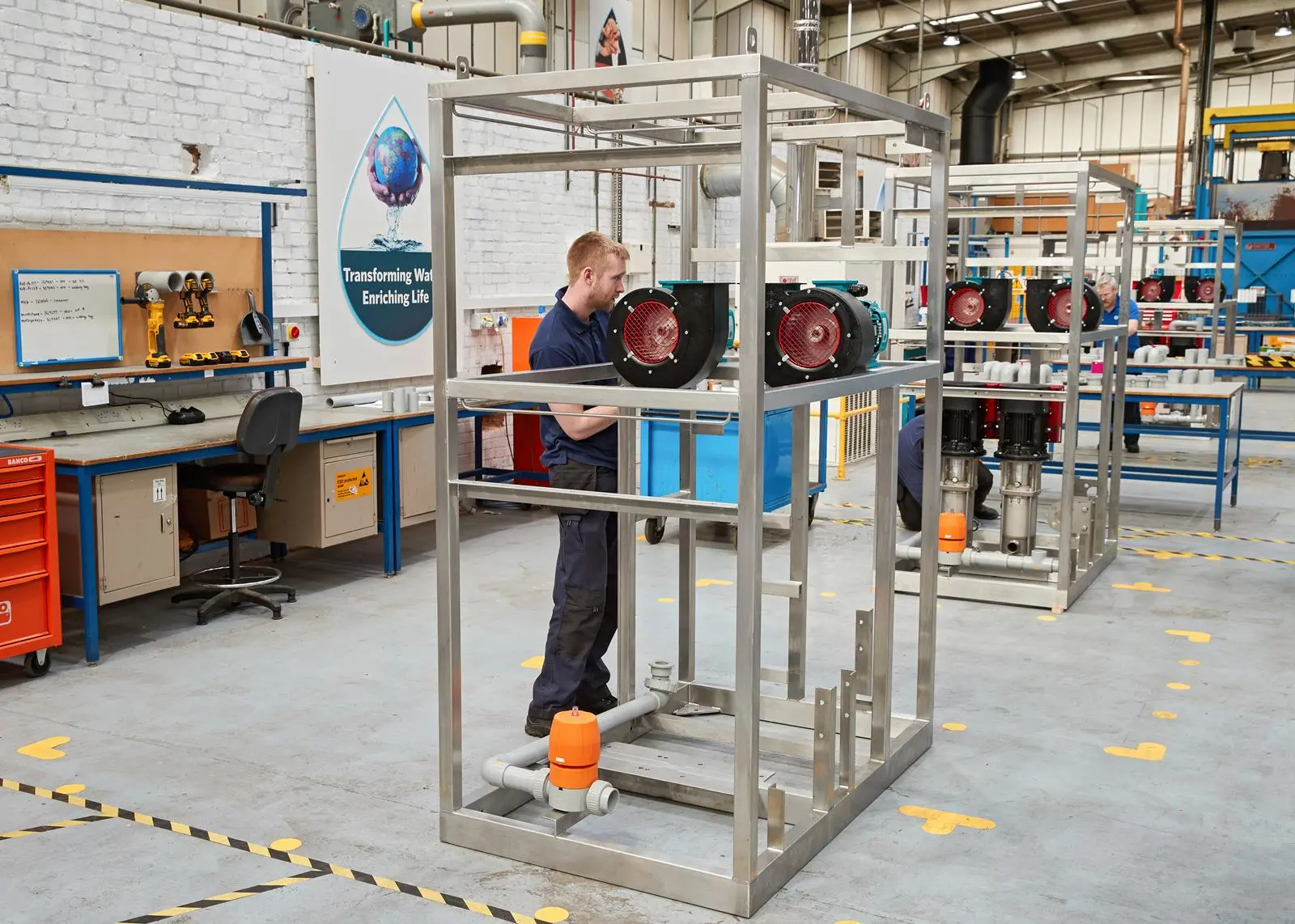
Here too Evoqua has been making progress. The company’s existing relationship with its filter supplier, and its recent acquisition of anode manufacturer Magneto, mean Evoqua has strong control over vital elements of its supply chain. The Caldicot production facility is also in the midst of an expansion and reorganisation intended to further reduce the time required to build the units.
The investment includes a new compressed air system, dedicated welding bays and upgraded testing facilities, while component and assembly lines and warehouse capacity have been optimised using lean methodology to streamline production and delivery. Additional production capacity will be provided by partners (Hai Cheung in China and Krosys in South Korea) who will be licensed to build the SeaCure system.
“Over the next five years, ballast water system suppliers could struggle to meet demand if they fail to invest in their production and supply lines,” explains Chris Thomas, director of operations, Evoqua (UK). “The investments will mean that ship owners and shipyards will not have to worry about long lead times which could delay installation and commissioning schedules.”
With all that progress, it seems that one vital ingredient is missing – US Coast Guard type approval. The company expects to file its final application in the first half of the year, pending the conclusion of testing at NSF, which is taking longer than expected due to the independent laboratory’s rigorous approach. Instead of adding organisms to test water, the lab is patiently waiting for the correct test conditions – a strategy of which Stentiford says the company remains in favour.
“We did not want to be a company that has all the certificates and badges in place but whose equipment fails in real time,” he explains. “We want to deliver a system that performs as we and our customers would expect a BWMS to operate in real-life conditions. We knew the challenges that NSF would place on the system. So we knew that if it could pass these very tough tests then it was going to work in the real world.”
The other piece of the jigsaw absent, for now, is a significant orderbook. In March the company announced a contract to supply two 114,000dwt tankers under construction in South Korea. Combined with previous retrofit tanker orders, the company now boasts ‘a couple of handfuls’ of contracts. After five years of intensive efforts, Evoqua anticipates that work will be paid off as the major installation opportunity approaches.