A ship for the ‘Green Corridor’
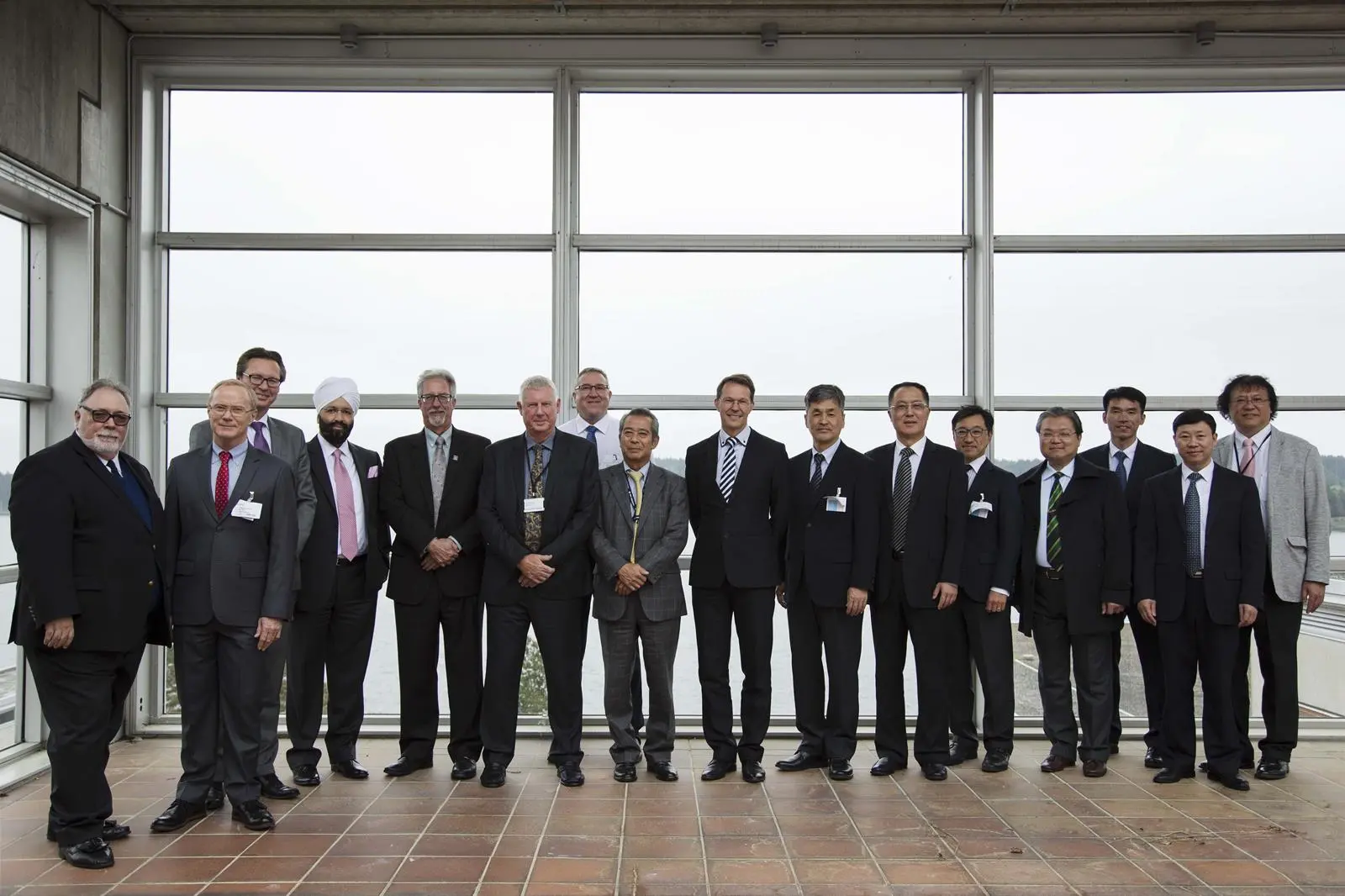
At the Nor Shipping exhibition in May project partners BHP, Fortescue, Mitsui O.S.K. Lines (MOL), Rio Tinto, SDARI, U-Ming, Woodside, and DNV GL presented the results from stage one of their “Green Corridor” joint industry project (JIP). The JIP aimed to demonstrate the commercial potential and technical feasibility of LNG-fuelled bulkers for iron ore and coal trade between Australia and China. The result is an LNG-fuelled Newcastlemax design which is in the process of receiving approval in principle from DNV GL.
The idea of developing LNG-fuelling infrastructure for the vessels operating on the Australia–China iron ore and coal trade route has been contemplated by major charterers, ship owners and operators for many years. As LNG production has climbed, especially in Australia, and in recognition of the upcoming IMO restrictions on sulphur emissions, the option of LNG as a single-system solution for emissions compliance has become ever more attractive.
The JIP investigated several compliance options that considered market and trade route characteristics including safety and ease of operation, cargo and fuel flexibility, energy efficiency and economic viability. According to Morten Løvstad, business director bulk carriers, DNV GL – Maritime, the strong multi-stakeholder approach enabled the JIP to arrive at solutions that fulfil owners and operators’ requirements as well as being in full compliance with international rules and regulations.
“By having both charterers and ship owners as active partners in the JIP, we are optimistic that this new design will materialise into firm orders in the near future,” says Løvstad.
Chinese ship designer SDARI developed the design of the 210,000dwt Newcastlemax bulk carrier based on their highly energy efficient Green Dolphin design. Dual-fuel engines were quickly decided upon by the JIP partners, as this is a mature technology with multiple suppliers offering solutions, and the dual-fuel design providing operational redundancy. Both low-pressure and high-pressure two-stroke engine types have been included into the design to allow for maximum flexibility, since both options have their own pros and cons. However, it is important to note that the design is fully NOx Tier III compliant, and thus the high-pressure engine option is also fitted with an exhaust gas recirculation system.
Based on fuel consumption analyses an LNG fuel tank size of approximately 6,000m3 was found to be optimal, with bunkering in Australia for the round-trip. Several locations for the LNG fuel tank were considered. The solution decided on places two tanks directly above the engine room and submerged a few metres below the main deck. This offers protection for the fuel tanks, enhances fire protection, and does not reduce the cargo carrying capacity even for volumetric cargoes such as coal.
New or old?
The study also examined whether a retrofit or newbuild option would be more economically and technically viable. The conclusion was that a retrofit option is possible from a technical point of view, but would allow less capacity for the LNG fuel tanks, and hence less operational flexibility. Retrofitting is also significantly more expensive due to the higher capex in the engine installation and the corresponding shipyard costs in comparison to a newbuild. From an operational and cost point of view, the location of LNG fuel tanks is also more challenging for the retrofit option, as the tanks would need to be placed on the aft deck.
Taking into account other environmental regulations that have already or will soon enter into force, including the Ballast Water Management Convention and NOx Tier III requirements, the partners found it likely that a newbuilding option may be attractive.
“An important part of the JIP was conducting the financial feasibility study for the design,” said Mike Utsler, chief operations officer of LNG supplier Woodside. “We looked at a wide range of capital and operational costs, including LNG and low-sulphur fuel oil price sensitivities, as well as conducting a high-level bunker supply chain assessment. Based on this we found that, under the most realistic scenario, the payback period for the design was under 10 years, and under the optimistic projection just 6.7 years.”
The project partners believe that the new design offers original solutions for cost-efficient, safe and flexible operations, resulting in a ship concept that is ready to serve as the outline specification for newbuilding orders.
David O’Brien, principal advisor, Rio Tinto, concludes: “This project has shown us the power of a collaborative approach to a regulatory step change. Outside the JIP, we can be partners, competitors, suppliers and principals but inside the JIP, the common goal is clear and has shown to be achievable. We strongly support this type of collective industry approach when faced with an uncertain target.”
‘GREEN CORRIDOR’ NEWCASLTEMAX – PRINCIPAL PARTICULARS
|
Length overall (m) |
300.0 |
|
Breadth (m) |
50.0 |
|
Depth (m) |
25.2 |
|
Scantling draught (m) |
18.5 |
|
Deadweight at scantling draught (tonnes) |
210,000 |
|
Cargo hold volume (m3) |
225,000 |
|
LNG tank volume (m3) |
6,000 |
|
Main engine |
WinGD 6X72DF or MAN B&W 6G70ME-C9.5-GI |
|
Class notation |
DNV GL, +A1 BULKCARRIER ESP BC-A GRAB[35] CSR, Holds 2, 4 ,6 and 8 may be empty, COAT-PSPC(B) GAS FUELLED |