



ABB launches low-load turbocharging solution
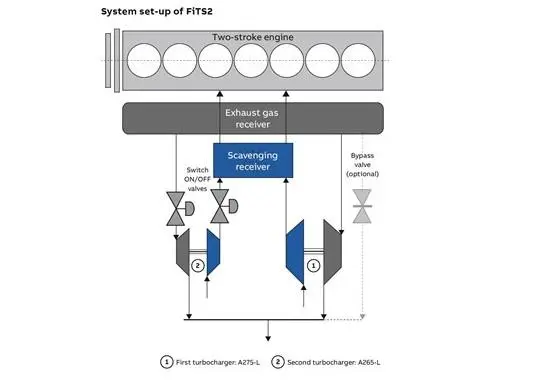
The Flexible Integrated Turbocharging System for Two-Stroke Engines (FiTS2) is suitable for engines with at least two turbochargers and cylinders of around 600mm bore or greater. The system works by bypassing one turbocharger when the engine is operating at low load – thereby maximising the scavenge air pressure generated through the single operational turbocharger and boosting efficiency.
According to Joachim Bremer, head of product line low-speed, ABB Turbocharging, the system could bring fuel savings of around US$100,000 a year for a very large crude carrier. “Big savings are also possible for other vessel types, such for container vessels and can amount to US$1 million or more over 10 years,” he said. “The payback of initial costs can be less than two years.”
Developed after a decade of low-load, slow steaming from ship owners across many segments, the system relies on modern electronic engine tunings. ABB worked with engine developer Winterthur Gas & Diesel (WinGD) to develop a tuning optimised for sequential turbocharging, and the system will be available on all single-fuel WinGD engines.
The system also requires specially designed cut-off valves, which are flow-optimised and integrated with turbocharger casings. The valves can be operated rapidly and automatically under load, without interrupting operation of the engine up to full load.
Sequential charging, which maintains NOx emissions within Tier II limits (or Tier III with SCR), also generates maintenance savings by reducing reliance on auxiliary blowers. These units are only required for engine loads under 25% using FiTS2.
Related Articles
 2-STROKE & 4-STROKE
 TURBOCHARGER
 TURBOCHARGER