Arctic innovation
Located in the Russian Arctic at the estuary of the Ob River, and icebound for nine months of the year, Yamal LNG will use a fleet of highly specialised LNG carriers to move its production to Asia and Europe.
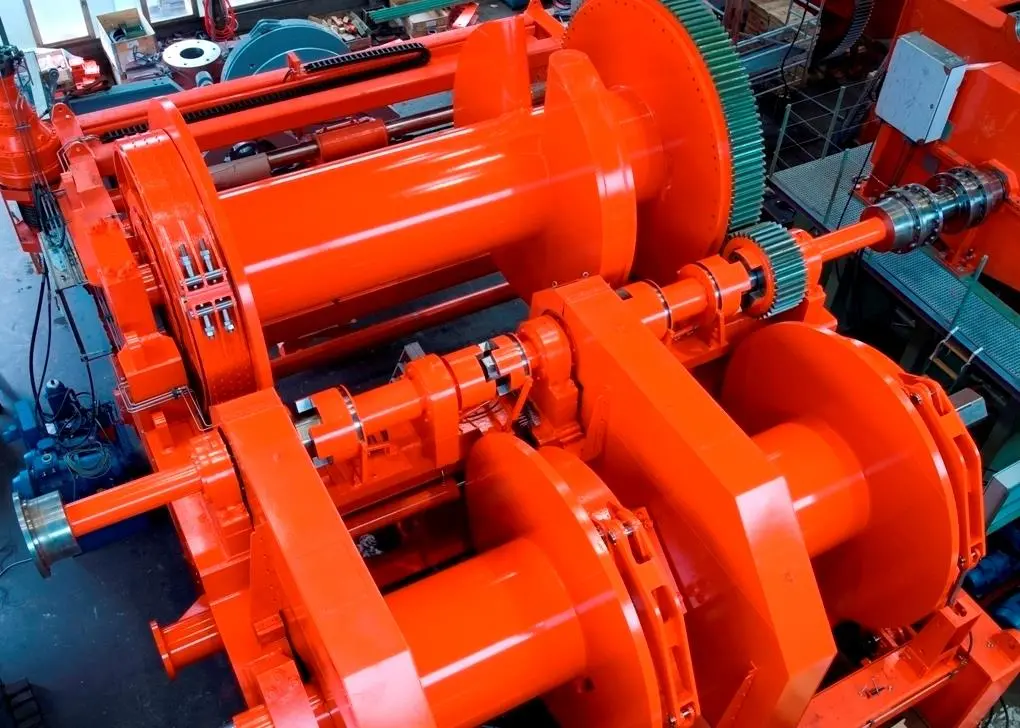
The dedicated ships, which will each have a cargo capacity of 172,600m3 and very high Arctic ice class Arc 7 rating, are under construction at the Daewoo Shipbuilding and Marine Engineering yard in South Korea, for delivery in 2017 and 2018. As the result of a contract with deck and cargo equipment specialist MacGregor, 15 of those carriers will feature Hatlapa machinery – including electrically driven windlass and mooring winches – that have been specially developed for the harsh operating environment.
MacGregor believes that demand for shipboard equipment capable of working in extremely low temperatures will increase, and that the innovation spurred by the demands of the Yamal contract – including new materials, variable frequency drive equipment and remote control capability – is a major step forward for the industry. “With these winches we have set a new benchmark in terms of technology,” says Dieter Kleen, product line manager, deck machinery, MacGregor Hatlapa. “This has put us in an ideal position to meet future market demand for marine equipment of this type.”
“MacGregor is demonstrating that it can deliver equipment that complies with the demanding technical requirements of operating in extremely cold conditions,” adds Alexander Nürnberg, vice president, auxiliary and machinery systems. “While the overall concept was based on existing designs, the specific requirements of the yard and shipowner meant we had to make a number of adaptations and changes to standard Hatlapa equipment. Our excellent cooperation and understanding with shipbuilder DSME was a pivotal factor in meeting the end-user’s needs.”
The project prompted the development of a completely new technology, suitable for use in ambient temperatures as low as -52°C. The solution demanded the use of special steel plates and shafts, but also the development of new sealing materials, as well as grease and gearbox oils, suitable for the extremes of nature.
MacGregor worked with its suppliers and other technical partners to identify the materials and parts for harsh and low temperature environments and, where none were available, conceived new solutions of its own. Results included special lifting gear for the electrically-driven brakes and heated electrically-driven motors incorporating special fail-safe functions.
Kleen explains: “The completely electrically-driven brakes for the mooring drums and the anchor chain lifter are unique on the market. This innovation allows for fully remote operation of all brakes on the winches, even when temperatures fall to -52°C.”
One of the main challenges in fulfilling the contract was finding the raw materials which could both withstand the low temperatures and were approved for use by the Russian Maritime Register of Shipping (RMRS). Kleen says: “To meet RMRS class rules, all raw materials had to be tested at ten degrees below the maximum ambient temperature of -52°C, requiring Charpy ductility tests to be carried out at -62°C.” The impact tests were carried out by MacGregor and verified by an RMRS surveyor.
Other design challenges from the owner meant that the anchor winch has to be able to retrieve the anchor when the entire 385m long chain is suspended, compared to the 83m of chain retrievable using standard Hatlapa winches. To meet the significantly higher forces, MacGregor designed a very powerful driving winch, and fitted a gearbox with two motors.
The new winches had to be tested on a test bench that was much bigger than those used previously by MacGregor, itself designed specifically to handle the higher loads. All the winches’ functions and loads have been successfully simulated and tested on the new bench in the presence of RMRS, the shipowner and the shipyard.
The electrical equipment used for the winches has also been tailored for this particular shipboard application. The programming of the variable frequency drive had to be specially developed in cooperation with the supplier, for example, while MacGregor also had to develop fail-safe, redundant heating systems to ensure that all equipment functions could be guaranteed to work under any circumstances.
Kleen adds: “Since the vessels will be operating under very harsh ice conditions, safety has to be the top priority. Consequently, we had to ensure the reliability of all systems are guaranteed, by incorporating additional safety features. In particular we have incorporated redundant systems where necessary to add an extra safety layer.”
Developing the deck equipment for the Yamal LNG carriers took around a year to complete. MacGregor will now be closely involved with the actual commissioning of the equipment onboard the vessels during the shipbuilding phase in South Korea, as well as final sea and ice trials.