Bio-LNG market growing strong
With LNG powered vessels ordered in 2025 accounting for 79% of alternative-fuelled tonnage, up from 67% in 2024, the LNG-powered global fleet both operating and on-order, including LNG carriers, today represents 10% of the global fleet by dead weight tonnage.
LNG bunkering is now offered in 222 ports globally. The number of bunkering vessels has increased from a single vessel in 2016 to over 62 in 2025 with a strong order book of 38.
“2025 is the year the methane decarbonisation pathway became a clear runway,” says Steve Esau, COO of SEA-LNG. “The year our advocacy for LNG as a transition fuel from fossil LNG through LBM (liquefied biomethane / bioLNG) to liquefied e-methane took off, with record amounts of LBM powering global shipping today and growing strongly into the future.”
Emissions reduction will depend on how the LBM is produced and the engines in which it is used. In general, it can reduce GHG emissions by up to 80% compared to marine diesel on a full well-to-wake basis, says SEA-LNG. When produced from the anaerobic digestion of waste materials, such as manure, methane that would otherwise be released into the atmosphere is captured, resulting in negative emissions of up to -190% compared with diesel.
Production of biomethane is currently running at approximately 36Mtpa, or 15% of shipping’s total energy demand. Biomethane produced from sustainable biomass has massive global potential – up to 20 times current production levels by 2050. Once demand from other sectors is taken into account, LBM has the potential to play a significant role in decarbonising shipping. If used in the form of a 20% blend with LNG, for example, it could cover up to 16% of global shipping demand by 2030.
Regulatory issues
Notwithstanding the uncertainties caused by the IMO’s decision to delay the adoption of the Net Zero Framework, the shipping industry has shown how quickly it adapts to new regulation, says Esau. Bunkering of LBM has exploded over the past year in Europe, driven by increasingly stringent EU regulations and voluntary, customer-related commitments. LBM bunkering operations have already taken place in key ports across Belgium, France, Finland, Italy, Lithuania, the Netherlands, Norway, Spain, Sweden and the UK, involving at least 10 major bunker suppliers.
The EU Commission’s new Sustainable Transport Investment Plan (STIP), published on 5 November 2025, represents a major milestone for the methane decarbonisation pathway. The Plan explicitly recognises LNG, bio-methane and e-methane within the clean-fuel mix, noting that “LNG, with effective methane-slip mitigation technologies, can also reduce GHG emissions,” and the trend of “ocean-going ships moving towards methane (LNG, bio-methane and in future e-methane).”
With this, the STIP reflects long-standing calls for fuel and technology neutrality, ensuring methane, biomethane and e-methane compete on equal terms with other clean fuels. It also urges Member States to avoid barriers to methane use and harmonise biomethane eligibility. This supports SEA-LNG’s vision for a single, cross-border EU market for renewable methane.
Key developments in industry uptake in 2025 include Hapag-Lloyd and Shell signed a multi-year agreement for the supply of LBM starting in September. Since 2024, Shell has expanded its offering to include LBM, and it is now available at 22 locations. The 2025 agreement followed a September 2024 announcement that Gasum was supplying Hapag-Lloyd with LBM to fulfil the requirements of their ZEMBA tender. ZEMBA being a first-of-its-kind buyers’ group within the maritime sector with the mission to accelerate the commercial deployment of zero-emission shipping solutions. The LBM is continuing to be used in 2026 on a route between Rotterdam and Singapore.
In August 2025, expanding upon their MoU with Shell in 2022 that encompassed the advancement of low-carbon marine fuels such as LBM, CMA CGM formed a strategic partnership with the U.S.-based renewable natural gas (LBM) provider Vanguard Renewables, to support the decarbonisation of its shipping activities. Vanguard will dedicate up to four projects to the production of LBM to be delivered to CMA CGM.
Since August 2025 Viking Line has run its two RORO vessels Viking Glory and Viking Grace operating between Turku in Finland and Stockholm Sweden on LBM to generate compliance for Gasum’s FuelEU Maritime pool. This LBM agreement built upon Gasum’s earlier agreement with Equinor in February 2025 to supply its two tugboats Borgoy and Bokn with LBM throughout 2025.
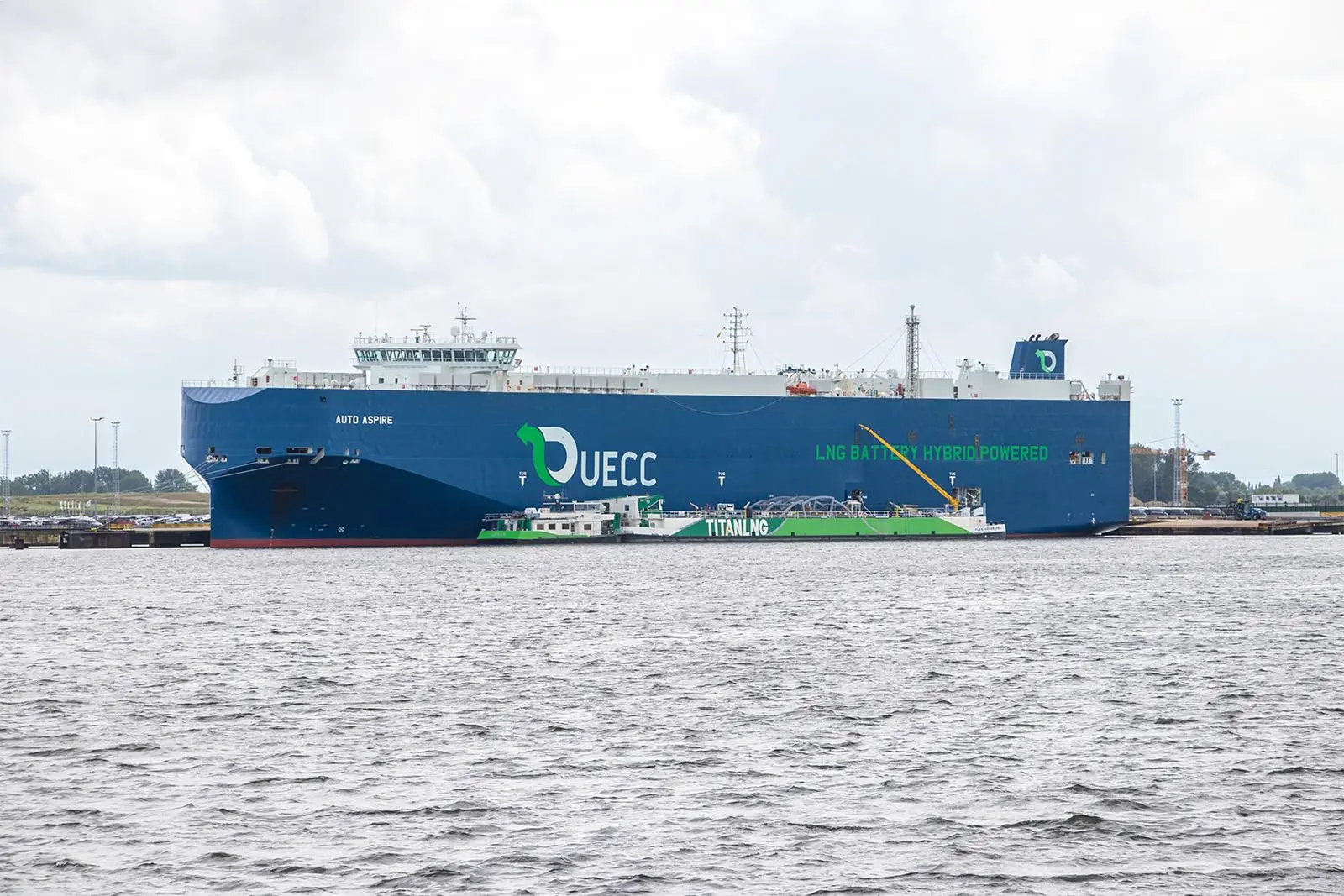
In December 2024, United European Car Carriers (UECC) announced that since July 2024 over 95% of the LNG used was LBM, avoiding 75,000 tonnes of GHGs being emitted. The company’s agreement with Titan Clean Fuels enabled UECC to continue to run on LBM for most of 2025. This transition to biomethane amplifies the success of UECC’s ‘Sail for Change’ sustainability strategy, as it will exceed its carbon intensity targets, which use the same metric as the industry’s forthcoming FuelEU Maritime regulation. The use of LBM will offer UECC overcompliance with FuelEU Maritime across its overall fleet, and so it is actively exploring pooling and banking options.
Pooling options
FuelEU Maritime allows for pooling by fleet operators to meet their GHG intensity targets. The use of LBM can generate credits within this pooling mechanism which can be used directly by fleet operators for compliance purposes or can be sold to other fleet operators. Having the flexibility to utilise biogas with highly negative GHG emission factors is a key component in making pooling work. At least four commercial FuelEU Maritime Pools are in operation in Europe: Gasum Pool, Ahti Pool, BetterSea & OceanScore. This is an important feature of the regulations and should continue to be encouraged and expanded, says Esau.
Also last year, Spanish ferry operator Balearia moved three of its dual-fuel ferries Margarita Salas, Abel Matutes and Rusadir to run exclusively on LBM from September to December 2025. To facilitate this, the company secured 132GWh of LBM, the equivalent of 13% of all LNG consumed by Balearia’s LNG-powered fleet in 2024. The move prevented the emission of 80,300 tonnes of CO2, the annual equivalent of taking 153,500 cars off the roads or planting 160,650 trees.
Avenir LNG announced that its vessel Avenir Ascension would be the first bunker vessel globally to run entirely on LBM for 2025, and Swedish shipping firm Furetank started running its EU fleet on mass-balanced LBM. Agricultural group Cargill produced the biogas from waste, while Titan Clean Fuels liquefied and delivered it. The purchased LBM provides a 150–200 per cent reduction in greenhouse gas emissions on a well-to-wake basis, moving the company closer to its long-term goal of fossil-free shipping.
Mass balancing is the most common chain of custody currently being employed as it avoids separate investments in transportation and storage infrastructure, using existing infrastructure to connect buyers and sellers. It tends to be favoured by regulators as it is lower cost, allows utilization of LBM without increasing lifecycle GHG emissions due to avoiding unnecessary infrastructure and transportation, and enables the market for green fuels such as liquefied biomethane market for maritime to scale more quickly.
The growing liquidity of the market in Europe is demonstrated by the recent introduction of LBM bunker price assessments by price reporting agencies S&P Platts and Argus, says Esau. “Outside Europe we are seeing the emergence of LBM bunkering for voluntary commitments, for example in the US.”
The IEA’s May 2025 report, Outlook for Biogas and Biomethane states that biomethane is an underutilised resource in the energy transition. It is currently growing at a rate of 20% per annum, and the IEA estimates some one trillion cubic metres of biomethane could be produced every year using organic waste streams (this would be the equivalent of around 25% of the total global natural gas demand today) yet only around 5% of the total potential for biogas and biomethane production is currently being utilised.
“The next stage of the methane decarbonisation runway extends beyond biomethane to e‑methane, a synthetic fuel produced using renewable electricity and green hydrogen,” says Esau. “With the potential to deliver net zero emissions on a lifecycle basis, e‑methane is increasingly recognised as a credible route for meeting the IMO’s 2050 climate ambitions. Its emergence aligns with growing industry interest in synthetic fuels as long‑term, scalable decarbonisation solutions.”
The New Energies Coalition’s recent study reinforces this trajectory, identifying e‑fuels as one of the most promising pathways for deep GHG reductions using renewable electricity and green hydrogen. E‑methane retains the energy density, storage properties, and handling characteristics of conventional LNG, ensuring that vessel performance and safety procedures remain unchanged.
“This, together with LBM, ensures methane investments are future proofed,” says Esau.
He notes that LNG dual fuel vessels can fuel switch between LNG, liquefied biomethane and e-methane, traditional fuels and biofuels depending on regulations and relative fuel prices. LNG is also particularly well-suited to onboard carbon capture technologies due to methane, as the cleanest hydrocarbon marine fuel, emitting purer carbon dioxide when burnt.
“E-methane project development is currently being driven by demand from the utility sector, particularly in Japan, Europe and America. Clearly this is a product that will see significant investment as the hydrogen economy develops over the coming decades.”