Biofouling regulations on the table
After persistent negative feedback during its public review process, California is now having to rework its hull fouling management regulations, set to enter into force in January 2014. Australia, on the other hand, has been criticised for taking an overly circuitous route in its attempt to replace its out-dated ANZECC policy on antifouling management and hull cleaning. The trouble with both situations is they promote unilateral policies and procedures which, history has shown, end up as models for voluntary IMO guidelines, a process “which easily leads to impractical criteria, unpredictable charter requirements and quasi-regulation, following surprisingly limited input from ship managers, class, charterers and other experienced players”, says Dr Rob Hilliard, principal consultant at Intermarine Consulting in Australia. Such fears have been raised with IMO’s voluntary biofouling guidelines (Resolution MEPC.207(62)), adopted in July 2011 after being pulled mostly from Australian and New Zealand draft policies and guidances.
Dr Hilliard is also surprised IMO’s new Ship Energy Efficiency Management Plan (SEEMP) contains no link or reference to its biofouling guidelines. The latter require a separate management plan and record book for each ship, but from the shipowner’s perspective, managing hull performance and biofouling are essentially inseparable and it doubles the paperwork to develop and maintain separate plans. “Shipowner groups and class need to keep on top of all hull performance and biofouling policy developments to ensure the most practical and cost-effective solutions can be identified and implemented”, he advises.
California and Australia have followed different approaches for evaluating if a ship’s hull poses an unacceptable invasive fouler risk. “Australia has been trying to apply its Quarantine Act for managing biofouling, but with this instrument you have to define what species you don’t want brought into Australian waters,” says Dr Hilliard. “A list of 56 unwanted foulers was proposed, and this generated widespread concern for containing a substantial number that were not pertinent or readily identifiable on the hulls of ships trading to or between Australia’s port; some were non-foulers, had a lake-dominated life cycle, or were parasites and microbes requiring laborious sampling and microscopic examination.”
Instead of focusing on particular species, California’s initial proposals required various checks to check if macrofouling coverage (not including turf algae) on particular niches and other wetted areas of an arriving ship exceed 5 or 15%, forming an arbitrary ‘gross exceedence’ of low invasion risk. “How to measure all parts of arriving traders quickly and reliably so there’s no argument, who pays for the diver training and deployments for the measuring, where and how often?” asks Dr Hilliard.
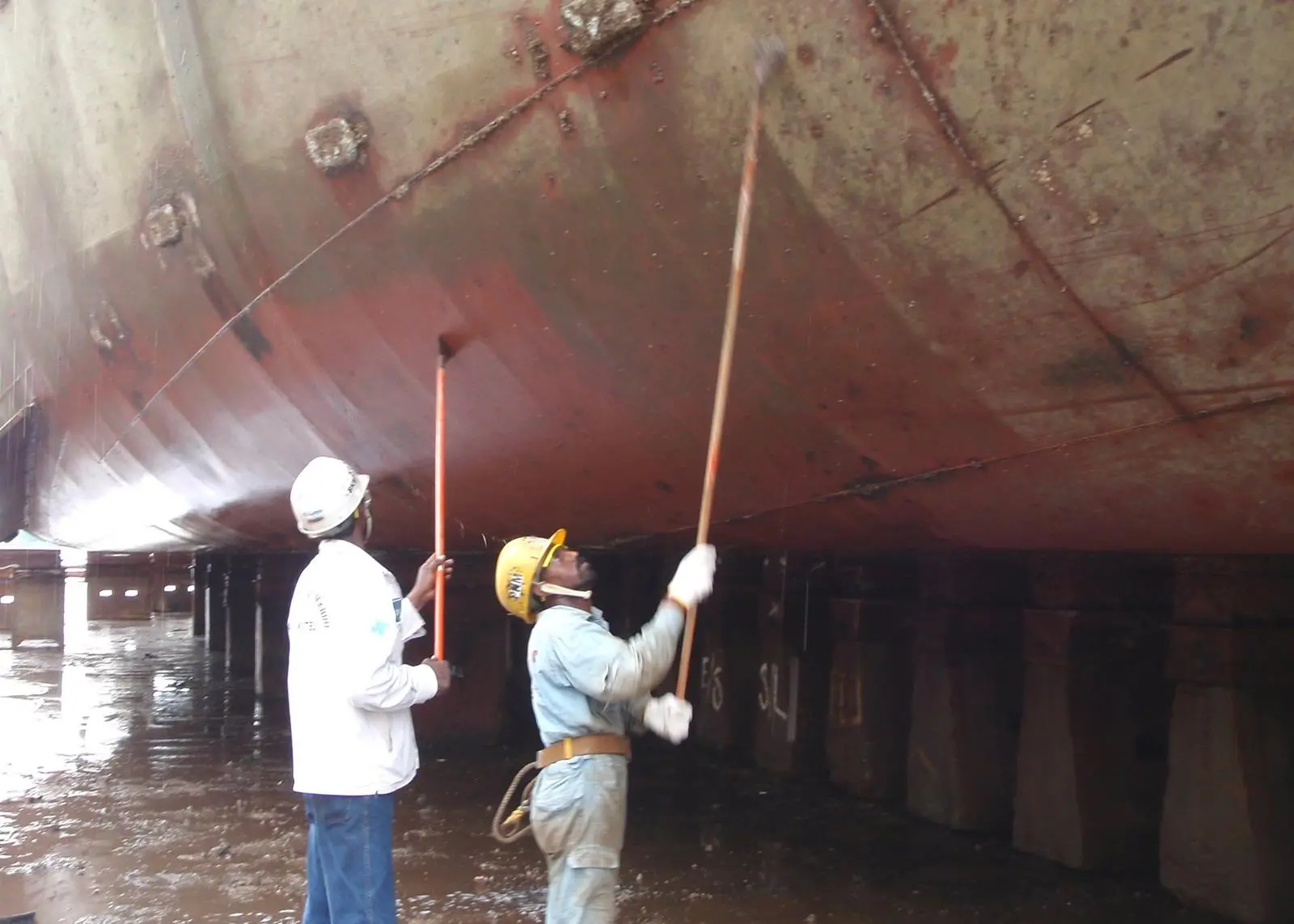
Easy-to-reach waterline and boot-top areas of laden bulkers and tankers have minimal fouling, as this accumulates on the deepest, permanently immersed turn of hull and flat bottom, especially dry-dock support marks, sea chests, thrusters, anodes and running gear. “Measuring critical areas 16-24 metres deep requires highly trained, mixed-gas diving to provide sufficient bottom time. It’s clear a great deal of consultation and thought are needed to identify practical criteria for regulating fouling – more than has apparently taken place so far” says Dr Hilliard, who understands shipowners and fleet managers like to keep things simple and practical.
With the phase-out of TBT paints and the dawn of improved cleaning technologies for capturing the material removed from hulls, Australia and New Zealand have been looking at re-allowing in-water cleaning. Yet debate on how much material should be captured, including what performance criteria will provide ‘best available technology’ targets for minimising bioinvasion risk and seafloor pollution by copper paint flakes, has been minimal.
“Although copper is nowhere near as toxic as TBT due to its rapid natural binding abilities in seawater and estuaries, releases of copper-laden particles can pose major cost headaches to any port authority that must identify and separately manage any copper-polluted sediment before dredging and open-water spoil location, in accordance with the London Convention and its 1996 Protocol”.
With in-water cleaning set to increase as a result of both SEEMP and invasive fouling management, Hilliard believes a standard is needed to cover its critical aspects, such as certified capture rates, diver training and the softness, angle and pressure/density of brush kart bristles and jet washers, so as to protect both shipowners and ports from dubious claims and ‘cowboy’ operations that damage hull coatings.
As vice chair of a technical group established by NACE International, he is presently helping develop a pictorial-based standard for improving transparency and consistency in measuring the different types, locations and amount of fouling biota during dry-dock and in-water inspections. Dr Hilliard believes a pictorial standard will provide a key step towards the development of stereoscopic instruments and pattern recognition software to enable fouling coverage, composition and roughness to be measured quickly and objectively.
Such technologies are for the future. At present, Dr Hilliard is talking over the issues with people across the industry and looking forward to the first ‘ANZPAC’ workshop on biofouling management (Melbourne in May). Pressure for a mandatory biofouling instrument will continue to grow. “The MEPC has already agreed the effectiveness of the present voluntary guidelines merit review, and we all know how effective they have been so far”.