Boxship Signals New Chapter For German Fleet
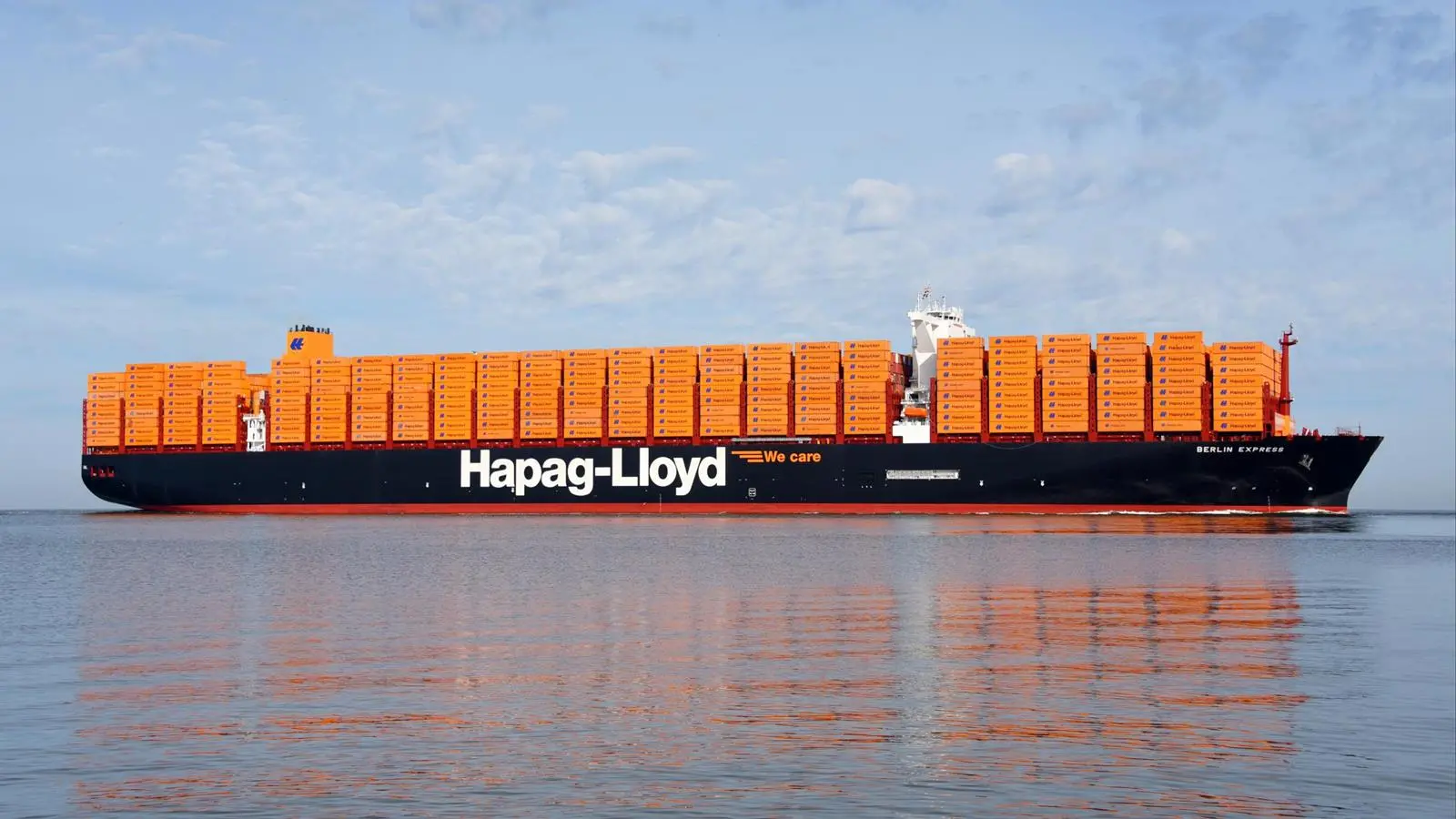
The 23,664 teu Berlin Express leads the 12-ship Hamburg Express-class from Hanwha Ocean’s Okpo yard in South Korea, combining an advance in scale economy with the comprehensive adoption of LNG fuel for the main engine, auxiliaries and boilers.
The company’s biggest ships hitherto have been the A19 series, delivered in 2015 and 2016 and acquired through the takeover of United Arab Shipping Company (UASC). Berlin Express offers nearly 20% more slots within the same overall length of approximately 400m but with the beam taken out a further 3m to 61m. The breadth underscores the considerable advance in post-Panamax design.
Lashing bridges over the entire weatherdeck afford security for deck-stowed cargo, typically such a huge proportion of total boxship capacity, and contribute to the expeditious port turnarounds demanded of the liner behemoths.
Berlin Express adopts the two-island configuration characteristic of the ULCS breed, with the deckhouse located relatively far forward so as to render the requisite line of sight over the deck stow. The funnel block sits above the engine room and is significantly slimmer than on conventional, HFO-powered vessels, as the cleaner-burning LNG does not require space for a scrubber. Scope for temperature-controlled cargo is rendered by sockets for 1,500 refrigerated containers.
“With the new Hamburg Express-class, Hapag-Lloyd is at a turning point,” said the company’s CEO Rolf Habben Jansen. “The highly efficient ships will allow us to reduce our emissions immediately and to a very significant degree. At the same time, they are an important building block in our strategy to gradually push ahead with decarbonisation. All the vessels in this class will sail under the German flag and thereby make an important contribution to strengthening Germany as a shipping hub.”
In fact, the organisation’s stated aim is to operate its entire fleet in a climate-neutral manner by 2045. Use of LNG as primary fuel by the incoming ULCS generation will reduce CO2 emissions by up to 25%, and cut soot emissions by 95%. For the longer-term, the dual-fuel technology embraced offers the opportunity to run on non-fossil fuels, such as bio-methane and e-methane.
Hapag-Lloyd’s new generation provides a showcase for MAN Energy Solutions’ dual-fuel, gas-injected two-stroke propulsion machinery in its most potent form. The 11-cylinder, G95ME-C10.5-GI ‘cathedral’ engine offers the option of operating either on LNG or conventional fuel, meeting Tier III emission standards throughout, as integral selective catalytic reduction(SCR) technology is brought to bear in diesel mode.
At its nominal maximum continuous rating, categorised as L1, the design produces 6,870kW at 80rpm for a potential 75,570kW output in 11-cylinder layout, with a power diagram ranging down to the L4 rating of 4,520kW at 70rpm. The specified MCR for the newbuilds is 58,270kW, equating to some 5,300kW per cylinder, indicating a substantial design reserve potential. Service speed is stated as 22 knots.
With a combined genset power of some 18.5MW, the auxiliary plant is not only substantial, reflecting the electrical load imposed by a multiplicity of reefer boxes and the onboard service needs of a huge mainline trader, but is also of dual-fuel type. Theg five main gensets are driven by Daihatsu DE35DF-series medium-speed engines. Four of the aggregates use the eight-cylinder model, and a singleton is of the six-cylinder version. The machinery runs at 720rpm, and the Japanese manufacturer lists the nominal MCR of the eight- and six-cylinder prime movers as 4,080kW and 3,060kW, respectively.
Berlin Express is the first-ever vessel to use a Type B LNG fuel tank made of high-manganese austenitic steel. At 18,900m3 capacity, with an internal, anti-sloshing bulkhead, it is also claimed to be the largest Type B fuel tank ever built.
An advantage of the design is that it allows for independent construction in parallel with the building of the ship, the tank then being lifted into the hull as a complete unit, accelerating the newbuild production process. On board, the tank ‘floats’ on wooden bearings to allow for contraction and expansion. So-called stoppers surrounding the tank prevent uncontrolled movement.
The vertical surfaces are covered by thick insulation panels. Installation involves leaving a narrow gap between the insulation and the tank walls so that, in the event of a crack developing in the containment, the LNG will run downwards and collect at the bottom in special drip trays.
Berlin Express and five of the newbuilds had been ordered from Daewoo Shipbuilding & Marine Engineering (DSME), the predecessor of Hanwha Ocean, at the end of 2020, and a contract for a second tranche of six sisterships followed in mid 2021. The second ship in the series has been handed over, as the Manila Express, and the 12th and final vessel is scheduled for completion in April 2025.
The vessels of the Hamburg Express-class will exclusively operate on the cargo-intensive Far East/Europe trade. Berlin Express has been assigned to the FE3 service, sailing between east and south China, Taiwan, Singapore, Benelux ports, Germany and the UK, with Ningbo and Hamburg as end points.
MAIN PARTICULARS – Berlin Express
| Length overall | 399.9m |
|---|---|
|
Length, load line |
383.9m |
|
Breadth, moulded |
61.0m |
|
Depth, moulded |
32.2m |
|
Draught, maximum |
16.5m |
|
Gross tonnage |
229,376t |
|
Deadweight |
224,995t |
|
Container capacity |
23,664TEU |
|
Main engine type |
Dual-fuel 2-stroke |
|
Main engine power |
58,270kW |
|
Speed |
22kn |
|
Main generators |
5 x Daihatsu dual-fuel |
|
Combined genset output |
18.5MW |
|
LNG fuel tank capacity |
18,900m3 |
|
Ballast capacity |
69,262m3 |
|
Class |
DNV |
|
Class notations |
1A Container ship, BIS, BWM(T), Clean, COAT-PSPC(B), Cyber Secure, DG(P), E0, ECO, FCS(C, FF), Gas fuelled LNG, LCS, NAUT(OC), Recyclable, RSCS+, RSD, Shore Power, Safelash, TMON(oil lubricated), ER(SCR, Tier III) |
|
Complement |
27 |
|
Flag/Registry |
Germany/Hamburg |