BV white paper promotes WtW approach
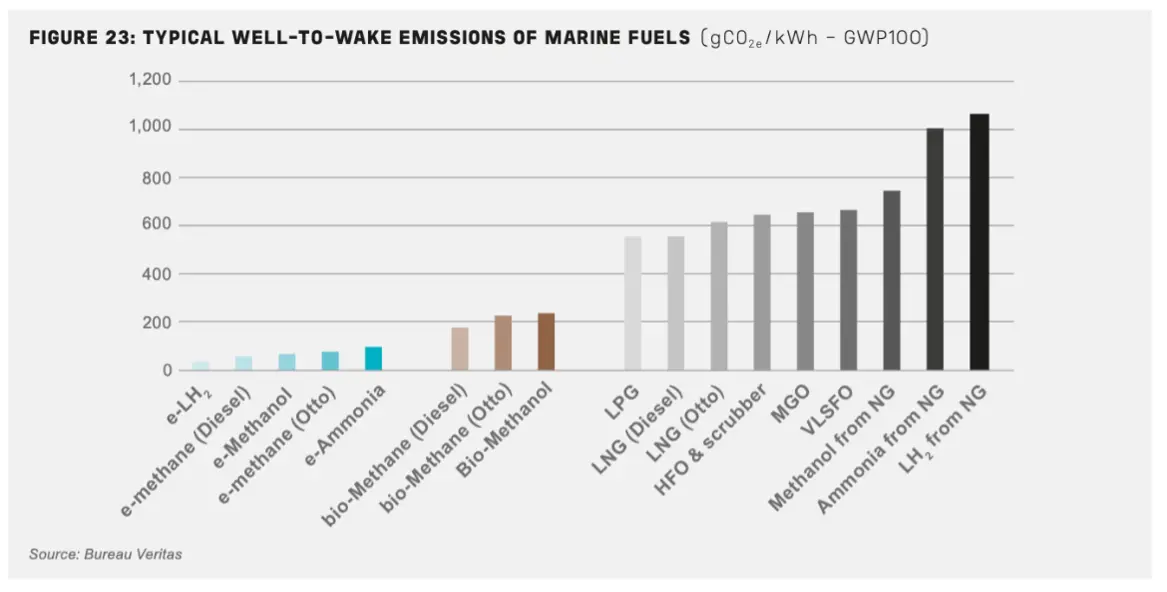
BV highlights the advantages and disadvantages of future fuels:
LNG offers an immediate CO2 emissions reduction and has a well-developed supply chain and global bunkering facilities, but is a carbon-based fuel subject to methane slip.
LPG requires lower CAPEX than LNG as fuel, but is a highly flammable gas which creates risks in the event of leaks. Additionally, marinized LPG fuelled four-stroke engines are not yet commercially available.
Methanol is a hazardous chemical that requires safety measures due to its flammability and toxicity. It is also biodegradable, water soluble and can be stored as a liquid at ambient temperatures. Based on experience gained from methanol carriers, the adoption of methanol as a fuel on merchant ships is achievable in the short to mid-term. When produced from fossil sources, it may not offer a significant reduction in CO2 emissions compared to conventional fuel oils. However, it could be competitively produced as a biofuel and from renewables and low carbon hydrogen as an e-fuel.
E-fuels will require a high level of renewable energy availability, and e-fuels production plants may have high CAPEX and OPEX requirements to remain economically viable, which will impact the cost of e-fuels. Taking into account an average e-fuels production efficiency of 50%, it is estimated that shipping industry would today require 20-24 EJ of renewable electricity.
First-generation or conventional biofuels are compatible with modern marine engines and can be used safely onboard ships. Questions remain about the full supply chain sustainability of biofuels. There is also concern about the wide-scale availability of advanced biofuels for the shipping industry, which may be in competition with other sectors.
Ammonia is a widely traded commodity already transported by the same tankers that transport LPG and other liquid chemicals with similar characteristics. Ammonia-powered two-stroke engines are under development. However, ammonia is toxic and corrosive. Its combustion should be controlled to minimize emissions of nitrous oxide (N2O), a gas with 273 times the global warming potential of CO2. Its energy density is low – about three times less than conventional fuel oils, significantly reducing space onboard for the transport of cargo.
Hydrogen is explosive and highly flammable. It also has low volumetric density, requiring ships to store significant quantities onboard or to drastically adapt their operating profiles. It must be stored using cryogenic technology at very low temperatures (-253°C), under high pressure conditions (>250 bar), or in a chemical compound (such as Liquid Organic Hydrogen Carrier, LOHC).
BV believes that assessing alternative fuel options must be done from a WtW basis to achieve true decarbonisation. Only through a complete life-cycle analysis can the environmental impact of fuels be properly evaluated. This approach requires collaboration and transparency with upstream supply and production chains.
The report is available here.