



China launches first hydrogen powered vessel
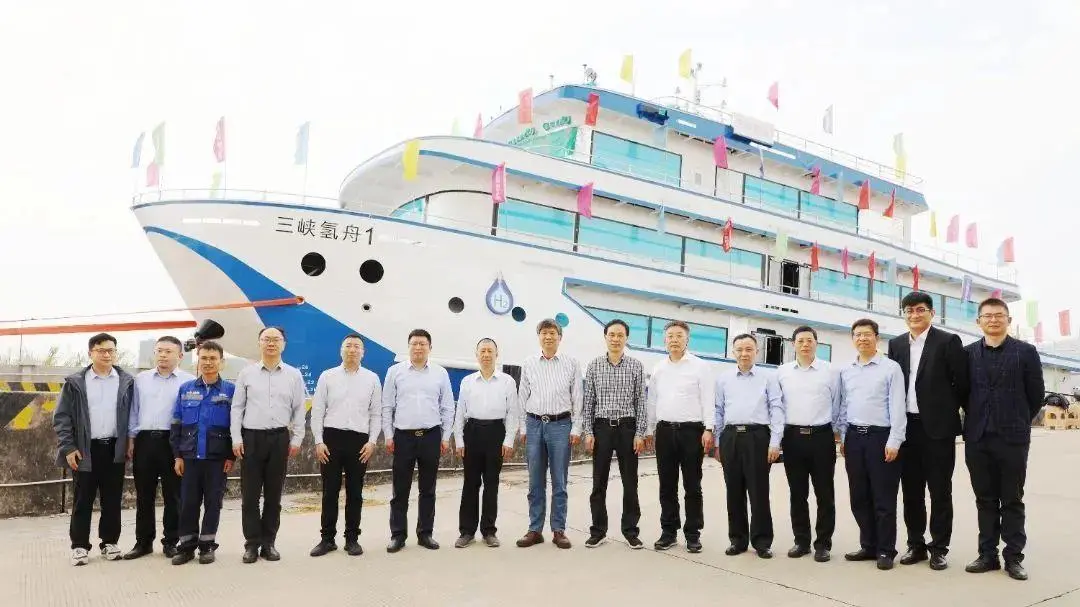
The steel-hulled, passenger catamaran was designed by Wuhan Changjiang Ship Design Institute, built by Jianglong Shipbuilding for China Yangtze Power Company, with class review by China Classification Society (CCS).
Three Gorges Hydrogen Boat No. 1 is 49.9 metres long, 10.4 metres wide, and capable of reaching a maximum speed of 28 km/h, with a maximum cruising range of 200 kilometres. The vessel will be used for traffic, inspection and emergency response in the Three Gorges Reservoir area and between the Three Gorges Dam and the Gezhou Dam.
To promote the widespread application of hydrogen energy within these Three Gorges’ waters, the Three Gorges Group has invested heavily in supporting the construction of shore-based hydrogen bunkering stations.
The vessel is powered by eight 70kW fuel cell modules located in two compartments. The storage capacity for hydrogen is up to 4,000 kWh, and a further 1,806kWh can be supplied from a lithium battery system. The motor uses direct current and has a rated power of 500kW. The power components were designed by the No. 712 Research Institute of China Shipping Group.
The performance of the fuel cell system has a big impact on the ship’s power system, says CCS, as it has good efficiency but poor response to load changes. To counter this, the Three Gorges Hydrogen Boat No. 1 has a new DC power system that, by combining the fuel cell and lithium battery, can meet the demand for manoeuvrability and power and improve dynamic response.
The vessel has obtained the characters of classification and class notations of FC-POWER 1, Green Ship-3, I-ship (M), EEDI-3 and Electrical Propulsion System, and has a higher green and intelligent ship rating. The maximum power generating efficiency of the fuel cell modules reaches 58% which greatly improves the ship energy utilization efficiency. Its DC power system results in a large increase in automation and intelligence level, says CCS.
The fuel cell system that meets the design criteria set out in the IMO’s Interim Guidelines for the Safety of Ships Using Fuel Cell Power Installations (MSC.1/Circ.1647). For example, the ship layout considers the potential for hydrogen leakage in the hydrogen cylinder storage room and the consequences of diffusion disasters.
“CCS is highly concerned about the safety and environmental protection,” said a spokesperson from CCS. “It is crucial to protect the crew and ship against the hazard of low temperature, fire and explosion and guarantee the hydrogen or hydrogen-rich fuel cell equipment has the same safety and reliability as existing equipment.
“Designing the engine room where the fuel cells are located was a top priority, so CCS led the design of the fuel cell space together with the designer. With reference to the IMO guidelines, we studied the hazardous area assessment methods of IEC60079-10, quantitatively calculated the design plan, and confirmed that the design can make the explosive atmosphere in engine room less than 1% of the engine room by volume. This will effectively reduce the risk of fuel cell engine room.”
CCS states that the implementation of fuel cells on the vessel will provide an important theoretical and experimental basis for the subsequent promotion of hydrogen fuel cell ships in China. “The Three Gorges Hydrogen Boat No. 1 is an important breakthrough in China’s marine hydrogen fuel. It will push the pace of applying hydrogen energy technology in inland waterways ships still further and help China develop hydrogen energy in the ship industry,” says the spokesperson.
“Besides, more than 20 countries have developed strategies for the development of the hydrogen industry, and people are very receptive to hydrogen ships. CCS believes that current policies, technology research, development and promotion operate in favour of hydrogen ships.”
Currently, CCS is involved with several hydrogen ships. Additionally, in June 2022, the class society issued a certificate of type approval for the first 120kW marine hydrogen fuel cell power system in China to SPIC Hydrogen Energy Company. The FCPS-S120 marine hydrogen fuel cell power system has an output voltage 450V – 750V. All its core components are designed and made in China. Also last year, CCS issued its first Test Agency Approval Certificate for marine hydrogen fuel cell testing agency to China Automotive Technology Research Institute Centre (Tianjin).
Related Articles
 BATTERIES, SUPERCAPACITORS, FUEL CELLS AND OTHER ENERGY STORAGE TECHNOLOGY
 BATTERIES, SUPERCAPACITORS, FUEL CELLS AND OTHER ENERGY STORAGE TECHNOLOGY
 BATTERIES, SUPERCAPACITORS, FUEL CELLS AND OTHER ENERGY STORAGE TECHNOLOGY