China Underpins Car Exporting Future
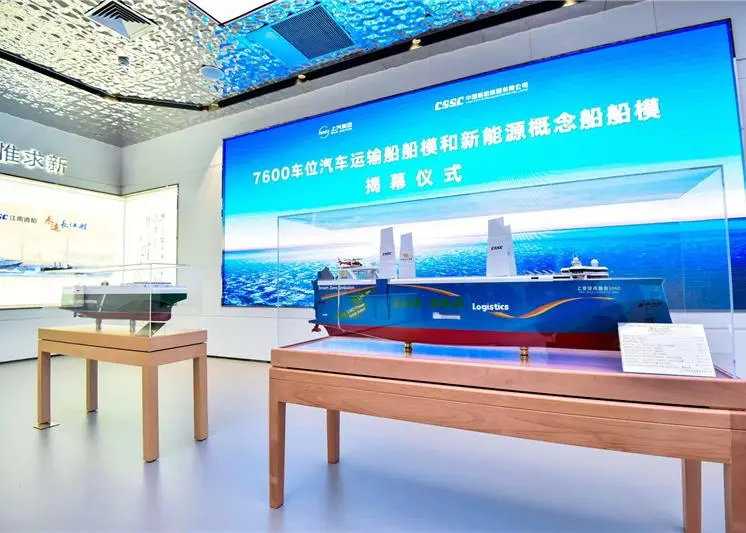
Completion dates have been stipulated in March and September 2024, respectively. The ships will assist SAIC and other Chinese producers to strengthen business in the global market. Chinese firms exported more than 2m vehicles in 2021.
Each 19-knot ship will employ an X62DF-series, two-stroke engine developed by Winterthur Gas & Diesel (WinGD), plus the Swiss-based, Chinese-owned company’s iCER exhaust gas recirculation technology, improving fuel efficiency and curbing methane slip. The project signifies the adoption of LNG dual-fuel power at a record vessel scale in the pure car/truck carrier (PCTC) category.
The newbuilds will incorporate an ‘intelligent ship’ system conceived by Shanghai Merchant Ship Design & Research Institute (SDARI).
Cargo will be carried on 13 decks, four being of hoistable type so as to facilitate various payload permutations, with access to the shore made via stern quarter ramp and side ramp. Deck heights are tailored to SAIC’s multifarious brands and ranges, not least those faring increasingly well abroad, such as MG and Maxus.
The ships’ outfit and handling procedures take full account of the technical trajectory of the motor industry and the market, by providing for battery electric vehicles (BEVs), hybrid electric vehicles (HEVs), fuel cell electric vehicles (FCEVs), and future, alternative fuel models.
Notwithstanding the payload extent, overall vessel length has been kept to just within the 200m restriction set for trade into various ports and terminals, while the post-Panamax beam has been taken out to nearly 38m.
Formerly known as Shanghai Automotive Industry Corporation, SAIC is one of the ‘big four’ state-owned automotive groups in China. Last year, COSCO Shipping Specialised Carriers revealed plans to set up a joint venture with Anji Logistics, to be domiciled in Hainan, and it is understood that the newbuilds will be deployed within this framework.
Jiangnan, part of the China State Shipbuilding Corporation, delivered China’s first dedicated car carrier, of some 4,000CEU capacity, in 1988. The yard has raised its international profile in the PCTC sphere through the construction for United European Car Carriers (UECC) of a trio of 3,600CEU dual-fuel/battery-powered vessel, the first of which was handed over last November.
The latest project for Anji Logistics bears out the unremitting Chinese bid for industrial self-reliance across the board, as exemplified in the newbuilds’ home-grown, bespoke design, ro-ro outfit, machinery, and LNG containment and gas supply system. Dual class is to be adopted, pairing notations from China Classification Society and DNV.