Design for safety approach encompasses mega-lifeboats
The project focused on a risk-based design approach, and produced a handbook for naval architects and marine engineers. Alongside this it submitted a proposal to IMO for a risk-based approval process, and generated a series of innovative ship and system designs to demonstrate the practicability of the Safedor approach. The project was led by Germanischer Lloyd and brought together 53 partners from across the industry.
With a definite eye to the future, Bureau Veritas produced a set of comprehensive guidelines covering safe applications of fuel cells on ships. BV was reported to believe that it was the lack of a regulatory framework which was likely to be the main obstacle to a wider application of fuel cells in the marine market, and so hoped to break the vicious circle where regulatory issues held back new technology.
BV is a major partner in plans to develop a hydrogen fuel cell hybrid powered tug. With Det Norske Veritas also actively involved in a fuel cell project, then there would seem to be few worries that such vessels might be delayed due to safety-related arguments.
As ships grow larger, then lifeboats follow suit, particularly for the mega-cruise ships which are currently entering service. With capacities rising to well over 5000, the thought of quickly and calmly evacuating so many people is, frankly, alarming. Maybe the cruise companies are correct in saying that the ships are their own best lifeboats. But one cannot help but remember that legendary supposedly unsinkable passenger liner that went down after contact with an iceberg 97 years ago.
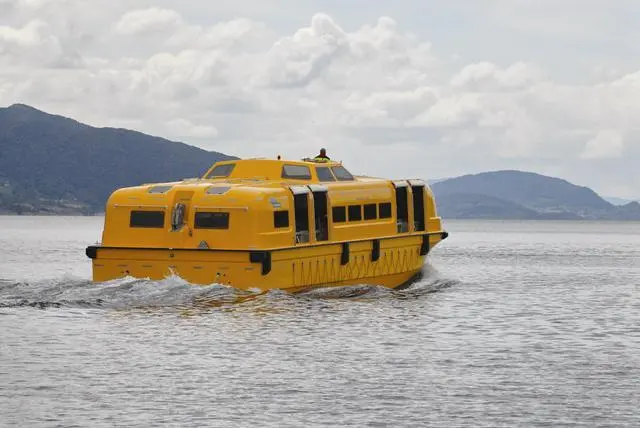
The Oasis of the Seas currently holds the ‘world’s largest’ title among cruise vessels, though it is soon to be joined by a sister ship. Capacity is quoted as 5400 passengers, although at full occupancy it could be carrying over 6000. It is equipped with 18 lifeboats, each capable of holding up to 370 people, ensuring that each passenger on board potentially has a place. But with over 2000 crew, the logistics of getting everybody to safety could pose an interesting challenge.
The lifeboats on Oasis are supplied by Schat-Harding of Norway, to the CRV55 design, with the same company’s LS45 davit systems. The CRV55 is claimed to be the only pure lifeboat with a catamaran hull, designed to provide improved sea-keeping capability and manoeuvrability.
The LS45 davit is an integrated system, newly developed specifically for cruise vessels. The lifeboats are lowered directly from the stowed position, so that no outswing is needed, and the entire boat is positioned outside the hull of the ship. The CRV55 boat itself is of FRP construction, using a vacuum moulding technique, and has a ‘green sea’ lashing system, making it secure in high waves.
Schat Harding says that it worked closely with builder STX, operator RCCL and class societies GL and DNV to find a way to improve the safe evacuation of the 8,000-plus passengers and crew, while still meeting existing SOLAS requirements. The new lifeboats are claimed to be safer and quicker to board for large numbers of people. They will also be easier to get away from the ship, because the davit does not have to move, and they will be safer once in the sea thanks to twin engines and full built-in buoyancy.
The CRV55 boat is 16.7 m long and 5.6 m wide. Each boat weighs 16 tonnes in its stowed condition and 44 tonnes when fully loaded. Two 70hp diesel engines give the boat a speed of 6 knots, and twin rudders are fitted to provide manoeuvrability.
Describing the design of the boat and davit system, Schat Harding vice president Ole Meijer says, “This is the nearest you can get to a ‘pull and go’ system. Lashing and bowsing are integrated and embarkation is at the stowed position through four colour-coded doors leading to ergonomically-planned colour-coded seating areas arranged on two levels. I believe this is the first of a whole new generation of very large and very safe lifeboats.”
Royal Caribbean agrees, saying that the design of the lifeboats ensures that safety remains the number one priority, and describing them as “superior rescue vessels, and ships unto themselves”. The operator likes the full redundancy, and the fact that minimal preparation is needed for launch.