Driving LNG innovation in North America
In 2010 when the North American Emission Control Areas (ECAs) were announced, it became very obvious that liners spending significant time in these zones needed to seriously consider the consequences of these regulations. Clearly traditional bunker fuels are part of the environmental concerns and need to be addressed when looking for ways to comply with the new regulations. The need for change is fairly obvious but as always, change is difficult. For Tote, a company that operates in some of world’s most pristine waters and almost always within identified ECAs, and takes its environmental and social responsibilities very seriously, it was clear that the time for bold action was at hand. The answer clearly did not lie in how we burn residual fuels; it was the fuel itself that needed change.
After years of review and dialogue, natural gas emerged as the fuel source that exceeded all known and anticipated environmental standards. In addition, liquefied natural gas (LNG) was already being tested as a transportation fuel for trucks and smaller vessels in Northern Europe.
Natural gas is lighter than air and, when liquefied, is safe to store and transport. Vessels carrying LNG as cargo were already using their cargo to fuel the vessels, proving that acceptable marine engine technology is available. However, LNG as a fuel was not readily available in the U.S. maritime sector. It was clear that in order to mitigate fuel supply risks, in addition to burning LNG, marine engines would also need to be able to burn traditional fuels such as marine gas oil (MGO) or marine diesel oil (MDO). This would lower the risk for a company converting to LNG allowing multiple fuel types to power the ship depending on deployments and natural gas infrastructure.
With leading engine manufacturers moving ahead with dual fuel technology in both the medium and slow speed markets, as well as experimenting with conversion of existing installed inventory, the time appeared right for an innovative, groundbreaking and brave decision.
Making the switch
In 2012 Tote’s parent company, Saltchuk, a family-owned private company based in Seattle, Washington, approved a plan to convert their ten year old Orca Class ro-ro vessels that serve Alaska to LNG. A major engine manufacturer agreed to develop conversion kits for the Orcas and discussions were soon opened to develop LNG fuel supplies in Tacoma, Washington, the Orcas’ homeport. Following this landmark decision, Tote’s Puerto Rico service operating from Jacksonville, Florida also faced a refleeting decision. In keeping with the company’s commitment to the environment and the communities it serves, a decision was made to build new Jones Act vessels with dual fuel capability at the NASSCO Shipyard in San Diego. NASSCO had built the Orcas and Tote and Saltchuk had confidence the yard could build a quality ship, on time and on budget.
Tote now had both a shipbuilding and a conversion project that would require LNG fuel availability in Tacoma and Jacksonville, the northwest and southeast corners of the U.S. It became immediately clear that vessels could be converted or constructed much faster than LNG liquefaction facilities could be designed, permitted, built and commissioned. This led to another interesting set of challenges. Tote needed a long term, sustainable supply of LNG as well as a short term supply to bridge the time from vessel availability to long term plant development and commissioning.
Tote had a lengthy project list it needed to complete in order to successfully implement its broad LNG strategy.
• New build – the Marlin Class with slow speed dual fuel engines.
• Engine Conversion –the Orca Class medium speed reengine to dual fuel LNG
• Long term LNG supply at the Port of Jacksonville and the Port of Tacoma
• Short term supply at the Port of Jacksonville and the Port of Tacoma
• Transfer capability of LNG fuel to a ship, both short term and long term
In short, in one broad project plan, Tote was addressing almost every aspect of maritime LNG development. While others were looking at various pieces of the puzzle, this project, once commenced, would require all the elements be addressed in tandem in order to enable Tote to complete its transition to LNG.
Building supply
One of the key challenges was how to bunker LNG. Neither the Port of Tacoma nor the Port of Jacksonville had any available or planned LNG liquefaction capability. Tote quickly realized it needed partners who shared the vision of maritime LNG and had the expertise, desire and financial capability to provide LNG in a timely manner.
Tote had one significant advantage with vessels committed to specific deployments and weekly calls at our base ports of Jacksonville and Tacoma. This allowed us to look for long term partners that would make investments in LNG liquefaction plants and storage supported by long term commitments for off take.
After an exhaustive and lengthy review of long and short term partners, Tote entered into a long term LNG supply contract with JAX LNG, a joint venture between Pivotal LNG, a subsidiary of AGL, a leading energy provider in the U.S. and Wespac Midstream which would service LNG requirements in Jacksonville. In Tacoma, Tote chose Puget Sound Energy (PSE). Identifying strong, knowledgeable and committed partners was a critical component and one that cannot be underestimated. Both partners also brought short term supply capabilities from existing peak shaving facilities, critical to the overall success of Tote’s projects. Once the partnerships were established, identifying LNG plant location became critical.
In Jacksonville, it was not possible to locate a liquefaction plant at or in close proximity to the vessels’ berth. However, JAX LNG purchased a suitable plant site close to the existing container terminal that served Tote’s vessels. This industrial site had suitable gas pipeline connections as well as a pier capable of safely mooring a bunker barge. Road access was also good for other potential users of the LNG. Barge distance from the LNG facility to the Tote facility is about one mile. Truck transfer (short term) and a barge (long term) will transport LNG to the vessels. Long term, it is possible that technological advancements may lead to an underwater cryogenic pipeline.
In Tacoma, land was available within a few hundred yards of the Orca vessels’ berth. This site also had pipeline access for gas supply and could bunker the vessel via a cryogenic pipeline, thereby negating the need for a bunker barge long term. There are also water-side berthing facilities available for a bunker barge to service other LNG users once the plant is operational.
A key component of the LNG bunkering process is that liner vessels must bunker while cargo is being loaded in order to insure the ships stay on schedule. While time is vital in any trade, it is especially critical in the domestic trades that are an extension of the mature logistics chains that larger retailers and other customers have come to rely upon.
Since the larger liquefaction plants would not be ready for the vessels arrival, the interim supply from existing peak shavers was a concern. For the Marlin Class vessels in Jacksonville the supply was coming from 200-400 miles away. This would mean an extended supply chain. It was also noted that each tank trailer requires about an hour to discharge its LNG load. With 200,000 gallons of LNG required for each vessel’s bunkering event unloading approximately 20 LNG road tanks was a serious issue for schedule reliability. The solution was very straightforward; unload four tanks at a time therefore keeping the bunker event to approximately six hours. Since the berth where the vessel stevedores has multiple uses, the device designed to transfer the LNG needed to be mobile. As the tanks represented a substantial long term investment it was decided to utilize ISO type tanks, built to specification that could be repurposed as needed in commercial maritime service.
For Tote’s Tacoma based Orca Class vessels, interim fuel will source from British Columbia. Once the Tacoma LNG plant is completed the Orcas’ will bunker from a cryogenic pipeline that will run directly from the LNG Plant to the vessel.
In order to fuel the vessels in Jacksonville in the longer term, Tote is building the first U.S. LNG bunker barge at Conrad Shipyard in Orange, Texas using GTT membrane technology.
Current status
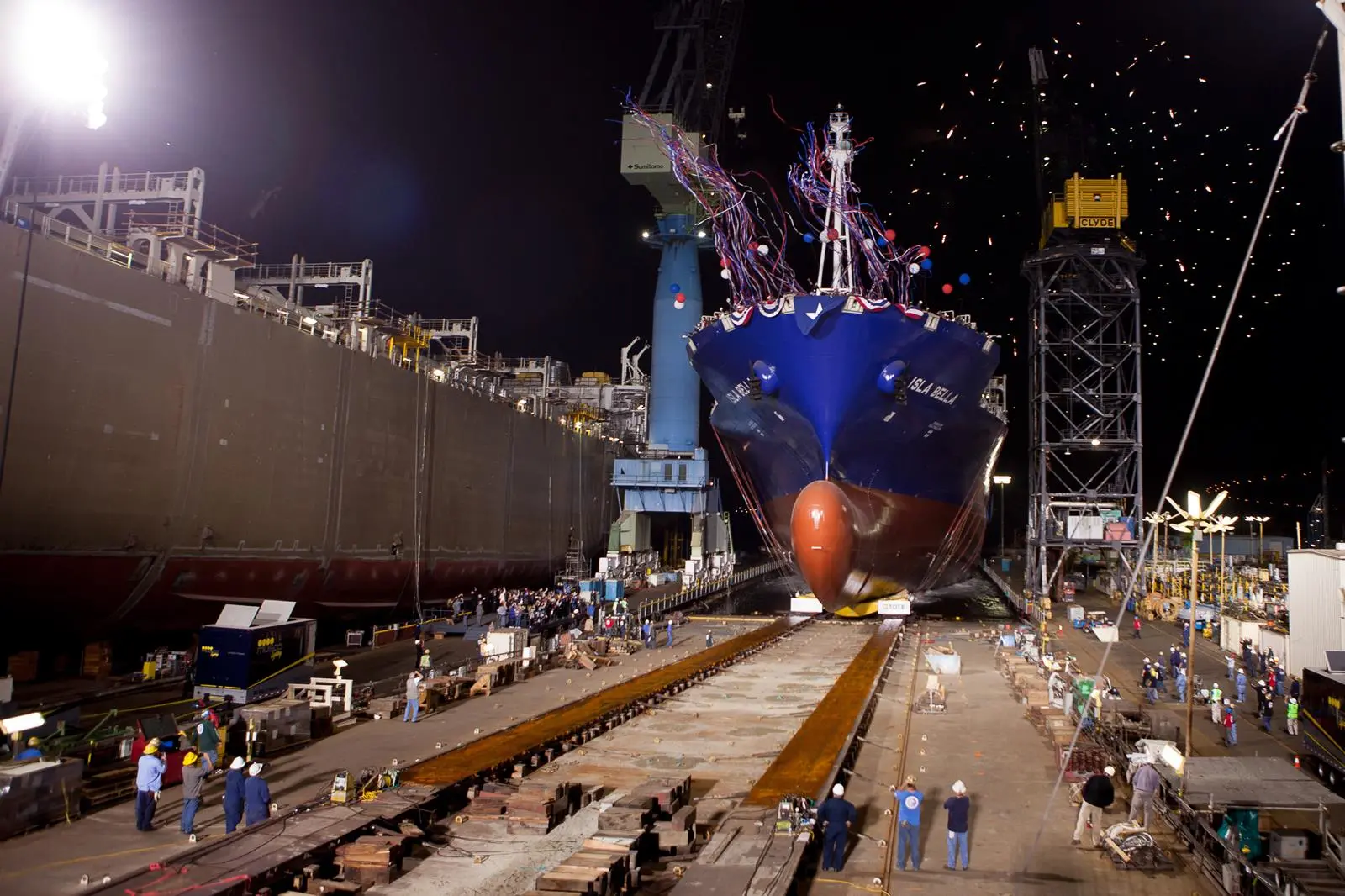
As of September 1, 2015, Tote has launched both of the Marlin Class ships, Isla Bella and Perla del Caribe, at the NASSCO shipyard in San Diego. Isla Bella is scheduled to enter service in the fourth quarter of 2015. The second ship is scheduled to enter service in the first quarter of 2016.
Tote’s first Orca Class ship is tentatively scheduled to begin her conversion in November 2015 to be complete in the first quarter of 2016. The second Orca Class ship will begin her conversion in November 2016.
Both LNG liquefaction facilities are currently undergoing final permitting reviews and are expected to break ground and commence construction in the near future.
The coordination and management of all of these projects has been a function of Tote’s outstanding partners who have been and will remain the primary keys to success. Pulling together key supply partners that include Pivotal LNG and Wespac Midstream (as JAX LNG), Puget Sound Energy (PSE) and their partner Fortis Canada have insured us of consistent and dependable supply of LNG for many years to come. Tote’s other major partners, Applied Cryo Technologies (ACT), CH-IV, Moffatt and Nichol, and Conrad Shipyard provide expertise and forward thinking that help make these leading edge ventures a success and set a course for a new, environmentally friendly maritime industry.