Dual class for icebreaking gas carriers
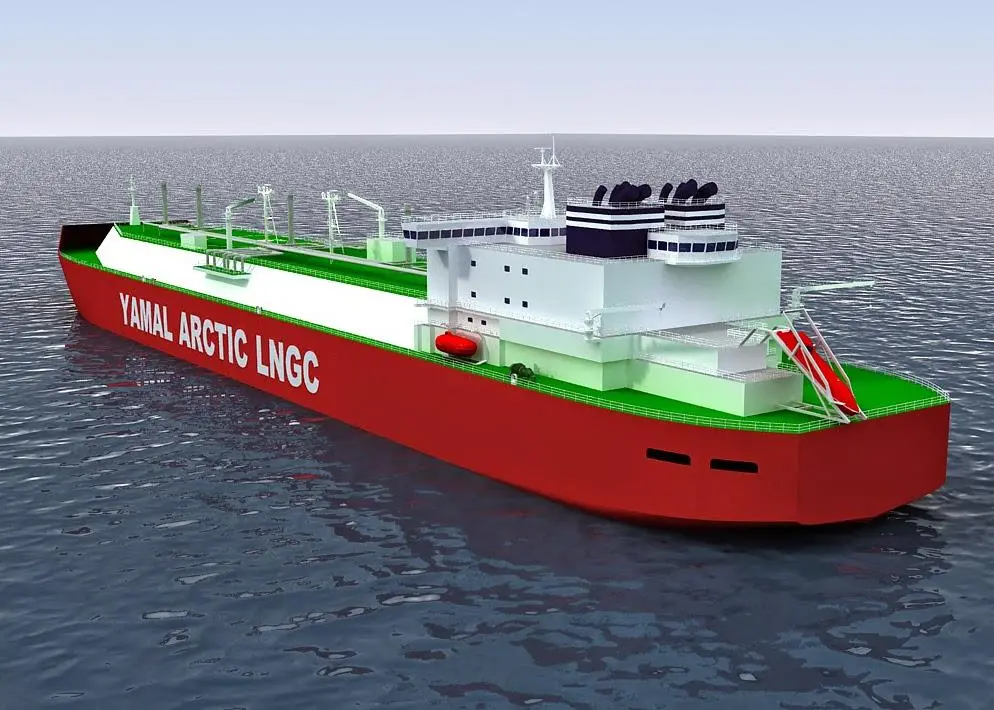
The 15 vessels, each with capacity for 172,000m3 and capability for breaking ice up to 2.5m thick, will be built by Daewoo Shipbuilding & Marine Engineering. Yamal LNG has awarded the ships to Sovcomflot (one vessel), MOL (three), Dynagas (five) and Teekay (six).
Philippe Donche-Gay, executive vice president and head of Bureau Veritas Marine and Offshore, said: “We have made extensive investments in research into ice loads and navigation in ice, working with major Russian institutions and Asian shipyards. This effort, coupled with our world-leading expertise in large LNG carriers gives us a strong technical base to class these highly sophisticated vessels.”
The 300m long vessels will carry LNG in four NO 96 membrane tanks from GTT. The hull features a moderate ice bow forward and a heavy icebreaking profile aft. The astern, heavy icebreaking mode is enabled by a propulsion system of three pods delivering around 45MW of power. Separate engine rooms, encased in a double hull to give protection from the ice and a high level of redundancy, house the vessel’s diesel generators.
The ships will be built to Russian Register Arc7 standard for year-round operation in second-year ice with old ice inclusions with ice thickness of 2.5 m. Bureau Veritas winterization notation COLD (-45,-52) will mean that the hulls are prepared for operation in -45°C ambient temperature, while equipment should work at -52°C.
A forward and aft ice belt will add strength to the hull in key areas, while a detailed fatigue life analysis – using Bureau Veritas’ IceSTAR tool – will ensure that the structures can withstand the expected extreme stresses.