



Dutch Training Vessel Features PEM FC
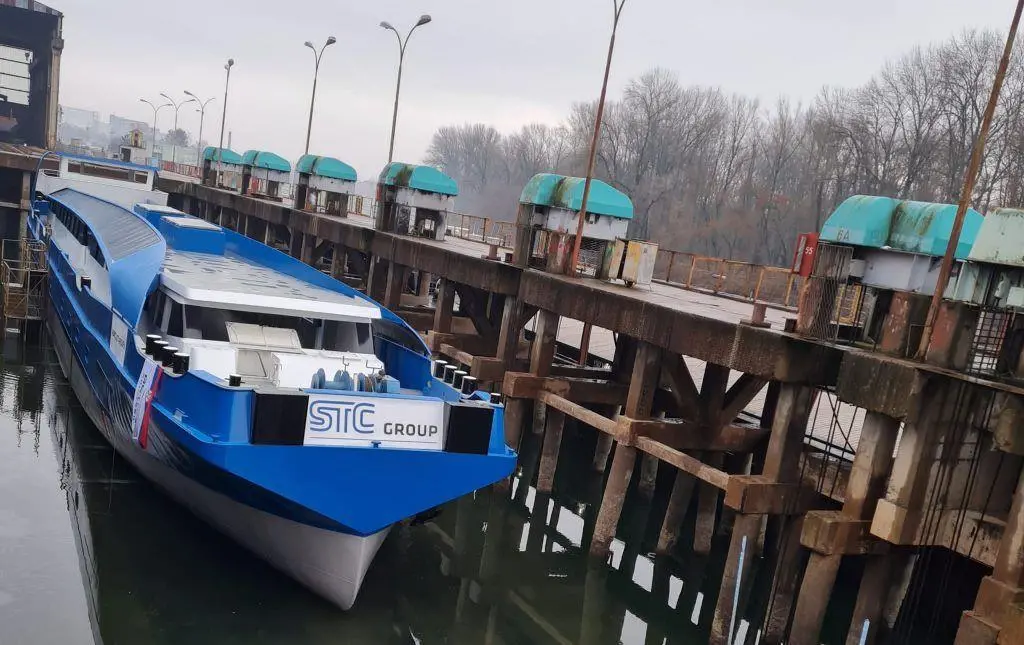
Purpose-designed for students of maritime courses related to inland shipping, the 67m futuristic-looking Ab Initio is equipped as a learning and operating platform, and technology demonstrator, in keeping with the rapid pace of change taking place in the sector. ‘Sustainability’ is to the fore in the newbuild, which incorporates a hybrid diesel-electric propulsion system with battery pack, a 200m2 solar panel array, and hydrogen fuel cell.
The project was initiated in 2018 by the Rotterdam-based training specialist STC Group, backed by a grant from the De Verre Bergen Foundation- (SDVB) and with subsequent sponsorship from a wide range of organisations, including marine equipment companies and Rotterdam’s port and municipality.
The focus from the outset was on achieving a state-of-the-art training ship, drawing on the latest insights and developments from the Dutch maritime sector, and raising the appeal of careers in the industry for young people. The newbuild award to Concordia Damen was announced in April 2020, whereupon hull construction was assigned to a yard in Serbia, with outfitting to be undertaken at the main contractor’s Werkendam premises on the Nieuwe Merwede waterway in the southern Netherlands.
Ab Initio (Latin for “from the beginning”) will replace two STC training ships dating from the 1960s, both of which were bought by Concordia Damen in conjunction with the newbuild deal.
The vessel will cater to pre-vocational secondary education (Dutch VMBO level), intermediate (MBO) and higher vocational (HBO) students who are following a maritime education programme at STC. There are 39 berths aboard, providing for up to 30 students plus crew and training staff.
Besides the primary role in developing and instructing future masters, deckhands and technical personnel, the vessel will double as a field laboratory in which companies can trial new equipment and technology, in collaboration with HBO-level students. The socio-economic dimension to the project, as reflected in SDVB funding plus local authority and government support, is to contribute to Rotterdam’s future maritime standing to the benefit of the community. This includes introducing pupils from vulnerable Rotterdam neighbourhoods and enthuse them for a maritime career.
Dutch consultancy C-Job Naval Architects provided the design, which draws only 1.8m and has been conceived to allow flexibility and facilitate through-life updating as regards powering. While a hybrid configuration was foreseen from the outset, the decision to also install a fuel cell module was only made by STC during construction, which necessitated a substantial increase to the original budget, achieved through subsidy applications and sponsorships by members of the maritime cluster.
STC’s rationale for the addition to the technical specification was the expectation of a growing role for hydrogen in the shipping industry. Zepp Solutions was accordingly nominated to produce and supply an integrated 45kW fuel cell system and 35kg-capacity hydrogen storage. The fuel cell will serve as a range extender, charging the vessel’s battery system. The compact nature of the module is a key characteristic, and the minimisation of critical interfaces and incorporation of all sub-systems reduces integration complexity and cost and makes for a ‘drop-in’ solution.
The adoption of fuel cell technology has meant that sailing duration in emission-free mode has been very substantially increased, potentially doubled, from the four hours initially envisaged on the 400kWh battery installation alone. Bunkering hydrogen, which will take place in Rotterdam, and working with the proton exchange membrane(PEM)-type fuel cell will form part of the students’ learning process.
The possibility of retrofitting larger fuel cells or alternative, zero-emission energy systems to replace one of the two generators in the future has been taken into account in the layout and construction of the vessel. The drive train is modular, and the Stage V-certified generators can be accessed or lifted from above through hatchways. One of the aggregates is a 600kW KEES generator from Koedood, which uses Mitsubishi high-speed engines, and the other is a 280kW set from Volvo Penta.
The propeller is driven by an Oswald permanent magnet propulsion motor, and De Waal supplied the complete, oil-lubricated shaft installation and seals, low-resistance Easyflow rudders and steering gear.
A dedicated training room provides a view through sound-proof window to the engine room in the stern section, so that instruction to students can be carried out without disturbing operations. Furthermore, the vessel has been modelled on STC simulators, and is to be equipped with sensors to facilitate remote monitoring of operational data and consumption and for maintenance purposes.
One facet of ‘hands-on’ training is the vessel’s push bow and coupling winches, so that students can learn how to handle barge coupling and uncoupling procedures.
The hull was built at the Apatia yard in Serbia, with support from Gebr de Jonge Shipbuilding Services. The ‘casco’ was then transferred by push tugs, via the Danube, Rhine, Waal and Merwede, to Concordia Damen at Werkendam, where outfitting and completion work was carried out in cooperation with local subcontractor CCM3.
The Netherlands has the largest inland shipping fleet in Europe. The continuing national and industrial commitment to transport by water, with fleet investments increasingly shaped by ‘sustainability’ goals, highlights the importance of accompanying investment in the people to operate the vessels.
Related Articles
 BATTERIES, SUPERCAPACITORS, FUEL CELLS AND OTHER ENERGY STORAGE TECHNOLOGY
 BATTERIES, SUPERCAPACITORS, FUEL CELLS AND OTHER ENERGY STORAGE TECHNOLOGY
 BATTERIES, SUPERCAPACITORS, FUEL CELLS AND OTHER ENERGY STORAGE TECHNOLOGY