ECDIS features information overlay
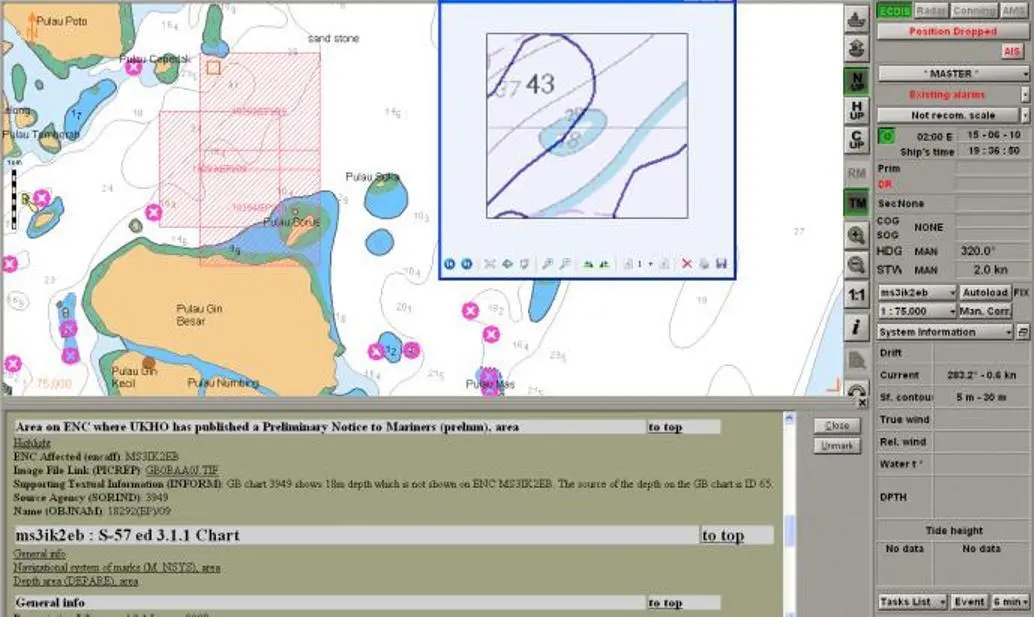
The overlay is displayed as a single layer on top of the basic ENC and it will be available within the standard Transas Admiralty Data Service (TADS) license, via the Transas Navi-Sailor ECDIS.
Transas says that UKHO has developed the new AIO to give seafarers an easy way to view the information that they need in addition to the standard chart, to navigate safely and compliantly. AIO is intended to make passage planning simpler and safer by clearly showing where important temporary or preliminary changes may impact a voyage. It will also give seafarers the same consistent picture of the maritime environment on ECDIS as they have always had with Admiralty paper charts.
As a result, shipping companies will be able to comply more easily with Port State Control requirements by providing T&P MNs where they do not currently exist in ENC coverage today. It will also help simplify their transition to digital navigation.
Soren Andersen, marine superintendent, SQE at Nordic Tankers Marine says: “We are using the AIO as an integral element of our ECDIS-based navigation within the Transas Navi-Sailor ECDIS. Used as a navigational and planning aid as part of the company’s wider move to adopt ECDIS navigation, the overlay is making passage planning and the task of keeping track of the latest ENC updates much easier. It will also make it easier for our crews to demonstrate compliance during PSC inspections. Overall, it has proved to be another important element in our efforts to continually improve the safety and efficiency of navigation.”
Michael Cauter, deputy chief executive with responsibility for developing new Admiralty products and services said “The marine environment is constantly changing. The AIO is needed because many nations don’t yet include important temporary or preliminary notifications of those changes in their weekly updates, and even when they are included, they can be difficult to identify within the ENC. AIO provides this information on top of the ENC and displays it clearly and consistently so the mariner can instantly see the impact of changes on a route and can take appropriate action.”
The AIO is intended as a further step forward in supporting the transition to digital navigation and ensuring vessels continue to sail safely, compliantly and increasingly more efficiently.
Training aids
Transas Marine has launched its ECDIS Computer Based Training course certified by Germanischer Lloyd.
Transas says that ECDIS is becoming a significant part of maritime navigation, so it is vital that crew members have appropriate knowledge in the use of the navigational equipment and charts. Transas ECDIS CBT is based on IMO Model Course 1.27 considering the requirements for ECDIS training in accordance with the Manila Amendments of STCW. The courseis designed to provides the necessary knowledge and skills involved in the use of all-important ECDIS features. Completing the course gives an understanding of both the benefits and limitations of ECDIS, together with an understanding of how it can be used for navigation, route planning and monitoring, display of navigation data, performing updates etc.
The complete course comprises 17 chapters and tests split by themes: ECDIS Theory, Basic functions of ECDIS, Operational Use of ECDIS, Errors and Malfunctions in ECDIS.
The combination of theoretical and practice parts enables trainees to gain knowledge about the system they operate. A trainee receives a certificate proving successful completion in order to prove equipment specific familiarisation. With this certificate the trainee may join a time reduced ( two day) course in a Transas approved training centre to gain a full GL-certified IMO Model Course 1.27 certificate in accordance with STCW.
Transas ECDIS CBT is supplied together with free ECDIS demo software developed to demonstrate the main ECDIS functionality and for training purposes. It includes simulation of navigational data (own ship and target motion, radar pictures and ENCs) and pre-set scenarios that display full-scale navigation situation.
The course is available in English on DVD or online. It can be undertaken either onboard ship or ashore and is intended for individual self-study.