Efficiency drives cargo system developments
DNV and Bergen-based open hatch bulker operator Greig Star recently unveiled the results of a joint study into the energy saving potential of a battery hybrid system for operating electric cargo cranes on the next-generation Greig bulkers.
The study concludes that the hybrid ship crane proposal can achieve a payback time of under one year, maybe less depending on fuel cost rises and the final cost of the battery pack, with fuel savings of around 30%, with corresponding environmental benefits.
The study set out to simulate crane operations on one of Grieg Star’s open hatch vessels. DNV simulation tool COSSMOS was used to model a conventional and a battery hybrid power production system on board the vessel. The simulation included four cranes using a conventional system of diesel generator sets to produce electric power while the hybrid system had a lithium-ion battery installed. Rather than the standard three diesel gensets, running inefficiently at low load most of the time, the hybrid system used just one genset, with a second for redundancy, running at optimum load, in combination with regenerative braking from the crane motor when the cargo is being lowered, to charge the Li-Ion battery pack which powers the cranes.
The combination of shipowner knowledge and a detailed simulation of the second-by-second ship operations showed that the battery hybrid cranes used 30% less fuel, could achieve annual savings of $110,000 and had less than a year’s payback time.
CARGO ACCESS
Traditional cargo access equipment can benefit from electric, rather than hydraulic operation. One of Cargotec company MacGregor’s core markets is ro-ro gear, and it recently secured orders worth around €10 million to deliver ro-ro cargo access equipment for four 6,700 unit PCTCs to be built in China. Two, to be built at Jinling shipyard will have electrically-operated internal ramps, with conventional operation for the other two ships, ordered from Samjin Shipbuilding
MacGregor has developed an offshore deck crane featuring three-axis motion compensation designed for installation, repair, maintenance and general service applications. Its first installation will be on a 74m infield support vessel, Siem Moxie, being built at Fjellstrand shipyard in Norway for Siem Offshore. The crane has a safe working load of 5t at 25m outreach.
“This crane is a first of its kind, not just for MacGregor, but for the offshore industry,” saidf Frode Grøvan, director, sales and marketing, advanced load handling. “Siem Offshore approached MacGregor’s competence centre in Kristiansand, to develop the crane especially for the vessel.”
One specific task for Siem Moxie will be to transfer equipment to the top of offshore windmill foundations to install power cables and other apparatus, for which a greater degree of precision is required than with standard active heave compensation (AHC). The crane has a hydraulically-tilting foundation, and is mounted at the centre point of the vessel.
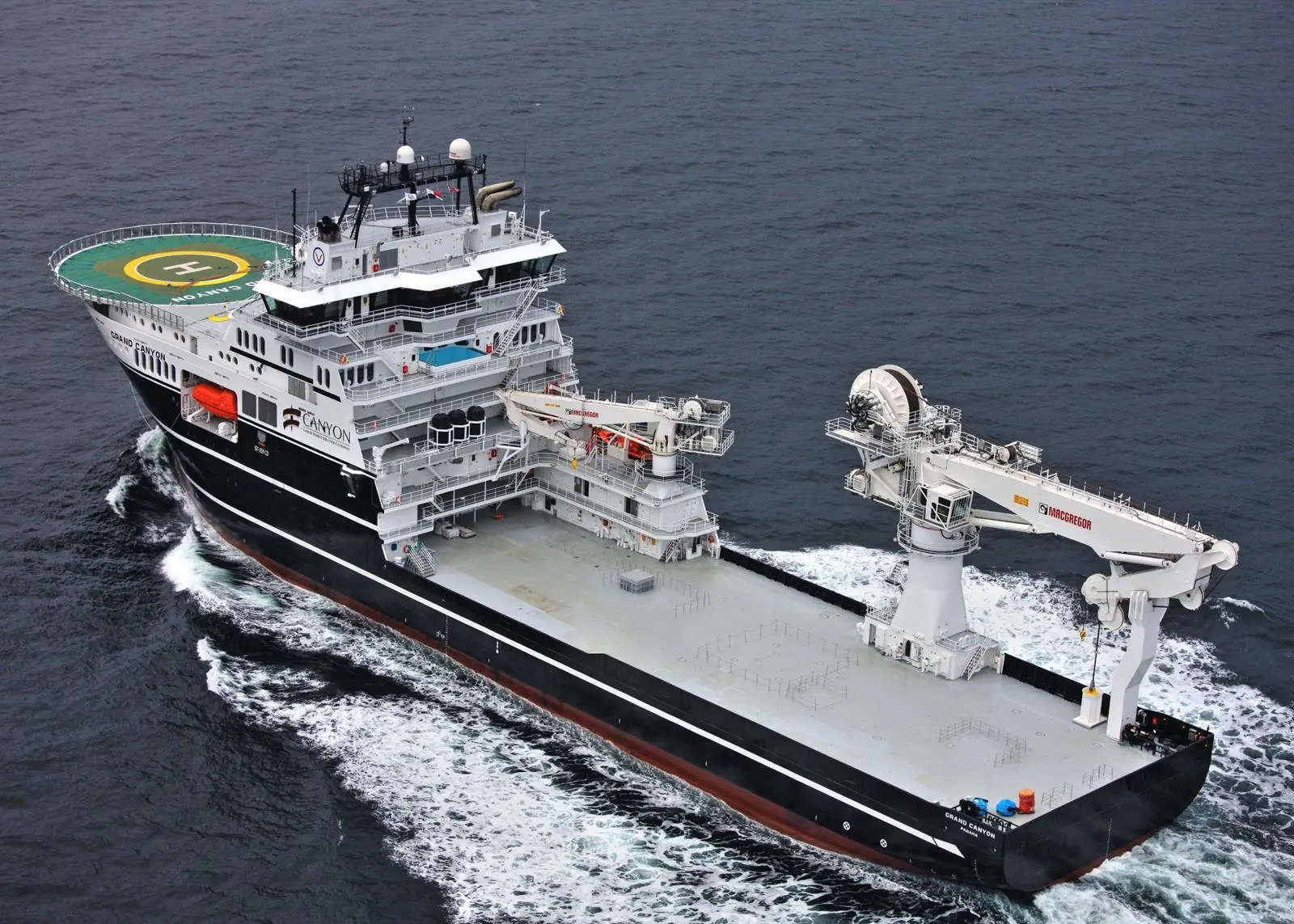
MacGregor has secured its third identical offshore crane contract for a series of 125m OCVs being built by Bergen Group Fosen shipyard in Norway for Volstad Maritime. Two more cranes have been ordered for the third in a series of Skipsteknisk ST-259-CD design sisterships. As with the two previous orders, the OCV will feature a 250-tonne subsea crane and a 15-tonne offshore crane. The delivery is scheduled for August 2014.
MacGregor has secured new offshore winch contracts from three Chinese shipyards, Fujian Southeast, Fuzhou Baima and Guangdong Yuexin Ocean Engineering. The winches are destined for 22 AHTS vessels under construction for various owners.
The scope of deliveries includes windlasses, mooring winches, capstans, tuggers, anchor handling/towing winches and storage reels; some of the vessels will also be fitted with MacGregor shark jaws/towing pins.
A new simulation platform from MacGregor, C-How, allows customers to run particular equipment through various simulated conditions and operations so that better decisions can be made and skills can be attained.
According to Frode Grøvan, sales and marketing director for advanced load handling: ” C-How is modular and scalable, so modules can be added or removed as requirements change. Furthermore, its use is not limited to MacGregor equipment; it can be tailored for products from other manufacturers installed on our customers’ vessels.”
At a basic level, C-How can be used as an interactive calculation tool, while at the other end of the scale it can be incorporated in hardware such as advanced crane simulators.
SHARK JAWS
Crane manufacturer Triplex has secured a new order for its MDH 42 from BOA Offshore, which includes shark jaws, vertical guide pins and spooling block, for a VS 491 AHTS, with an option for a second. The company says that BOA is the third shipowner in Norway to opt for the MDH on its AHTS vessels. The MDH-system includes a range of safety features, such as separate wire clamp for controlled spin-out of twisted wires, dedicated manipulator arm for fine operations, two cameras, floodlights and manipulator tools to catch buoys and pennant wires automatically. The BOA crane will be prepared for handling polyester mooring lines up to 260mm, and for ROV and oil recovery operations.
Mitsubishi Heavy Industries recently signed an agreement with STX Construction (Dalian) to license production and marketing of MHI’s marine deck cranes. MHI has agreed similar licences with Jiangsu Masada Heavy Industries of China and SPP Machine Tech of Korea. The STX licence covers two 30t capacity crane types, with working radius of 26m and 28m. MHI will supply STX with components, including hydraulic machinery.
iMPROVED PIPELAYING
Ulstein of Norway says that it is currently customising its chain type stinger handling system concept for three different companies. The system aims to improve offshore pipe-laying operations through increased efficiency and greater depth capability, while reducing capital and operating costs.
Market demand led Ulstein Idea Equipment Solutions to develop the chain type stinger handling system. The system is characterised further by its small footprint, and is based on hydraulic chain pull units, which can be quickly removed by simply removing some pin connections and some connections at the manifold. By its nature this system does not require an A-frame, and it can be easily upgraded to avoid slack chain due to stinger uplift.
GAS HANDLING
As part of a complete propulsion and equipment package, Wärtsilä is to supply cargo handling systems for a series of Dragon 27500 LNG carriers being built for Danish operator Evergas, at the Sinopacific shipyard in China. The ships are designed to carry and reliquefy Ethane and LPG as well as LNG, and the Wärtsilä cargo handling package will reflect this.
“The customer’s essential requirements for these vessels are to achieve the operational and fuel efficiencies needed to optimize their operating costs,” said Aaron Bresnahan, vice president sales, Wärtsilä Ship Power. “The advanced technology solution to be provided by Wärtsilä, whereby the cargo handling system, the gas supply system, and the propulsion machinery are fully integrated with each other, will make the vessels the most modern and environmentally sustainable LNG carriers ever built.”
For example, the LNG supply system is integrated with the cargo handling system so that it can be used to cool the cargo. In so doing, less energy is needed to control the cargo temperature.
TANK INVENTORY SYSTEM
UK company PSM Instrumentation has supplied a simple but highly functional system solution to a shipyard in Turkey. The company says that there are many inventory systems available for tank gauging, mostly focusing on the high-end of the market, where custody transfer or fiscal billing necessitate a complex and expensive system of radar level transmitters, temperature profiling probes and calculation software. In this case the shipyard sought a simplified option for a new build product tanker, and PSM proposed its TankView ict 1000 hydrostatic level transmitter, which it said could provide the required accuracy while reducing the cost of the complete installation.
For each of 12 tanks, a type-approved PSM ict 1000 transmitter connected to a central display and control unit using PSM connection modules in a Modbus communication loop. This digital architecture is claimed to provide 0.1% measurement accuracy while reducing cable and installation complexity. This was important in order to reduce installation and commissioning costs and ensure build deadlines were met. One level and one temperature transmitter were installed per tank, plus two additional level transmitters for heel and trim measurement to correct the tank level measurement for vessel orientation and draught.
The central unit is a Windows PC running PSM’s TankView software package, configured to suit the geometry of the tanks and the density and temperature characteristics of the products. Each cargo type is available to the crew in a library of product choices, providing inventory readings in temperature corrected volume and mass units. The system can assign low and high level alarm points on each tank, and provide historical records of cargo level movement.