



Electric pusher designed for Europe inland waterways
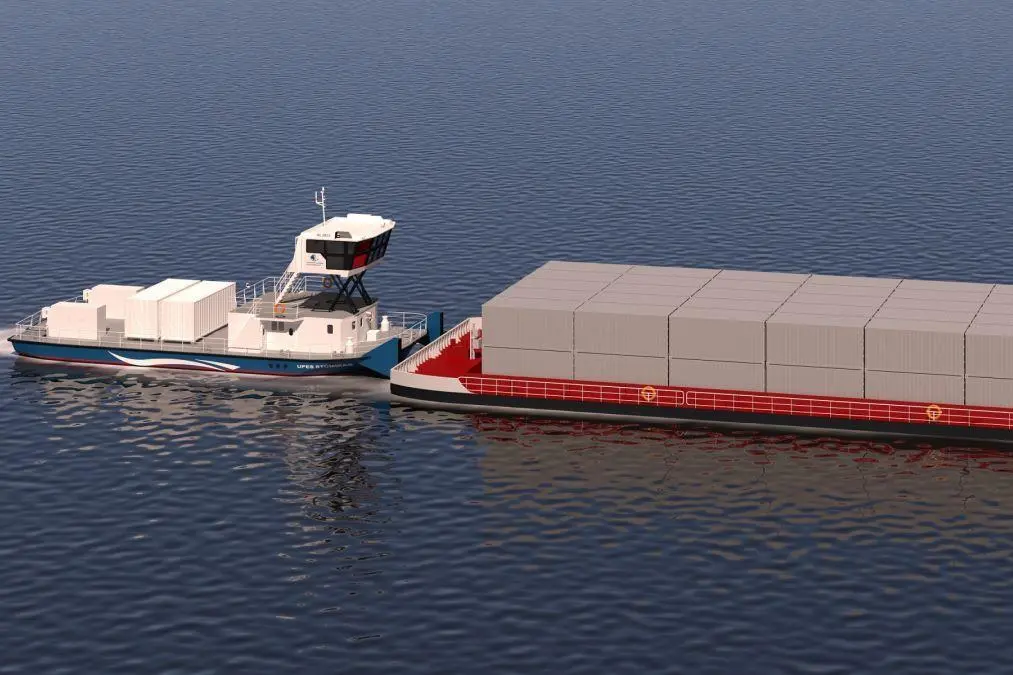
The first Electric Eel is due to be built next year for the Lithuanian Inland Waterways Authority.
The vessel is designed to replace diesel pushers which presently dominate the market for ‘pushing’ non-propelled barges around Europe’s inland waterways.
The pusher design is pending class Approval in Principle with Bureau Veritas and can operate at a range of 300km before needing to stop. The 26m long vessel is powered by three DNV approved batteries with a combined weight of 74 tonnes, two held in TEU containers on deck which can be replaced via crane at harbour, and one permanent battery below deck which can be charged at quayside.
The vessel has a pushing capacity of 2,000 tonnes and a top speed of 22km/h downstream at 85% engine load. The electric batteries create an engine power of 500 HP/400kW compared to a diesel equivalent which has 1000 HP/800kW.
WBE is producing the concept just as the European Union is ramping up pressure to shift freight to Europe’s Inland Waterways via more green powered vessels.
WBE’s Head of Sales & Marketing, Eglė Mikalauskienė, said: “The Electric Eel has huge potential to help cut carbon emissions on inland waterways across Europe and worldwide. The idea came after we were approached by the Lithuanian Maritime Cluster to see if we could help the Lithuanian Inland Waterways authority create an eco-efficient pusher.”
The biggest design challenges were weight and draft. The Lithuanian inland waterway is very shallow so the design needed to be as light as possible, no more than 195 DWT, with a draft not greater than 1.2 metres. “We have created a super-efficient hull design which will operate brilliantly on shallow waters in Europe and around the world,” said Mikalauskienė. “Through trial and error using rigorous computerised fluid dynamic (CFD) testing we have produced the smoothest possible hull resistance. We’re also using thin lighter steel, approved by class, to reduce weight while at the same time keeping safety of paramount importance. In addition, we have innovated the wheelhouse, using a jack up design made of aluminium, again to spread and reduce weight.”
Another innovation on board is the use of a wind turbine to generate 5kw of additional electricity for lighting, the galley and crew facilities.
The authority has big plans to ramp up use of the 450km stretch of waterway between Klaipeda on the Baltic Sea to Kaunas to switch cargo from the road network in line with EU policy. The authority estimates the pusher can help remove 10,000 trucks a year from Lithuania’s roads.
There are 41,000 km of inland waterways flowing through 25 EU Member States transporting 150 billion tonne kilometres of cargo every year. Mikalauskienė said Governments and transport firms are under pressure from the European Commission to reduce CO2 emissions and shift road freight, which accounts for 75% of EU inland freight, to zero emission vessels operating on inland waterway transport, which accounts for 6%.
“The market is huge,” she said. “According to figures there is a fleet of 332 diesel pushers on the Danube alone pushing more than 2,000 non-propelled barges. We estimate each of these vessels is emitting 196,317kg tank-to-wheel of CO2, per navigation, while our electric pusher design slashes this at a stroke as it emits zero CO2.”
Related Articles
 ELECTRIFICATION AND BATTERY HYBRIDS
 ELECTRIFICATION AND BATTERY HYBRIDS
 ELECTRIFICATION AND BATTERY HYBRIDS