



Emission-Free Fast Ferry Makes Debut
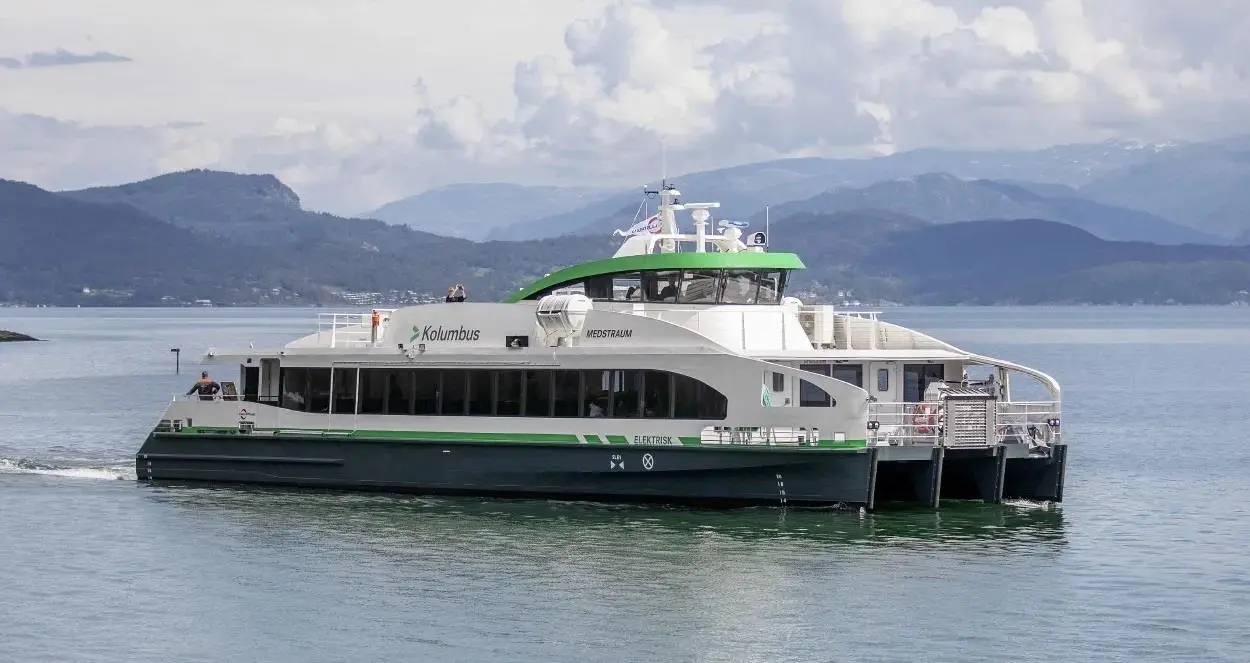
The TrAM project is regarded as ground-breaking in the context both of the zero-emission technology applied and the production methods employed, the particular combination having been shaped by pragmatic considerations as to cost-competitiveness and cost-acceptability of the concept.
The world’s first fully-electric, battery-driven passenger/car ferry, the Fjellstrand-built, 10-knot double-ender Ampere, was introduced seven years ago, and Norway’s commitment to cutting the carbon footprint of its transport infrastructure is such that there are now multiple small ferries operating largely or wholly emission-free at points throughout the country’s fjord-indented coastline. However, the Medstraum denotes a further evolutionary stage for the industry, as the first all-electric, zero-emission ferry classed in accordance with the International Code of Safety for High-Speed Craft (HSC Code).
A key differentiating feature of the new, passenger-only ferry in relation to vessels delivered hitherto is the ability to operate for an entire hour at a high speed, a minimum 23 knots having been stipulated, using electrical power drawn wholly from batteries. The bank of batteries will be recharged by connecting to the landside grid, with the opportunity of tapping renewable energy sources.
Arranged for 147 passengers and a crew of three, the Medstraum has been assigned to a multi-stop commuter route in the Stavanger area under the aegis of Kolumbus, the transport and mobility company of Rogaland County Council. Through deployment on an intensive and varied schedule, the vessel’s validity as technology demonstrator for the TrAM project and its industrial-cum-environmental objectives will be enhanced.
The ferry’s two 550kW electric propulsion motors are fed from a 1.5MW battery installation having a charging power of 2.3MW. Both the hull and superstructure have been fabricated from aluminium, and the design has been conceived throughout for plates, extrusions and friction stir welded (FSW) panels to be used in a modular construction system. The build method is fundamental to the precepts that have shaped the TrAM collaborative enterprise. The modular approach is intended to yield considerable gains in efficiency, the stated objective at the start of the project having been a reduction in production costs by 25% and a diminution in engineering hours by as much as 70%.
The savings achieved through the step-change in the manufacturing process are seen as instrumental in making electric-powered, high-speed vessels competitive in terms both of construction and acquisition.
“Not only have the project partners developed and demonstrated a new and emission-free propulsion system that can maintain higher speeds than before, but we have also adopted a completely new modular design and construction methods that will revolutionise the way we build boats in the future,” affirmed Hege Okland, CEO of the Norwegian maritime industry cluster organisation Maritime CleanTech. The latter had initiated and established the EU-funded TrAM research project, implemented in 2018.
TrAM was launched with a budget of EUR14.7m ($14.63m), and the EU has backed the project to the tune of EUR11.7m ($11.65m), drawing on the Horizon 2020 R&D funding pool. Moreover, Rogaland County Council is understood to have provided NOK68m ($6.8m) in co-funding towards prototyping the first vessel for commercial traffic. The TrAM consortium comprises 13 partners, under Rogaland’s coordination through Kolumbus as the owner and operator of the demonstrator vessel.
Medstraum was designed and built by Fjellstrand at Omastrand, with modules delivered by the Leirvik shipyard, using aluminium supplied by Hydro Extrusion Norway. The ferry’s energy system has been provided by Wartsila’s Norwegian arm, and the propulsion system by Servogear of Rubbestadneset. The Fraunhofer Institute in Germany led the work in adapting modularity models from the automotive and aviation industries to the needs of the maritime sector. Project partners University of Strathclyde (UK), National Technical University of Athens (Greece) and HSVA Ship Model Basin (Germany) were responsible for R&D, simulation and testing.
Wartsila’s remit was to deliver the PMS/EMS control systems, propulsion motors, power converters, batteries, onboard and shore-based battery charging equipment and associated electrical systems. Lightweight materials were a fundamental requirement of the scheme, given the nature of vessel involved.
The charging system posed a challenge, as existing solutions were too heavy for the parameters involved with the TrAM/Medstraum requirements. Wartsila accordingly looked towards a new lightweight shore charging concept using standard CCS2 chargers. Besides meeting the needs of the specific application, the ‘standardisation’ of the charging system is seen as contributing to the future accelerated uptake of electric vessels.
TrAM has helped Servogear to refine and develop new innovations, including carbon fibre-reinforced propeller brackets, and the Ecoflow Propulsor System supplied to Medstraum offers a significant efficiency gain and weight reductions relative to conventional propulsion arrangements.
The battery pack affords a capacity of 1,524kWh and is based on the Corvus Dolphin energy storage system, devised specifically for lightweight vessel applications. The installation is fitted above the main deck and away from potential damage zones. The Basque group Alconza developed and produced the 750kW propulsion motors. The permanent-magnet synchronous machines achieve a high efficiency and are compact and lightweight in form.
The exceptionally high propulsive efficiency (80%) attained in the Medstraum is essential for the feasibility of the TrAM concept, due to the design constraint set by the weight of the batteries as the single source of onboard energy. The University of Strathclyde and the Ship Design Laboratory of the National Technical University of Athens provided key inputs as to weight efficiency ratios and hull design, and HSVA analysed 1,000 different hull forms drawing extensively on computer resources. Parameters such as vessel dimensions, lines, resistance, radiated waves, and required power were thoroughly investigated. Servogear developed the initial aftship hull form as well as the demonstrator’s propulsion system.
After performing numerous simulations of hull variations and propulsive arrangements, the final hull form and propulsive system were verified through calm water resistance and self-propulsion tests at HSVA’s large towing tank in Hamburg.
It was verified that the propulsive efficiency of the optimised catamaran reached approximately 80% at the design speed. The results allowed the operator and shipyard to proceed to the final selection of battery capacity and electric motor power for the desired speed profile of the Medstraum.
The demonstrator has been allocated to regular service between Stavanger and Hommersaak. The itinerary can embrace up to 10 jetties serving communities on nearby islands as well as the two mainland end terminals, such that there can be a wide variation in the number of stops on each run, in accordance with passenger demand. Calls at some of the islands are on request.
This means that route lengths per voyage can range between 10.5 and 22.3 nautical miles. The ferry is required to make up to 15 round trips per day, maintaining transits at 23 knots.
Two replicator vessels are also contemplated under TrAM, one of which will be for passenger service with Thames Clippers in Central London, and the other for operation on Belgium’s inland waterways.
MAIN PARTICULARS – Medstraum
| Length overall | 30.40m |
|---|---|
|
Length bp |
29.76m |
|
Breadth |
9.00m |
|
Depth |
2.80m |
|
Draught |
1.43m |
|
Gross tonnage |
228t |
|
Passenger capacity |
147 |
|
Propulsion system |
All-electric |
|
Battery capacity |
1,524kWh |
|
Electric propulsion motors |
2 x 550kW |
|
Speed, cruising |
23kts |
|
Class |
DNV |
|
Class notations |
+1A, HSLC Passenger craft, Battery(Power), E0, Shore power, R5(nor) |
|
Registry |
NIS/Stavanger |
Related Articles
 ELECTRIFICATION AND BATTERY HYBRIDS
 ELECTRIFICATION AND BATTERY HYBRIDS
 ELECTRIFICATION AND BATTERY HYBRIDS