END OF THE LINE FOR MaK PRODUCTION
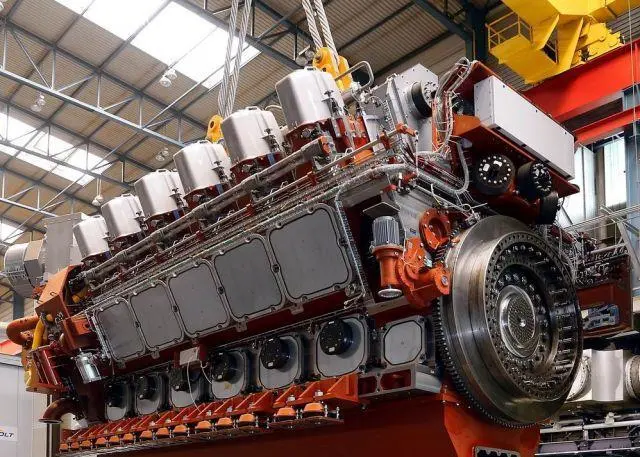
An official statement has not been externally released, but employees have evidently been informed that Caterpillar intends to discontinue the sale of MaK engines and focus the business solely on aftermarket services. The move affects the MaK manufacturing plants of Caterpillar Motoren in Germany, at Kiel and Rostock, and also the joint venture CSSC Motoren Anqing-Kiel factory in China.
It is understood that the phase-out of production is to be completed by the end of 2022.
The MaK portfolio encompasses diesel, gas and dual-fuel, 4-stroke medium-speed engines serving main propulsion applications in the 1,000-16,800kW unitary power range, and as genset aggregates across the 979-16,111kWe output band. The marque has a very wide coverage in terms of ship types, and has featured in a substantial number of cruise ship primary power references over the past decade. The MaK badge is also favoured among many operators in the European short-sea trades.
Caterpillar had purchased MaK from the Krupp Group in 1997, and went on to augment its German presence with the December 1999 takeover of the modern Warnemunde engine assembly premises of Dieselmotorenwerk Rostock(DMR).
The former DMR plant was subsequently converted for the production of the then widest-bore MaK engine, the M43 series, leaving the Kiel factory to concentrate on the M20, M25 and M32 designs. The Anqing plant in China’s Anhui province has gone on to play a key role in the supply of the M20 and M25 families.
The first dual-fuel engine platform, the M46DF, derived from the M43C, was unveiled in 2011, and in-line models were later augmented with potent vee-form models and complemented by the smaller M34DF dual-fuel type, drawing on the M32 design series. Caterpillar Motoren pioneered new techniques to increase the attractions of running on gas. R&D work at Rostock in 2016 demonstrated the efficient running of M46DF machinery on LNG at loads less than 20%.
Efficient part-load performance, realising both fuel efficiency and reduced smoke and other emissions, was also pivotal to the development of ‘E’ versions of the 250mm-bore M25 and 320mm-bore M32 diesels .
Aside from the consistent attention to the environmental standing of its products, Caterpillar Motoren’s endeavours to reduce its manufacturing footprint at the Kiel Engine Centre was formally recognised little more than a year ago by an environmental award from the Economic Association of Schleswig-Holstein, Germany’s northernmost state.
In mid 2020, the US group sold Caterpillar Propulsion, including the manufacturing operations in Sweden and Singapore, to a holding company controlled by Swedish businessman and former Berg Propulsion chief operating officer Stefan Sedersten. Only seven years previously, Caterpillar had acquired Berg, a producer of controllable pitch propellers, thrusters and control systems. The reborn Berg Propulsion has concentrated all production in Sweden.