



Entering a new era of enabling efficiency and emission reduction
Despite the sudden stalling of shipping’s voyage towards Net Zero caused by the events at MEPC ES2, the search for further efficiencies and reductions in emissions is continuing apace. At some point in the future, fuel cells and nuclear power may make turbochargers in commercial shipping obsolete but so long as propulsive power for ships comes from an internal combustion engine, turbochargers will remain an essential component of the engines used regardless of the fuel type.
A turbocharger serves one purpose and that is to deliver the air needed for the desired level of combustion. Too little air and combustion will be incomplete resulting in high levels of soot and unburnt fuel escaping into the atmosphere. Electronic engine control has revolutionised fuel delivery and timing and just as with the engines they serve, turbocharger development has accelerated in recent years with features such as turbocharger cut out and variable geometry allowing slow steaming and more efficient operation at part loads and two-stage turbocharging for NOx reduction.
The new challenge for turbochargers is to be able to meet the obstacles thrown up by the introduction of new and alternative fuels such as ammonia, methanol and hydrogen. It has been suggested that the exhaust streams from some of these fuels may have a corrosive effect on some turbocharger components and for other fuels higher turbocharger pressures may be needed.
To those challenges must be added that the majority of new ships now being built and where the owner has indicated an intention to use an alternative fuel are fitted with low-speed two-stroke dual-fuel engines and will likely be running much of the time on conventional oil fuels or the low-sulphur fuels in use since the IMO’s 2020 sulphur level regulations came into force. Even when the alternative fuels are available it is likely that there will be times when regular switching between fuel types is needed so turbochargers need to be capable of meeting what may be very different demands.
New alternative fuels are not limited to two-stroke engines and methanol, ammonia and hydrogen have also been employed or planned in this segment. Some of the challenges with these fuels are different here than for two-stroke engines. The air to fuel ratios for example need precise control to prevent misfire, knock and incomplete combustion. Therefore, turbochargers need to be able to respond rapidly to any changes in loads.
Another factor that needs consideration is that as regulations around emissions become ever more stringent, systems such as scrubbers, EGR and SCR need to be accommodated close to or on the engine making extra demands on space. Turbocharger manufacturers are responding by increasing the pressure capability and flow rates of their products thus allowing the option to drop down a size compared with older less efficient models without loss of turbocharging capacity.
For the past five years or so, turbocharger manufacturers have been engaged in developing new models that are intended to meet the challenges presented by alternative fuels. To some extent the slow speed of alternative fuel take-up and the lack of availability has given some breathing space to both engine and turbocharger manufacturers, and which will hopefully make for a safer and more efficient progression to new fuels.
CIMAC sheds light on developments and new models
Some insight into what turbocharger makers are doing with regard to ensuring their products work well with new fuels can be gained by the various papers that were presented in May this year at the CIMAC Congress in Zurich.
Taiyo Shirakawa from Mitsubishi Heavy Industries which manufactures turbochargers under the MET brand, presented a paper that covered how development of its new turbochargers was progressing. A few weeks before the paper was presented, Mitsubishi had announced it had just received a new order for a MET48MBII turbocharger to be fitted on the WinGD ammonia-fuelled 6X52DF-A1.0 engine destined for a 1,400teu container ship under construction by Hyundai Heavy. Mitsubishi had already received orders for MET66MBII turbochargers for ammonia-fuelled 7S60ME-C10.5-LGIA-HPSCR two stroke engines from Everllence and also for a MET53MBII unit for a J-ENG UEC50LSJA engine thus having references from all three of the major designers for two-stroke engines. Mitsubishi has plenty of experience with methanol-fuelled engines having notched up orders for 88 turbochargers for 41 engines of MAN ME-LGIM types.
The paper described the risk assessments carried out for ammonia slip on engines because of the corrosive effect ammonia can have especially on copper and copper alloys. As a consequence, the materials used for thrust bearings and oil labyrinths was modified as were any rubber parts such as O rings. The bearings were also assessed for potential ammonia contamination in the lubricant.
In preparation for delivering a MET33MBII turbocharger for a J-ENG UEC35LSGH DF engine likely to be fitted to a MOL vessel under a project to develop hydrogen engines announced in 2021 that also includes Kawasaki Heavy Industries and Yanmar among the partners, Mitsubishi also explored the question of hydrogen embrittlement. Components that were identified as being at particular risk included turbine wheels and gas inlet casings were subjected to hydrogen embrittlement susceptibility tests and the results found that the risk was low.
Another paper on a similar topic was presented by Thomas Pitschel of KBB. This company’s products are intended for medium speed four-stroke engines and as well as covering in depth the corrosive effect of methanol and ammonia it also explored the ignition issues for these fuels on the engines it targets.
It suggests that with port-fuel methanol injection and direct ammonia injection using diesel as a pilot fuel, are compatible with a state-of-the-art single-stage turbocharger without the need for significant modification. However, in certain instances, a two-stage turbocharging system may be the optimal choice.
Improved performance
Accelleron presented two papers examining alternative fuels and also detailing development of its two new turbocharger ranges. The first paper by Cyril Bessonard covered sequential turbocharging and introduced the A101-R range. And the second was by Simon Ma and was on the ACCX300-L turbocharger first announced in 2023.
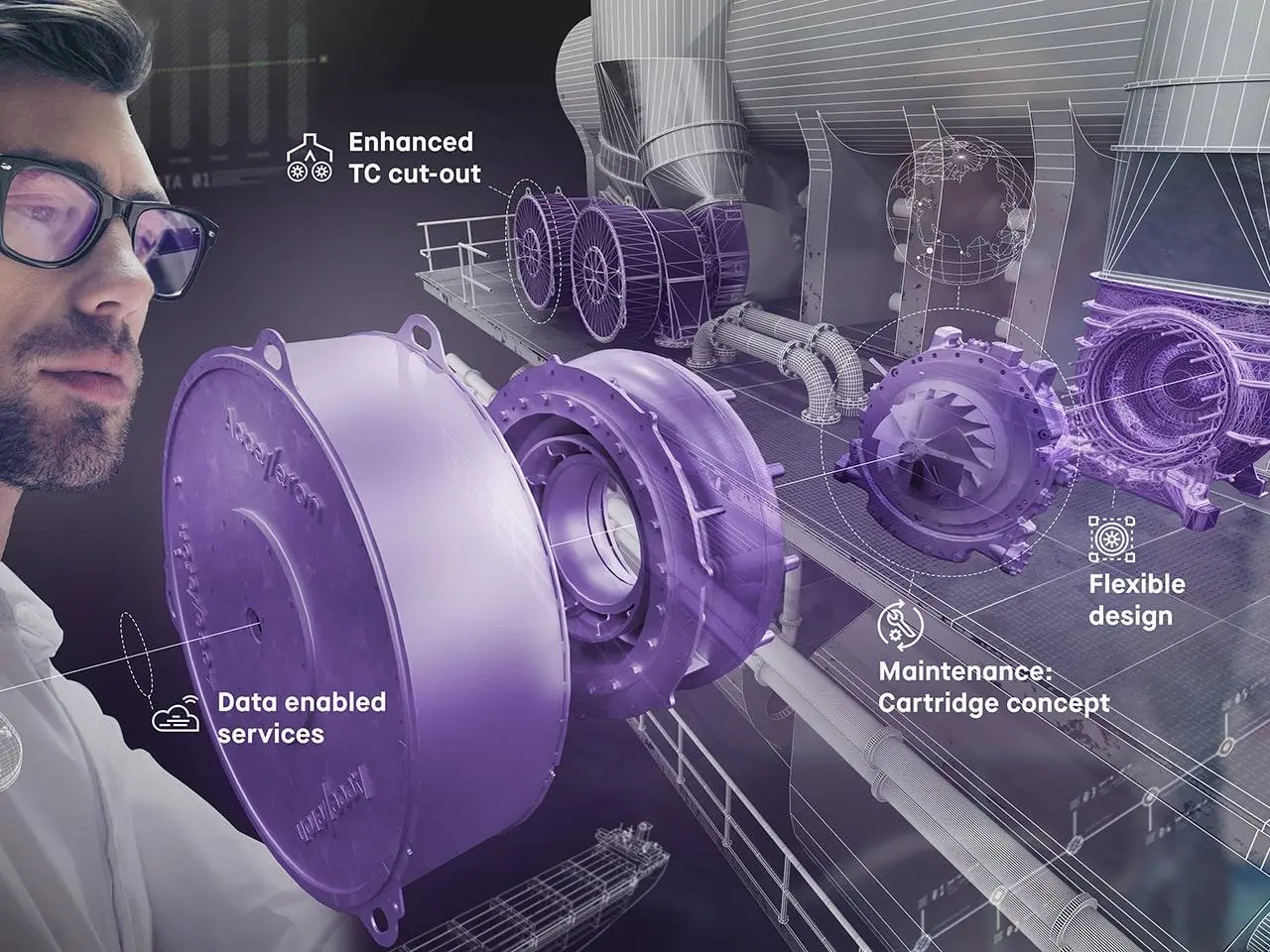
The first paper suggests sequential turbocharging – where two or more turbochargers operate alone or in tandem to meet the engine demands – can confer more benefits over conventional wastegate systems (where a valve controls enabling the exhaust gases to by-pass the turbine controls boost pressure). Sequential turbocharging enables the highest compressor pressure ratios from the lowest volume flow range. With turbocharger cut-out, as the total engine flow is directed to fewer turbocharger units, the active turbines benefit from higher exhaust mass flow, thus enabling better transient response.
The paper also describes how Accelleron’s development team focused their attention on improving the high performance already obtained by its established A100-H single-stage turbocharger series. The result is the new A101-R series, featuring a new turbine stage, a robust bearing and shaft sealing system, optimised bearing to turbine casing joint, and a modular compressor design. The compressor has a high-pressure ratio capability, while the new turbine stage enables higher rotational speeds than the existing A100 turbines. The A101-R also has increased ability to provide the air needed for combustion during the cut-in process of the second turbocharger.
The end result is that the A101-R can, for example, increase operating speeds for high cyclical applications by 11% by enabling a 30% increase in achievable compressor pressure ratio and a 27% improvement in specific flow capacity.
For the latter new model, development is now well underway with the procurement of prototype parts and an extensive qualification programme. The starting frame sizes in development are ACCX365-L and ACCX370-L. Core target of the compressor development for the new turbocharger is a significant increase of power density and at the same time, the compressor map range is extended from pressure ratio πC, of 4.8 up to above 5.0, enabling engine builders the next steps in increasing mean effective pressure. Another target was to integrate compressor specifications for 2-stroke and 4-stroke (low-pressure stage of a 2-stage turbocharger system) applications respectively within one concept.
A feature of the design means that the entire rotor subassembly can be exchanged in a single port call, using a new or refurbished cartridge. This means that turbocharger overhaul is no longer tied to dry docking schedules and instead of servicing turbochargers every five years, exchange at port means the full run time between overhauls can be used to reduce operating costs and give flexibility.
Martin Kern from Everllence (then MAN Energy Systems) also spoke of new turbochargers and upgrading a medium -speed engine. The thrust of the paper was the need for improved turbochargers to meet IMO efficiency requirements and reducing CII values over the next five years but was focussed on how this was achieved using a new TCF turbocharger on a MAN 32/40 engine.
The paper highlighted that the maker’s old TCA and TCR denoting axial or radial configuration ranges had been augmented by the new TCF and TCP ranges with F indicating flow and P pressure. Both the new turbochargers are radial configuration although smaller frame sizes of the TCF can also be used on small two-stroke engines which were once the preserve of the TCA range.
Everllence has presented these two new ranges elsewhere listing the benefits of the TCF as conferring an increase in specific volume flow of at least 20% allowing for smaller or fewer units to be used on engines. There is also a significant improvement of dynamic behaviour, and the models are said to be suited as the low-pressure stage in two-stage application.
Related Articles
 2-STROKE & 4-STROKE
 TURBOCHARGER
 TURBOCHARGER