Failure is not an option
With the release of the USCG final ballast water regulation and pending ratification of the IMO ballast water management (BWM) convention, ship owners will soon be on a strict time line to select and install suitable ballast water treatment (BWT) technology and bring their vessels into compliance. Major Classification Societies have highlighted specific concerns related to installing BWT on vessels, including:
- Reliability of filtration
- Risk of explosion due to generation of hydrogen gas
- Danger to crew due to ozone
- Increased risk of corrosion
It is critical for owners to do their homework and select the most reliable and practical technology to ensure their vessels comply with the BWM regulations with minimal impact on vessel operations and without incurring unnecessary expense.
Efficient transfer of ballast water is essential to the safe and economical operation of most commercial vessels. Failure of any part of this system could result in loss of revenue or promote potentially unsafe cargo transfer. As BWT becomes a requirement, the reliability of these systems should among the highest priorities in the selection process.
Filtration may be considered by some the ’Achilles’ heel‘ of a BWT system. An inadequately sized filtration system can reduce ballast flow rate and increase the time in port. If a filter is unable to clean itself and plugs, manual intervention is required, ultimately delaying cargo off-loading operations.
Although avoiding filtration entirely seems to be an attractive prospect, the reality is that most marine biologists agree that filtration is necessary to remove certain organisms that occur in nature. Many marine species go through life stages where they are dormant or otherwise protected from the BWT disinfection process and may pass through the BWT system unharmed. These organisms may not be present during a type approval test but will likely be encountered as a vessel takes ballast in ports around the world. Organisms that survive BWT present a considerable risk of non-compliance to the vessel owner, when Port State Control is eventually implemented.
It is understandable that owners may think all ballast water treatment filters are the same, but this is an inaccurate and risky assumption. Filtration is an inexact science. The performance of a filter, both in terms of operating parameters and quality of output, can vary greatly from one application to another depending on the quantity and characteristics of the contaminants. To compound the confusion, filter efficiencycan be measured and reported in different ways by different manufacturers.
For the ballast water treatment application it is important to look beyond the ’micron rating‘ provided by the filter maker. There are many important performance and operating characteristics that have a critical effect on the overall performance and reliability of a ballast water treatment system.
Ballast water is an extremely difficult filtration application because the influent challenge water changes constantly while the effluent must be consistent in order to achieve reliable treatment performance. The quantity and the physical nature of ballast water contaminants are different from location to location. Sediment quantity, particle size distribution, and density can vary, as can organisms’ quantity, physical dimensions, shape and consistency, compressibility, and stickiness.
The ability of a filter to clean itself, even in times of high sediment or biological loading, is one of the most important factors in successful long-term operation. If a filter becomes plugged during ballasting operation, it must be shut down, disassembled, and manually cleaned. This means a major maintenance task at a very difficult time because it is likely to be during a cargo offloading when crew are otherwise occupied. It could result in delays in cargo transfer and associated increase in turnaround time and cost.
Screen filters used on many BWT systems form a simple barrier allowing water and small sized material to flow through while larger sediment and biological materials are retained on the surface. The barrier can be wedge wire or woven mesh in a range of micron ratings and produced in various stainless steel alloys.
When needed, the separated material is removed from the filter surface using one of several methods that rely on differential pressure to create flow from clean side to dirty side of the filter media. In the case of drum type screen filters, this is accomplished by a series of small suction pipes passing over the surface to ’vacuum off‘ the material. With candle type screen filters, individual candles are cleaned by back-flowing the total surface of each screen in sequence out through a drain pipe that passes the end of each filter cylinder.
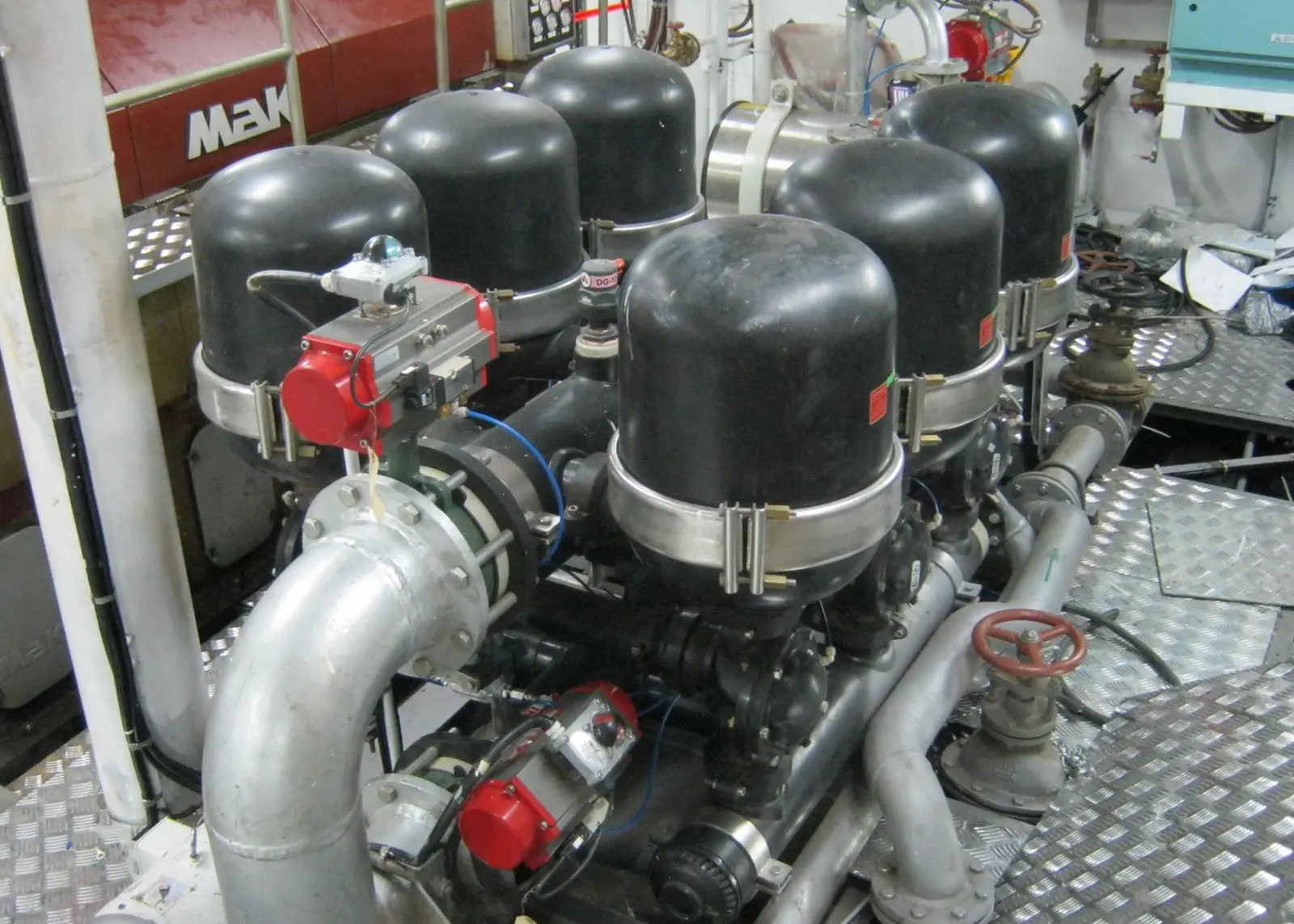
Disk filtration technology consists of thin nylon disks, which are stacked on polymer spines to form filter elements. The disks have a precise pattern of diagonal grooves of a specific micron size on both top and bottom and when tightly compressed, the intersections form a three- dimensional filter matrix to separate solids. Water flows in between the disks, while contaminants are captured on the surface of the element and at stopping points within the matrix. The resulting depth filtration provides high removal efficiency and solids holding capacity while maintaining low-pressure drop.
When needed, a booster pump is energized, and high-pressure water from the clean side flows backward into each module, pushing the spine pistons up and releasing the compression on the disks. Tangential jets of high-pressure water spray from nozzles on the spines through the disks, which are free to spin and flex. This vigorous backwashing ensures that the filters are quickly and completely cleaned before being placed back into service.
In addition to the obvious comparison of dimensions, installation complexity and cost, there are several key characteristics which differentiate these filtration approaches when considering performance and operational reliability. These include:
- Filter surface area: Greater surface area results in increased material holding capacity, longer time between backwash and lower velocity through the filter media for less risk of carry through.
- Surface filter vs depth filter: Greater media depth increases the probability of capturing all size and density of materials and organisms. This results in consistently high quality effluent and longer intervals between backwashing.
- Backwash differential pressure: Higher differential pressure results in more vigorous and effective cleaning of the filter media, more effective discharge of backflush material overboard, and less risk of filter plugging.
- Backwash velocity: Higher velocity passing backward through the media is beneficial to the cleaning process. The backwashing must be capable of removing sticky, compressible algae and other difficult materials.
- Materials of construction: All internal surfaces and parts should be non-corrosive for long service life. Note that even exotic metal alloys used in screen filters require replacement many times during the life of a vessel.
While there are many factors to consider when selecting ballast water treatment technology, filter performance and long-term reliability should not be overlooked. Ship owners seeking to minimise long-term operational risk for their vessels may find that the best place to start is at the Achilles’ heel.