First chemical tanker orders for Orcan ORC units
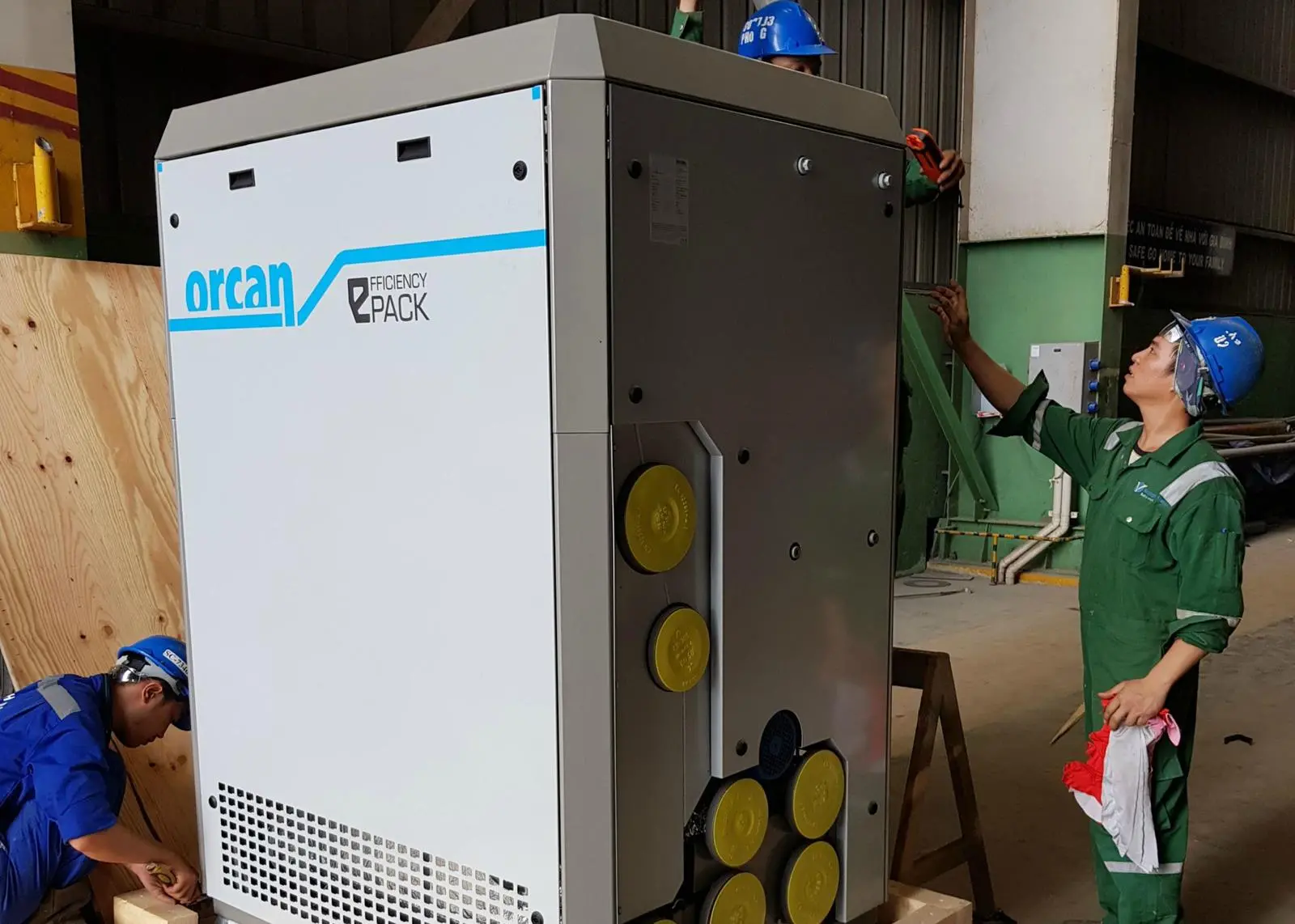
Orcan Energy’s efficiency PACK will achieve CO2 savings of around 295 tons per year, and fuel savings of 100 tons per year, according to the company.
The order for 2 x 22,000dwt, LNG-fuelled, oil and chemical tankers follows the recent launch of LNG-fuelled passenger ferry MS Willem de Vlamingh, which features a twin Orcan efficiency PACK installation.
The efficiency PACK uses waste heat from the thermal oil system and the jacket cooling water to produce electricity, thereby recovering waste heat from both the main engine and the auxiliary engines. In order to do that a heat exchanger transfers waste heat from the thermal oil circuit to the ORC. The HT water is being routed through the efficiency PACKs directly. Here, the refrigerant is evaporated – a non-toxic, non-flammable hydrocarbon – and routed to the expansion machine as superheated vapour. The highly pressurised refrigerant is expanded, thereby driving the expansion machine. The rotational energy is used to drive a generator that produces electricity.
One of the main advantages of the fully enclosed screw expansion machine inside the system is that it’s very well suited for fluctuating amounts of waste heat, meaning that it retains its efficiency. The efficiency PACK will provide well over 80 kW of additional electrical net power to the ship’s grid while discharging, because of the energy-intensive inerting operations. And also at sea the waste heat recovery system contributes significantly to the on-board electricity demand by feeding back more than 70 kW into the grid.
Ingvar Lorensson, managing director at Donsötank, explains the choice for this technology: “This generation of tanker is designed with a focus on the energy efficiency from the beginning. To recover the waste heat and convert it to electricity is one step to minimize the emissions. We came in contact with Orcan Energy in an early stage and their solution fits perfectly into our vessels.”
The installation of the efficiency PACKs was supported by the Swedish Environmental Protection Agency.