



First zero-emission pusher boat christened
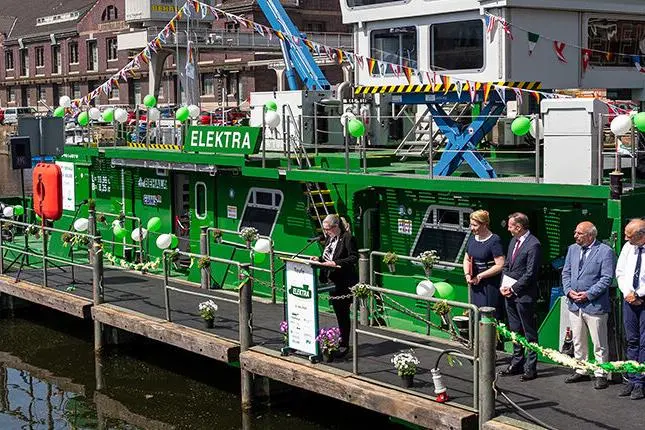
The 20m-long pusher has a beam of 8.2 metres and a draft of 1.25 metres and will deliver 21,200kWh of electric power. Its newly developed hybrid power system consists of a battery package, consisting of 242 DNV approved Green Orca 1050 modules with a total capacity of 2.5MWh as well as three maritime PEM fuel cell systems (NT-PEMFC, 100kW peak power each). Although the power of the battery and the fuel cells will be used together to power the electric motors, for complete redundancy the two powertrains are entirely independent systems.
Onboard, the waste heat from the fuel cells is used by a consistent water cooling system and the rooms are heated by a brine-water heat pump. The use of a self-developed energy management system and a driving assistant supports the skipper and logistician in planning operations and executing the transports.
The energy storage system, delivered by EST-Floattech, has a unique active balancing and passive safety system applied at a module and string level. Heat is dissipated by an off-the-shelf air conditioning unit.
With 750 kg of usable gaseous hydrogen at 500 bars on board, the ship has a range of approximately 400 kilometres in a pushed convoy with the loaded heavy freight lighter, Ursus. Therefore, along the shipping routes of Berlin towards Rhine/Ruhr, Hamburg and Stettin, there will only be one additional shore station required to provide Elektra with compressed hydrogen and electricity aside from Berlin’s Westhafen. Replacement hydrogen tanks and electric charging stations will be operational in Westhafen and Lüneberg harbour.
Elektra can push convoys of up to 150 metres long. The vessel’s crew lives and works on board, so energy must also be provided for maintaining the temperature in the rooms and in the wheelhouse, the crew also cooks and washes on board and the batteries also require “comfortable temperature levels” for their efficient operation and a long service life.
The vessel’s developers include BEHALA – Berliner Hafen- und Lagerhausgesellschaft (logistics), the Hermann Barthel shipyard, BALLARD Power Systems (fuel cells), Argo-Anleg (hydrogen system), SER Schiffselektronik Rostock (electrical energy system), EST-Floattech (battery system) and HGK Shipping (nautical operation).
TU Berlin has finalised a supply agreement with the Industrie- und Gewerbepark Mittelelbe/H2 Green Power & Logistics GmbH for filling and transporting the tank systems (Multiple Energy Gas Container – MEGC) with compressed green hydrogen until the end of the project’s term at the end of 2024.
The MEGCs can be replaced with the ship’s own crane and the electricity is connected through a charging gallows where the cables are run on the shore side. Dealing with the arm-thick cables is therefore very easy for the ship’s crew, and the ship can be quickly connected to the charging station, with the pier free from cables.
Initially, testing of the vessel’s performance will, for the most part, take place in the capital region. From 2023, testing will then increasingly be conducted in long-distance transport in the direction of Hamburg.
The project is funded by the Federal Ministry for Digital and Transport (BMDV) supervised and coordinated by Project Management Jülich (PtJ) and the National Organisation Hydrogen and Fuel Cell Technology (NOW).
In his opening remarks, Federal Minister Dr. Volker Wissing, talked about the significance of hydrogen mobility for achieving the climate protection goals of the federal government. “The Elektra is a lighthouse project: It is the first pusher boat worldwide where a battery-electric drive will be combined with hydrogen and fuel cell technology. The entire project is a blueprint for climate- and environmentally-friendly inland shipping and is a true pioneering achievement not just technically, but also in terms of regulation.”
The Managing Director (Chair) of NOW GmbH, Kurt-Christoph von Knobelsdorff, added: “The Elektra is already a role model for more new ship builds and for that alone, is already a huge success story for the funding strategy of the BMDV. Considering their service lives of 50 years and beyond, the transition to climate-friendly propulsion systems in shipping must now be accelerated.”
Related Articles
 BATTERIES, SUPERCAPACITORS, FUEL CELLS AND OTHER ENERGY STORAGE TECHNOLOGY
 BATTERIES, SUPERCAPACITORS, FUEL CELLS AND OTHER ENERGY STORAGE TECHNOLOGY
 BATTERIES, SUPERCAPACITORS, FUEL CELLS AND OTHER ENERGY STORAGE TECHNOLOGY