Fresh water without frustration
The demand for fresh water at sea was once satisfied by the simple practice of loading supplies on sea-going vessels in tanks before setting sail. Later, the demand for drinking, cooking, washing and cleaning supplies necessitated the on-board production of fresh water, and so desalination systems were born. Initially, vessels from cruise ships to military ships, as well as offshore oil and gas platforms, produced their supplies via thermal desalination, in which sea water was boiled and steam vapour condensed to produce fresh drinking water in much the same way that the natural cycle of the Earth’s atmosphere produces rain. This removed the need to transport tanks of fresh water across the seas but introduced a new problem; since the energy demanded to keep boiling the water was considerable and the large units that performed the task consumed valuable space on board, crews were lumbered with a noisy, hot and labour-intensive method of desalination that they often loathed. Relief from this unsatisfactory process came when designers and engineers began to pursue a new avenue of possibility: reverse osmosis technology.
The 1980s saw the introduction of reverse osmosis (RO) technology on commercial vessels and the process has since been refined and adapted to offer a more efficient and pain-free method of desalinating sea water across a range of vessels. RO produces fresh water by pressurising sea water above the osmotic pressure with a high-pressure pump; this propels the sea water across a semi-permeable membrane that removes some 99% of its impurities.
With the many advantages of reverse osmosis, there are now few vessels that would be better served by a thermal desalinator, not only for reasons of efficiency and environmental quality on-board but also for reasons of economy. RO units typically consume around 5kWh per litre of water, whereas the demands of thermal desalination units can be more than three times that amount.
With RO desalination, the shipowner not only saves cost but also improves working conditions. Thermal desalinators produce heat and noise (and the bigger the vessel, the larger the unit is likely to be) but RO units do not lose such large amounts of energy in heat, or produce such unpleasant sounds. Modern RO systems are smaller and lighter than their predecessors, a relief to crews in the sometimes cramped conditions below decks, while the modest demands they make on the crew for maintenance are also welcomed.
RO has improved and developed since the 1980s and continues to offer new options for those who take advantage of the technology. In recent years, designers have continued to reduce the overall size and weight of the units, as well as their demand for energy, while improving the efficiency of key components such as the membrane filters, offering increasing economy and reliability. They have also focused on improving ease of use and introduced convenient features enabling crews to swiftly and efficiently monitor the quality of the water being produced.
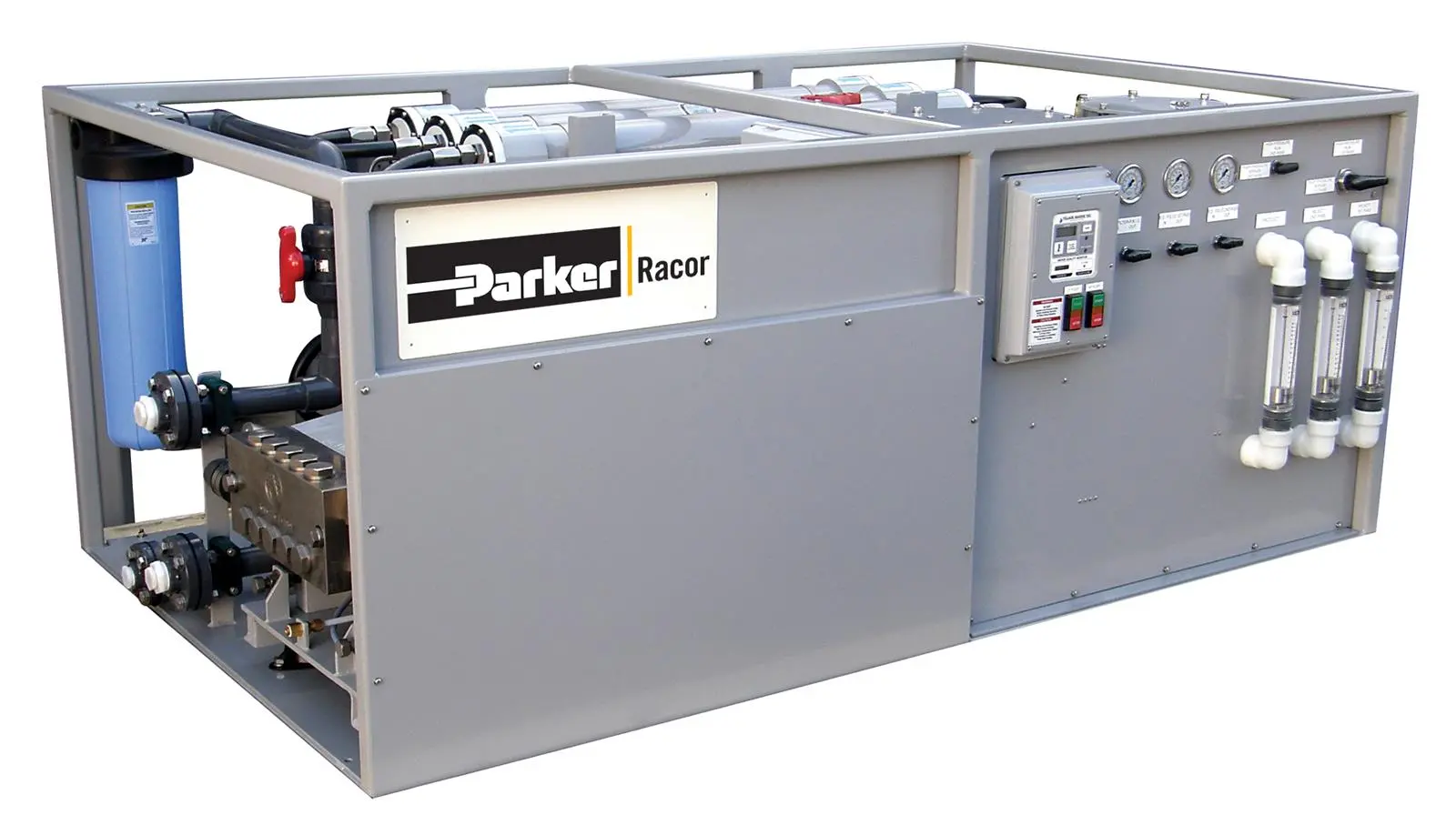
Pump technology has contributed to improved economy in RO systems, through pumps that create strong but consistent pressure with a reduced energy demand. Low-energy/high-output components such as positive displacement pumps and Parker’s Village Marine high pressure pump, which uses less power for increased output, are examples of such progress.
Changes in the composition of key components have improved efficiency, with the introduction of titanium, ceramic and GRP materials significantly extending the lifespan of both individual parts and water-making units as a whole. A constant concern of designers and engineers has been the capacity for sea water to degrade parts within RO desalinators but in the most recent units, titanium pumps with ceramic pistons are offering a robust defence against corrosion that scores a marked improvement over stainless steel. Pressure housings have been upgraded with stainless steel giving way to composites. Elements such as remote control systems and master control panels are now resistant to dirt, weather and corrosion, thanks to protected electrical components with the NEMA 4X classification.
Improvements in the performance of membrane filters have been at the vanguard of modern developments and remain key to the efforts of designers when re-evaluating components. Cost efficient, high performance materials that offer an increased level of purity with a low maintenance requirements have raised the performance of RO desalinators to new levels. For example, Parker’s Village Marine PW and SW series uses spiral-wound membranes, made from high-grade polyamide thin film composites, along with sediment pre-filters, to ensure integrity and performance. The potential efficiency of these components is boosted by the fact that some models allow automatic fresh-water flushing of membranes with no need to spend time manually flushing. This means that, if the desalination equipment is maintained correctly, crews can expect an almost 100% level of purity from today’s membranes. And if any user still requires reassurance, designers and engineers have further enhanced reliability by adding back-up systems that divert supplies overboard if the quality of the water drops below an acceptable standard.
Maintenance has always been, and continues to be, a major issue in the review and redesign of RO systems. Since the days when thermal desalination was the most common method of producing fresh water at sea, maintenance has been an unenviable task, so there has been a need to educate and reassure users that modern units are far easier to maintain than they perhaps realise. More importantly, there has been a need to back such claims with features that really do save time and money.
Operators and crews have been successfully convinced that maintenance of RO systems is less arduous than hitherto. Maintenance requirements and downtime have been reduced to a minimum by the introduction of lifetime seals and self-regulating features, such as check valves that enable a gradual start-up to balance pressure and flow and thus reduce the possibility of damage caused by hydraulic shock to the membranes. Access to key components has been improved, so that servicing can be carried out with minimum disruption and at maximum speed. Ease of maintenance has been enhanced by modular units; this has enabled customers to install a system via narrow hatchways which can be configured in different ways once on board to make best use of the space available and provide the minimum obstruction.
Having addressed maintenance issues, designers of RO systems have further challenged the sometimes negative view of on-board watermakers (as RO systems are often called) by providing useful control options. It is possible to monitor watermakers via remote controllers with LCD colour touchscreens, enabling easy management of water purity, salinity and temperature. These controllers can provide alerts when water pressure is low, when salinity levels are beyond the set range and when regular services are scheduled.
The continuing developments in the efficiency and reliability of RO units have expanded the market, resulting in the design and production of a range of units tailored for a full range of vessels. Hot, noisy and large thermal desalinators could be, for the most part, a distant memory, while RO units can provide soft, clean water with minimal maintenance, leaving crews free to focus on other tasks. Life at sea has been enhanced by the development of RO desalinators, as discovered by a growing number of users as the technology becomes increasingly economically viable.