



Fuel Cell Projects Maturing Fast
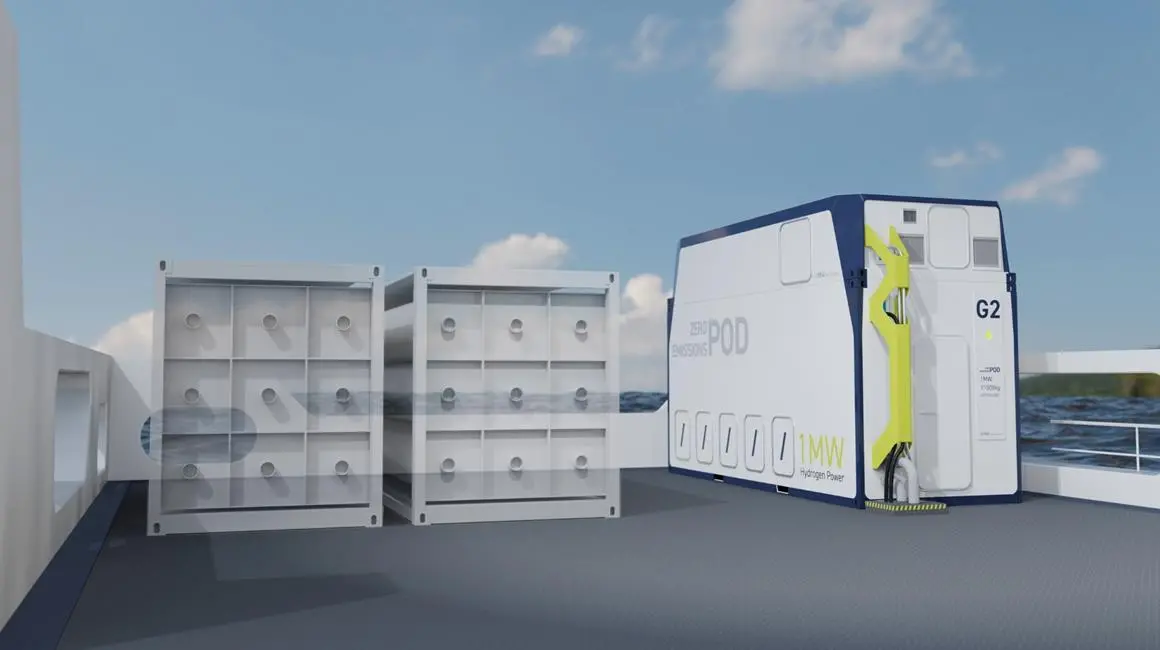
HAV Hydrogen says it has been inundated with requests from shipowners since the launch of its containerized, deck-based hydrogen system. It’s an indication of the progress that has been made with fuel cell technology as the many projects underway begin to gain traction in the market.
The systems integrator announced DNV Approval in Principle (AiP) for its containerised system in March. The Zero Emission Pod is based on a 20-foot container that contains hydrogen fuel cells and supporting equipment such as ventilation, cooling, safety and control systems, DC/DC drives and fuel distribution system. By using 200kW hydrogen fuel cells, the system is flexible and can easily provide 1MW within the footprint of a standard 20 container.
More containerisation to come
The HyEkoTank project partners, including TECO 2030 and Shell, are also developing a solution in a 40ft container, including a 2.4 MW fuel cell system, hydrogen fuel gas conditioning, air filtration systems, power converters, battery storage and automation system. It will also include a containerised, 350 bar, compressed hydrogen storage system with a 4,000kg capacity so that vessels can be refuelled by swapping containers.
In April, Navalprogetti obtained AiP from Lloyd’s Register for a containerised hydrogen storage system for use with a fuel cell system that will be used to power propulsion and hotel loads on new Viking Cruises’ ships. The development is part of the four-year sHYpS project, and the swappable hydrogen storage container system will be based on 45-foot ISO c-type containers. The containers will be swappable, and the project is examining scale-up of storage capacity and supply in the Port of Bergen. It will also develop the concept of fuel tank by adding a connection space for an evaporator.
A first for liquid hydrogen
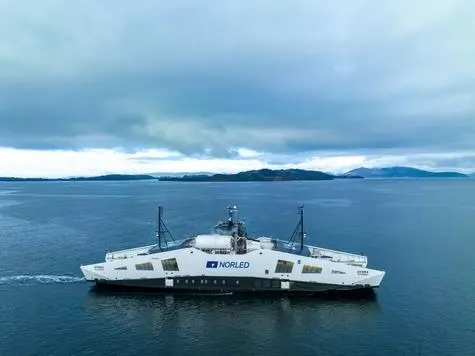
The DNV-classed MF Hydra, a ferry delivered in March to the Norwegian Public Roads Administration, became the world’s first vessel sailing on liquid hydrogen this year. The fuel cell system was developed as part of the FreeCO2ast project; Ballard developed the fuel cells, and SEAM acted as system integrator.
The current lack of prescriptive regulations means that companies wishing to launch hydrogen systems need to follow the IMO guidelines on alternative design (MSC.1/Circ.1455). “It was a lighthouse project where we had the first application of liquid hydrogen,” says Benjamin Scholz, gas expert at DNV. “Fulfilling alternative design requirements is an intensive process. It was important that we cooperated within and beyond DNV, and of course we worked to address the questions the flag authorities needed answered to sign the final certificates for the vessel.”
More Norwegian ferries
SEAM is system integrator for Torghatten Nord’s project for two hydrogen ferries, designed by The Norwegian Ship Design Company to operate on Norway’s longest state ferry connection, highway 80 across Vestfjorden, from 2025. While electric ferries are becoming increasingly common, battery-electric propulsion is not viable for longer routes like the one between Bodø and Lofoten.
Torghatten’s hydrogen ferries received approval in principle from Lloyd’s Register in August 2022, and the owner has specified that they must run on a minimum of 85% hydrogen and a maximum of 15% biofuel over long and demanding distances of up to four hours.
SEAM will deliver an in-house developed control and safety system, as well as the entire powertrain including fuel cell, batteries, switchboards, and electric motors. The fuel cells will be supplied by PowerCell, with the company’s Marine System 200 providing the two ferries with 6.5MW power each, the largest for a Norwegian ferry to date.
Multiple 200kW Marine System 200s will be combined to achieve the required electric power output. “In terms of size, this project vastly supersedes any previously built application in maritime history,” says Johan Burgren, Business Manager at PowerCell. The 32 fuel cell units for each ferry are going to be clustered into groups, to provide redundancy, and will work together on a direct current DC switchboard.
The main fuel line coming from the storage system will be split within the clusters until the inlet is only a few millimetres thick on entering each unit. There’s a safety benefit to the clustering as well as a financial one, says Burgren. Spaces requiring ventilation will be smaller, including purge lines, and it avoids bunching issues that arise if there are too many cables going into a compartment.
PowerCell claims the highest power density in the marine market thanks to it having developed the core technology for on-road and aviation applications. Additionally, reforming is part of the company’s heritage, says Burgren, and it is involved in projects where the hydrogen is reformed from other feedstocks. Projects include providing fuel cells to the Hydrogen One, the world’s first methanol-fuelled towboat being developed by Maritime Partners using e1 Marine’s methanol-to-hydrogen reformer technology. Other project participants include naval architecture firm Elliott Bay Design Group as well as ABB, who will supply electrical power distribution and automation systems. The first-of-its-kind towboat is set to hit the water in 2023. PowerCell has also received an order from Amogy for a workboat that will have an ammonia-to-power generator.
Burgren is positive about the operational benefits of fuel cells. “From a service perspective, you can stop the fuel cell system and service it; you can replace parts, and then you can get it going again without stopping the other units. And you don’t have to go to dry dock to handle very heavy units. This contrasts with rotary machinery, such as large 2-stroke engines that have to be built into the vessel. We can bring things in and out of our fuel cell systems and maintain the system continuously.”

PowerCell is scaling up to support larger power systems. “We are close to having more powerful single units ready, but right as we speak, we think that we will reach pretty far with 200kW increments, covering the short sea market very well, up to let’s say, 9-10MW,” says Burgren. The company plans to support power systems for main propulsion and deep-sea shipping in the future. “Owners need zero-emissions technology as the next-build solution for their fleets, and cannot wait until the next generation of ships to adopt the zero-carbon technologies of the future. Hydrogen electric fuel cell solutions are playing a key role in the maritime industry to deliver immediate, true sustainability for owners in the green transition.”
More to come
More fuel cells are coming to market. HELION Hydrogen Power received Approval in Principle from Bureau Veritas for its FC-RACKTM Marine version, a zero-emission hydrogen powered electric generator dedicated to maritime applications. Marinization involved a double envelope enclosure to seal the system and a thermal management system, dedicated on-board control system and a hydrogen safety system that enables the FC-RACK Marine to be installed inside or on the deck of the vessel. The HELION system will be operational by the end of 2023 supplying a 200kW hydrogen generator integrated in a 15-foot container to a dredger built by Piriou shipyard.
Guillaume Daniel, Engineer, Regulatory Development at Bureau Veritas (BV) Marine & Offshore, says the partnership with Helion has supported the development of the BV’s rules. “At BV, all our Rules are developed and updated regularly in constant dialogue with the industry to ensure that they reflect technology evolution and the realities on the ground.”
He notes that BV’s rules for fuel cells (NR 547) cover safety equipment such as fire-fighting systems and the use of specific electric equipment in hazardous areas. For example, the space around the fuel cell must either be ventilated or made inert. Additionally, NR 547 is to be used jointly with others that address the specific safety requirements for alternative fuels.
For the next few years, risk assessment must remain at the core of the process leading to the installation of fuel cells on board ships, he says. “We recognise that fuel cell technology is evolving quickly, and as such classification rules need to be kept up to date. In addition to monitoring regulatory discussions at the IMO, close collaboration with industry stakeholders will be essential to achieve this. By working together and sharing knowledge and experience from early projects, we can help advance solutions that will help different companies progress in their decarbonisation journeys, while also supporting shipping’s energy transition as a whole.”
Starting small
Madadh MacLaine, Secretary General at Zero Emissions Ship Technology Association (ZESTAs), says experience on smaller vessels is a good way to develop technologies suitable for deepsea sailing. Energy storage systems (ESS), hydrogen fuel cells, and wind technology can all be combined to deliver on zero emissions goals. Working together, they reduce costs and increase efficiencies throughout the system, creating a virtuous circle of complementary energy efficiencies.
The Zero Emissions Ship Technology Association (ZESTAs) exists to accelerate the large-scale uptake of zero emissions ship technology. For the 30+ members of ZESTAs, zero emissions mean zero greenhouse gas emissions at point of use on the vessel, with minimal upstream impact. It means true zero, not net-zero.
Green hydrogen, used in energy-efficient hydrogen fuel cells, can act as a range extender when there is not enough wind, or if the ESS has been depleted. Marine batteries complement hydrogen fuel cells and wind propulsion to deliver maximum efficiency in zero emissions propulsion. They deliver instant power up to multiple MWh and have the greatest energy efficiency of any fuel or energy storage system.
Combined with electric drives, these technologies enable zero emissions and optimised manoeuvring in port. As there are minimal moving parts, vibration and sound, both onboard and projecting out into the marine ecosystems, are drastically reduced.
“By combining these zero emission technologies, we can achieve true zero faster, particularly on smaller, return to base vessels,” says MacLaine. These vessels under 5,000 GT represent 15% of international shipping emissions, according to the IMO’s 4th GHG Study. ZESTAs believes the IMO and EU must include 400 – 5,000 GT vessels in environmental legislation (i.e. IMO DCS and CII, EU MRV and ETS etc) to create immediate impact.
“Excluding them is a wasted opportunity, and lack of policy is a key barrier to action. By tackling this 15% of GHG emissions, we can make significant progress on the harder-to-abate 85% within this decade,” she says. “Smaller vessels serve as the ideal test bed to circumvent the chicken and egg situation that is hindering development for hydrogen and efficiency technology providers: currently, hydrogen production is held up by a lack of demand, despite significant potential up-taker markets, and efficiency technology providers need cash flow to invest in R&D and explore upscaling for larger vessels.
“We only have seven years to 2030, and to keep shipping in line with 1.5ºC of warming. This 15% is a window of opportunity where we can we reduce emissions right now. The technology is ready today for smaller vessels. It makes most sense to start here and scale up for larger, deep-sea vessels. By excluding the smaller vessels from policy, we are effectively stopping ourselves from starting.”
In Hydrogen Forecast to 2050, DNV predicts that the uptake of hydrogen will differ significantly by region, heavily influenced by policy. Europe is the forerunner with hydrogen set to take 11% of the energy mix by 2050, as enabling policies both kickstart the scaling of hydrogen production and stimulate end-use.
Olaf Drews, Head of Machinery Systems and Marine Products, is often asked whether or not fuel cells will be used to power deepsea vessels. “It will come,” he says. Projects are being discussed, and DNV is already working on multiple fuel cell projects involving different vessel and fuel cell types, including design concepts up to 10MW and one for a container feeder vessel.
For now, PEM fuel cell technology is benefiting from the development work undertaken in the automotive industry, but the ultimate choice between PEM and SOFC for shipowners will often be driven by fuel choice considerations. “For LNG and methanol, we already have an interim guideline and the IGF code available. So it’s sometimes quite an obvious choice if one of those fuels is already onboard or is easier to implement than hydrogen. However, some shipowners are more focused on hydrogen as a future fuel. There’s no single best solution.”
Related Articles
 BATTERIES, SUPERCAPACITORS, FUEL CELLS AND OTHER ENERGY STORAGE TECHNOLOGY
 BATTERIES, SUPERCAPACITORS, FUEL CELLS AND OTHER ENERGY STORAGE TECHNOLOGY
 BATTERIES, SUPERCAPACITORS, FUEL CELLS AND OTHER ENERGY STORAGE TECHNOLOGY