Growing gas challenges
It’s partly an effect of rising eco-issues: Statoil has specified advanced, environmentally responsible technology to keep ahead of the game. So, these LNG dual fuel vessels are “complex, high end and very sophisticated”, explains Mr Rasmussen.
The same issues are beginning to be reflected in concerns in other areas such as around the Gulf of Mexico. Harvey Gulf International is getting Trinity Offshore to build the very first US flagged LNG powered offshore support vessels, and these will be ENVIRO+, Green Passport certified by the American Bureau of Shipping, making use of Wärtsila’s 6L34 dual fuel packages.
The orders, both in the Gulf of Mexico and the North Sea tend to be clustered: it’s notable that the first pair 92m vessels for Trinity was followed quite quickly by a second pair, and of the recent handful destined for the Norwegian continental shelf, four are being built by Kleven. The batch from Kleven includes two gas-fuelled vessels for Eidesvik (the Viking Prince and Viking Princess), and one each for Rem Management and Remøy Shipping. This last yields a total contract value for Kleven of around NOK400m (US$69.43m) with an option for a further vessel of the same type.
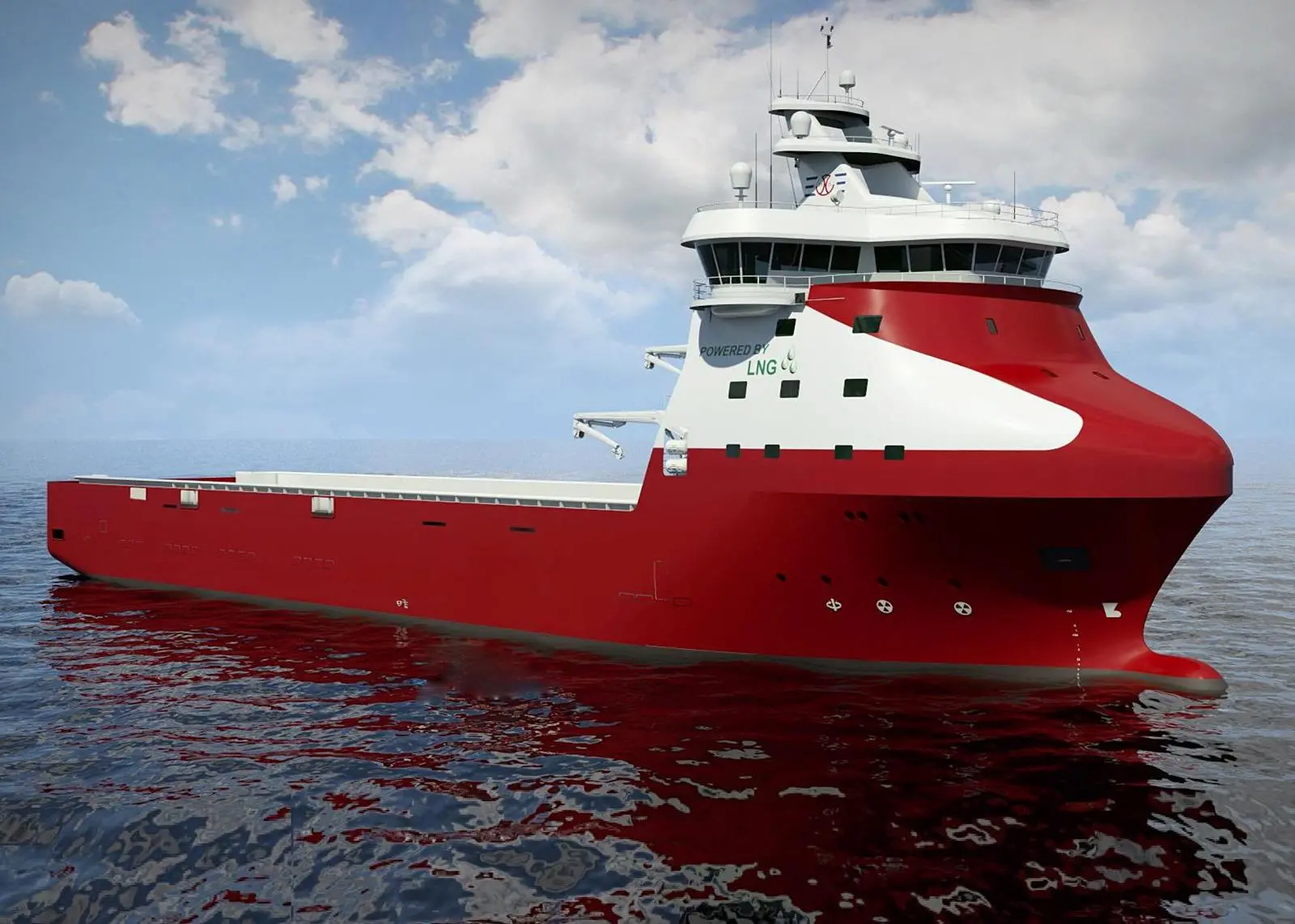
Now underway at the Kleven Verft shipyard, the vessel is of the VS 4412 dual fuel design from Wärtsila. The 6,000 dwt, 92.20 metre PSV has a broad 20.00 metre beam which gives a working deck of around 1,000 sq metres and accommodation for 26 crew.
As pointed out Kleven, an independent builder executing third party designs, now has a number of these LNG builds to its name – there are nine so far, quite an achievement in a competitive new field. It’s enlightening to find out what the build issues actually are.
Mr Rasmussen explains that the intersection of manpower and hardware is always an issue on a complex build, but “this becomes critical on an LNG vessel, mostly because of the twin fuel to engine interfaces which doubles the complexity and, for part of the build anyway, doubles the workload”. Firstly, the engine structure has to cope with two independent inputs with two separate tanks and lines, one running at an ambient temperature the other coming from a tank kept around 170 degrees below zero. This means bringing up the fuel temperature from a liquid, chilled storage state to a near-ambient temperature gas before it reaches the combustion chamber.
While Wartsila supply the dual fuel engines and ship designs, there are still complex installation issues to deal with related to safety, ventilation and last but not least, explosive mixes. “On top of this, the normal tolerances are much reduced in relation to LNG so you simply can’t afford to let anything slip,” says Mr Rasmussen.
With a dual fuel engine you have gas-only tanks that resemble a huge thermos flask plus of course lengths of double skinned piping arranged specifically for taking the LNG from it’s cooled down liquid state to near ambient temperatures.
The pipework has insulation which is very effective and only around 8cm thick, but the build has to keep an eye on cold-air ‘leakages’ with every join as it’s an absolute necessity not to create a thermal bridge. This can be tricky because the pipework has a huge number of turns as well as needing to be able to expand and contract with the rising and lowering of the draw on the cooled fuel.
Likewise, there’s the matter of the electronics which need both sealing and shielding, especially the current and signal cables, says Mr Rasmussen: “You don’t have a lot of space play with but there are a number of remote control units so there’s a need to keep the interference down.”
All this means there is a tight space and timetable to work in. “You don’t want expensive gear standing idle on the quayside – and likewise, you don’t want to have workers waiting around or working in such confined areas as to be ineffective,” he adds.
“Like baking bread, you need to get both timing and conditions right: you simply can’t put everything together at once and bake a loaf at 2,000 degrees in two minutes,” concludes Mr Rasmussen.
By Stevie Knight