Hull Vane success in naval trial
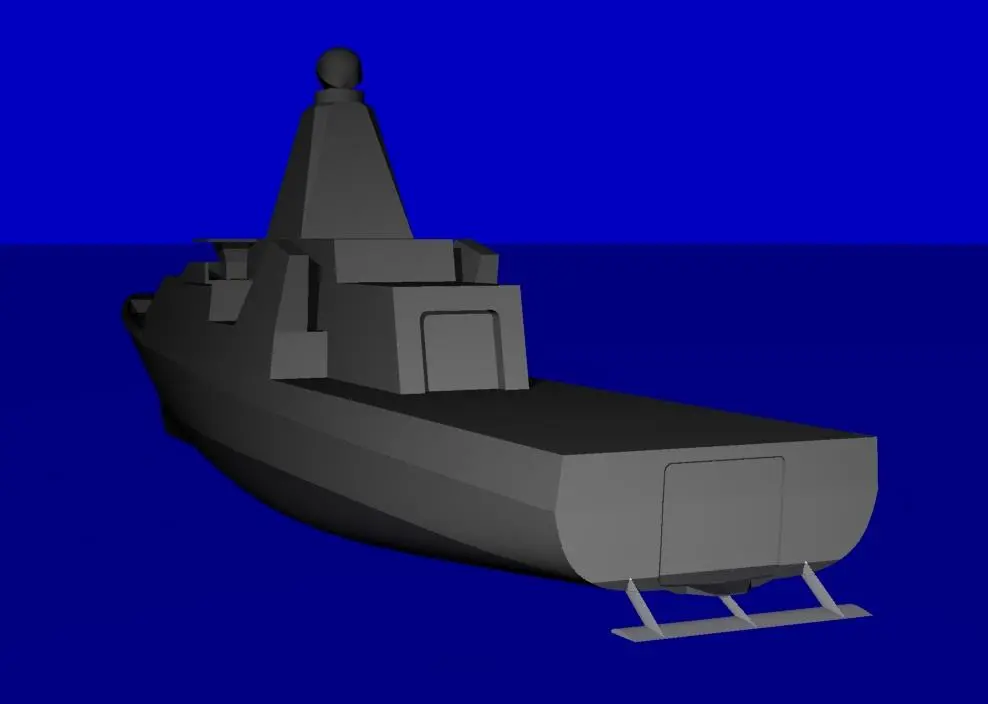
By way of a CFD study, it recently retrofitted a Hull Vane to the 108m Holland Class OPVs of the Royal Netherlands Navy to demonstrate the fin’s viability.
During the study, the Hull Vane was optimised for a speed of 17.5 knots because it was determined that based on the operational speed profile and the power curve of the ship, most fuel is consumed at speeds between 15 and 20 knots.
As the vessel has a pronounced trim wedge – incompatible with a Hull Vane – the trim wedge was partially modified to the limits set by the DMO. Subsequently, CFD runs were done to determine the resistance at 5 knots, 12.5 knots, 17.5 knots and 22.5 knots, showing resistance reductions of 1.3%, 13.7%, 15.3% and 11.1% respectively.
An annual 12.5% fuel saving means that the amount of CO2 emissions avoided should exceed 1,000 tonnes per ship per year, making the Hull Vane an extremely cost-effective CO2 abatement measure, as the investment will be paid back many times over during the lifetime of the ship.
As well as the fuel savings and emissions analysis, a seakeeping analysis was completed in a typical wave condition. This showed a reduction of the pitching movements of 7% and a reduction of the vertical accelerations on the helicopter deck of 13%. As the vertical accelerations are the limiting factor for helicopter operations, this will increase the operational capacity of the vessel.
Finally, the range of the vessel will be increased by 17% from 5,000 to 5,850 nautical miles.
As the savings are greater and the costs lower in the case of a newbuilding, the DMO has indicated that it will also consider the Hull Vane for its future newbuilds.
The Hull Vane has so far been successfully applied to a 30m passenger vessel, a 42m superyacht and a 55m fast supply vessel. It was originally developed for the America’s Cup.