



HYBRID COASTER SERIES FOR NORDIC OWNERS
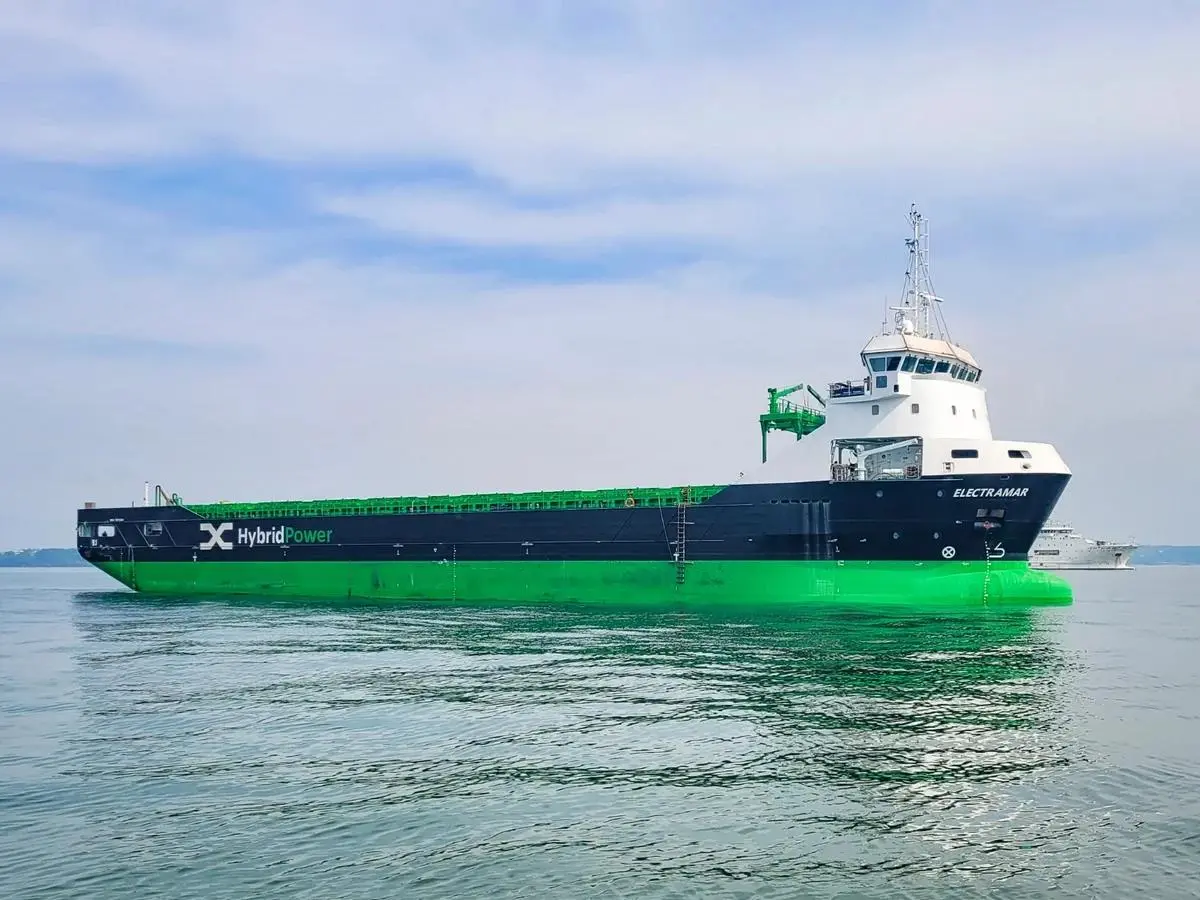
The investment programme implemented by Finnish dry bulk specialist ESL Shipping through its Swedish short-sea subsidiary, Ystad-based AtoB@C Shipping, is remarkable both for its scale, entailing 12 newbuilds, and for the innovative nature of the design involved.
The project also signifies a further advance in the export market for Indian shipbuilding contractor Chowgule & Co, from whom the entire series was ordered in three tranches, the initial six-ship commitment worth EUR70m ($77m) having dated from September 2021.
Attributed with an electric-hybrid power train, the multi-purpose type employs a fuel-flexible diesel main engine, complemented by a substantial battery pack enabling fuel-saving, zero-emission port stays, manoeuvring and peak shaving. Dubbed the Green Coaster generation, the design and model testing was undertaken in conjunction with the Dutch company SMB Naval Architects & Consultants.
The Cyprus-flagged Electramar has given first form to the class, and is set to make her debut in northwest European trade. Commissioning of second-of-class Stellamar is imminent, while the third newbuild, Ecomar, was launched at Chowgule’s Goa premises two months ago, paving the way for final block assembly of fourth-in-line Aquamar. Handover of the final vessel in the 12-ship series is expected by mid 2026.
In an alternating delivery sequence, six of the 12 newbuilds are for AtoB@C itself, while the other six will be owned by institutional and private investors, fronted by Green Coaster Shipping, also of Ystad on Sweden’s southern coast. The entire series is destined for the pool of the same name, under the commercial management of AtoB@C.
The 90m vessels are suited to the transportation of a wide variety of bulk goods and breakbulk products, and are strengthened to Finnish/Swedish ice class 1A standard and for loading and discharging aground at tidal berths.
The arrangement of the bridge and accommodation forward has optimised the hull envelope for revenue earning, and the long, unobstructed deck allows for more deck cargo and longer items of project freight compared to that possible with the company’s existing vessels. The ship’s configuration, and the compactness of the machinery spaces, is claimed to have yielded up to 20% more cargo capacity than coasters of similar dimensions.
The single, box-like hold provides a total cargo volume of 7,650m3 and incorporates three movable bulkheads and the means of providing partial tweendeck subdivision along nearly half the hold’s 60m length. The tanktop is reinforced to 15t/m3 overall and for 20t/m3 in a loading pattern. The underdeck cargo spaces are closed by pontoon-type hatch covers, creating a flush, obstruction-free weatherdeck.
The main engine is from the medium-speed portfolio of Yanmar, a marque well known for its reliability, robustness and comparative simplicity. The nominal maximum output of 1,920kW meets the requirement for the modest laden speeds in the coastal and short-sea traffic, while manoeuvring at tight berths and in restricted channels is assisted by a 300kW bow thruster.
The main propulsion machinery will run on low-sulphur fuel and is also able to burn various renewable fuels or diesel blends such as the Neste marine 0.1 co-processed fuel produced at Neste’s Porvoo refinery in Finland.
Dependency and expenditure on auxiliaries and the associated fuel consumption is lessened through the adoption of a battery pack. The Corvus Energy-supplied battery installation provides an energy storage capacity of nearly 1MWh. The ‘plug-in’ nature of the system means that the batteries can be charged from the shore when alongside, as an alternative to being re-energised by the main engine when under way.
Energy storage and the attendant electric drive solution provide for peak shaving, or delivering boost power in ice conditions, feeding the ship’s net when berthed or at anchor, and potentially also allow for port entries and departures to be made solely on battery power. Moreover, electricity can be drawn from the landside grid at suitably equipped quays and jetties, obviating the need to run a genset. The overall nature of the arrangements not only lessens fuel usage and atmospheric emissions, but also cuts down on noise disturbance for port communities.
Hoglund’s Integrated Automation System (IAS) seamlessly links alarm monitoring, control and power management systems. The IAS integrates with Hoglund’s cloud-based ship performance monitor (SPM) using data from the automation system to oversee performance in real time.
Founded in 2000, AtoB@C deploys ice-classed short-sea carriers in the 3,000-6,000dwt range, mainly shipping woodpulp, steel products, scrap, sawn timber, and other bulk commodities plus project cargoes. The company has been part of ESL since 2018 and is increasingly engaged in contract of affreightment traffic.
A recent endorsement of the Green Coaster philosophy encapsulated by the new series was expressed in a new transportation contract signed with Finnish stainless steel producer Outokumpu. The agreement will see AtoB@C Shipping cover more of the import and export traffic generated by Outokumpu’s Tornio steel mill in northern Finland.
Besides improving efficiency in the steelmaker’s supply chain, use of the Electramar class is expected to reduce voyage emissions by 40% per cargo ton relative to current vessels. Outokumpu’s environmental agenda is to realise a reduction in direct and indirect emissions of 42% per ton of stainless steel by 2030, from the 2016 baseline.
Furthermore, AtoB@C and Outokumpu are looking to use the Virtual Arrival concept as the standard operating practice whenever possible. Virtual Arrival entails adjusting ship speed in accordance with berth availability at the destination port, so as to save fuel and achieve correspondingly lessen emissions. At the end of last year, AtoB@C said that Virtual Arrival had enabled the shipping company to cut voyage emissions by 10% where the system had been applied.
The company’s new vessels are presently exempt from the Carbon Intensity Indicator (CII) and EU emissions trading regulatory edicts due to the design’s gross tonnage measurement (4,200t) lying below the 5,000gt threshold. However, with an eye to the future, and so as to provide transparency for customers, AtoB@C has taken the initiative in establishing an internal reporting system whereby emissions and the CII rating are calculated for each ship.
Execution of the Green Coaster programme denotes the attainment of a new technological level by Chowgule & Co, building on the Indian group’s extensive track record in producing dry cargo vessels for the North European short-sea owner community. The order benefited from a financial assistance scheme offered by the Indian Government to shipbuilders.
The subvention arrangements took effect in 2016 and are due to run until 2025. At the time when AtoB@C’s Finnish parent booked the initial tranche of six newbuilds, in 2021, the scheme covered 17% of the contract price or the adjudged ‘fair’ price, whichever was the lower as determined by international valuers.
MAIN PARTICULARS
Electramar
| Length overall | 89.95m |
|---|---|
|
Length bp |
84.95m |
|
Breadth |
15.95m |
|
Depth, moulded |
10.05m |
|
Draught, maximum |
6.10m |
|
Gross tonnage |
4,135t |
|
Deadweight, all-told |
5,424t |
|
Deadweight, carrying capacity |
5,082t |
|
Cargo volume |
7,650m3/271,500ft3 |
|
Holds |
1 |
|
Movable bulkheads |
3 |
|
Main engine power |
1,920kW |
|
Battery pack |
994kWh |
|
Bow thruster |
300kW |
|
Class |
LR |
|
Class notations |
General cargo ship, Unrestricted navigation, Bottom-strengthened for loading/unloading aground, *IWS, ECO, *LMC, UMS, Electric hybrid(PM, PB, ZE), BWTS, Cleanship, Green Passport, Ice Class 1A |
|
Registry |
Limassol/Cyprus |
Related Articles
 ELECTRIFICATION AND BATTERY HYBRIDS
 ELECTRIFICATION AND BATTERY HYBRIDS
 ELECTRIFICATION AND BATTERY HYBRIDS