



Hydrogen supply and storage impeding fuel cell uptake
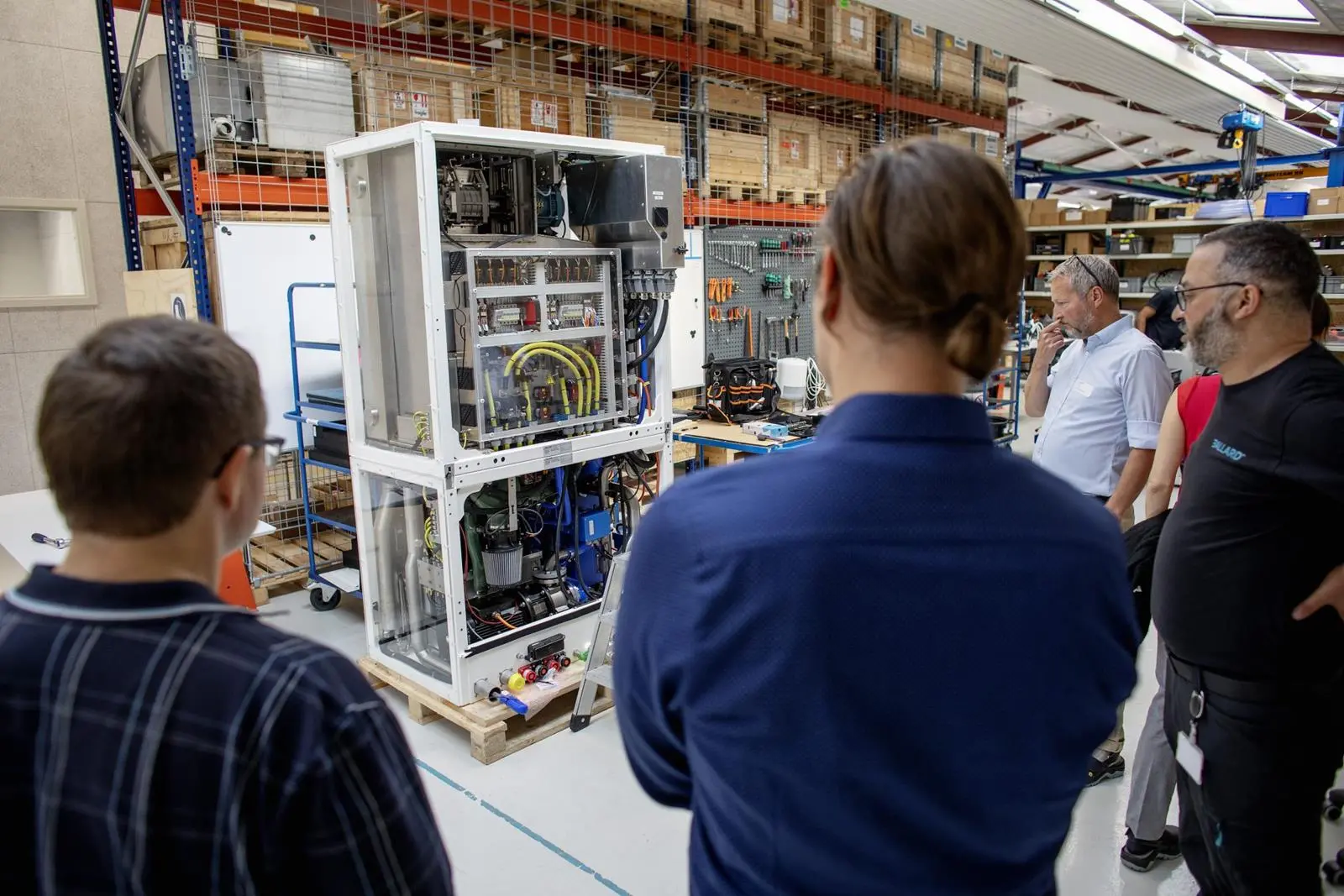
Challenges lie ahead for the marine fuel cell, but not all are what they seem, says Sami Kanerva, Global Product Line Manager, Fuel Cells, ABB Marine Ports. Fuel cell systems may take up more technical space on board ship than combustion engines for example, but they also do away with some of the auxiliary systems that eat up revenue-earning space in conventional power plant.


Fuel cell stacks and handling systems call for specialized knowledge, but most of a fuel cell’s auxiliaries are simple pumps and fans, while fewer moving parts than conventional engines should actually mean less maintenance, he says.
Harder to counter is the matter of storage space. Hydrogen has the highest energy content per mass of all chemical fuels – exceeding MGO by 2.8 times – but its lower density means it takes up four times the space (by carried energy). In liquefying at -253° C, hydrogen also needs extra layers or vacuum insulation for cryogenic storage, as well as other structural arrangements.
This will mean new developments in ship design, but it could also require a change in approach to bunkering, if hydrogen is to be both feedstock and fuel. “It’s possible hydrogen-powered ships will have to bunker more frequently than they do today,” says Kanerva.
Much will therefore rely on the hydrogen supply chain, the lack of which Kanerva describes as the “largest single obstacle” impeding progress. However, developments in land-based industries suggest that the picture is changing fast.
As a group, ABB is already investing in hydrogen power landside, believing this will establish a foundation for maritime use. ABB’s portfolio encompasses the full hydrogen value chain from production, transportation, storage to consumption. The company is working closely with partners and customers to create the new hydrogen ecosystem. Commitments to green hydrogen include developments projects in Italy (partnering with Swiss utility company Axpo), France (working with Lhyfe) and Canada (Hydrogen Optimized).
“The World Economic Forum projects that, if all of the land-based projects announced by industry involving hydrogen as a fuel become reality, they could amount to 60 gigawatts of power by 2030,” says Jostein Bogen, Global Product Line Manager, Electric Solutions, ABB Marine & Ports. The resulting scale-up in manufacturing capacities could reduce the cost of electrolysers by 70% over the same period. DNV, meanwhile, has suggested that enabling policies in Europe make it likely that hydrogen will contribute 11% to its energy mix by 2050.
“With the landside supply chain in place, the technical progress and approvals we have secured will mean the marine fuel cell is ready to make its full contribution to shipping’s decarbonisation goals for 2050,” he says.
According to the World Economic Forum, more than 100 pilot and demonstration projects are under way which use hydrogen or its derivatives to fuel shipping. Using the reaction between hydrogen and oxygen to convert chemical energy into electricity which emits only clean water and heat, fuel cells offer far higher efficiency than combustion engines.
ABB has supported numerous customers in passenger and cargo segments with the planning of onboard fuel cell systems. It is also one of the key technology partners in FLAGSHIPS – the EU-funded, Seine River project which aims to deliver the world’s first commercial cargo ship with hydrogen propulsion, with a prototype vessel due delivery to Blue Line Logistics (BLL), a subsidiary of Sogestran Group, later this year. Ballard Power Systems Europe has been granted Design Review Attestation from classification society Bureau Veritas for the two 200kW FCwaveTM fuel cell modules that will be installed on board the Flagships project vessel Zulu 06.
From the technical standpoint, marine fuel cell technology is mature enough to deploy as a zero-emission alternative auxiliary power source for ships in power ranges of 1-3 MW, while practical applications could be made to 10-20 MW, says Kanerva.
Together with Ballard Power Systems, ABB has already secured Approval in Principle (AiP) from DNV covering a PEMFC cell capable of generating 3MW of electrical power. It also recently signed an MoU with RINA on decarbonization which includes a commitment to developing fuel cell systems.
ABB is looking into both proton exchange mechanism (PEM) and solid oxide fuel cell (SOFC) variations. Both use hydrogen as their fuel, although the SOFC can be installed with its own reformer so that other fuels (e.g. LNG, methanol or ammonia) can be used as feedstock.
Related Articles
 BATTERIES, SUPERCAPACITORS, FUEL CELLS AND OTHER ENERGY STORAGE TECHNOLOGY
 BATTERIES, SUPERCAPACITORS, FUEL CELLS AND OTHER ENERGY STORAGE TECHNOLOGY
 BATTERIES, SUPERCAPACITORS, FUEL CELLS AND OTHER ENERGY STORAGE TECHNOLOGY