



In search of the better battery
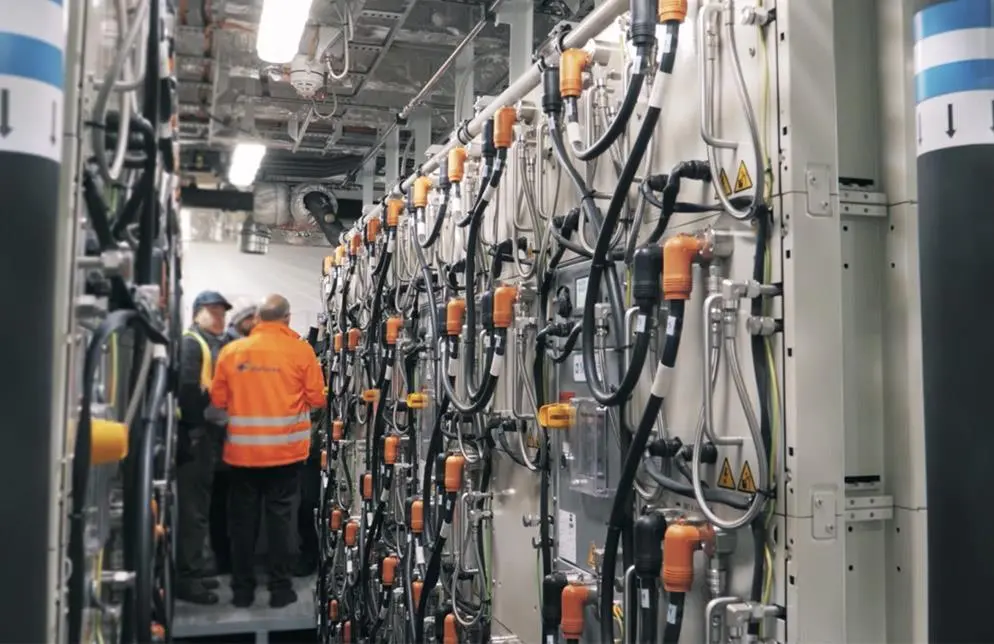
So far, lithium-ion battery adoption in the marine industry “has been driven by widespread availability and large-scale manufacture of batteries for road vehicles”, says Duncan Duffy of Lloyd’s Register, so pragmatically, development has crystallised around what’s on offer rather than the ideal candidate.
However, while general battery storage prices have fallen sharply to US$156/kWh and energy density also rose to around 250kWh/kg, don’t necessarily expect this trend to continue unabated: there are limits to the amount that current tech can reasonably deliver.
It’s down to the physics. While present lithium-ion batteries still fall a little shy of its theoretical 350Wh/kg, “you’re fighting harder and harder to get to these higher efficiencies”, points out Denis Pasero of energy storage specialist Ilika.
While it’s possible to tweak li-ion’s characteristics, there’s always a flipside. “For example, silicon in the anode increases energy density… but it decreases lifetime,” says Henrik Helgesen, of DNV GL. Likewise, “lower cobalt, higher nickel chemistries reduce cost and increase energy density – but it decreases lifetime and thermal stability”.
So, what’s next? Solid-state batteries are certainly a contender.
It appears there’s something of a technology race to get these up, running and commercially viable. Ford, Hyundai, Nissan, Toyota and Volkswagen have all invested in automotive-directed research – but it’s not been straightforward, and Dyson relinquished its electric car ambitions last year. This is relevant to the marine industry because its own energy storage has, so far, piggybacked onto automotive developments.
ENERGY & POWER DENSITY
But when (not if) it does become commercially viable, solid-state battery technology should deliver quite a bit more for the marine industry to play with. According to Helgesen, despite predictions that are “still rather uncertain”, energy density figures fall somewhere between 300 and 600Wh/kg: Dyson partner Sakti3 has claimed its solid-state batteries already reached 400Wh/kg under tests. “It could raise the range of electric vessels two or three times,” adds Helgesen.
Further, Pasero explains that solid-state batteries will have a significantly increased cycle life – potentially four or five times that of liquid electrolyte li-ion. This should push down the investment cost and bring it closer to a ship’s own lifetime – no five or ten-year cell replacement to factor into the investment.
Importantly, these batteries should also pack far more punch: “There’s a potential for 3,000W/kg output, so weight for weight a solid-state battery may provide six times the power of standard li-ion cells,” says Pasero.
Likewise, charging time is reduced: that’s down to 16% of the standard li-ion. He adds: “We think an installation that would normally take hour could be fully charged in 10mins. So it’s quick.”
This, in turn, could broaden onboard battery applications: a higher, faster power draw could allow batteries to pick up a worthwhile segment – if not all – of the regenerated charge from onboard cranes, potentially dropping the expense of supercapacitors on the cranes and bringing the harvested energy back into the primary power distribution grid.
It could also support the auxiliary gensets which provide substantial, megawatt-scale reefer draw onboard containerships. The interest is already there: Maersk is installing a (standard) 600kWh battery pack to underpin reefer and thruster demand alongside providing emergency power onboard a 4,500teu, 150-plug feeder vessel.
Solid-state batteries may allow even more ambitious configurations, although as Duffy explains, “you have to be careful that if your battery source has multiple uses including emergency power, you protect that emergency capacity from critical depletion”. So, while higher in energy density, solid-state battery installations will still require designers to do the sums.
It could also move the business case forward: as Helgesen admits, “it can be hard to justify the expense of the batteries if peak-shaving does not enable running fewer engines, or more optimal average engine loading”.
According to Brent Perry of SPBES, it’s not the size of the battery that makes the most significant difference to commercial viability, “it’s how often you use it”. He adds: “You really need to utilise your energy storage in as many ways as possible to generate payback.” Duffy goes on to say that even “incremental gains”, like regenerated energy from a frequently used crane, will contribute to overall efficiency.
CHEMISTRY
Interestingly, the chemistry is not very different to standard lithium: “What’s different is the solid electrolyte,” says Pasero. There are many candidates including polymer bases, but Ilika’s pursuing a robust, lithium oxide ceramic mixed with a smattering of other metals.
Overall, the key advantage is that instead of swamping the battery in liquid, the anode, cathode and electrolyte are sandwiched together without a separating membrane – and the physical layers can be really very fine. Ilika’s medical implant batteries are manufactured by a thin-film vacuum deposition process and are under 3mm in each dimension.
While scaling up to larger sizes requires 3D printing, it’s still possible to manufacture a standard pouch cell with dozens of layers. This could significantly decrease the footprint: according to Pasero “it may result in a total package that’s a third to half of present installations”.
There are a few hurdles to overcome, as sticking these layers together isn’t so easy as with a liquid, he explains: “The main technical issue is making sure the components – anode, cathode and electrolyte – are in good contact on an atomic level so that the ions can migrate across.”
It’s a tiny, persistent problem that a number of companies are racing to solve: grain boundary defects are simply the result of non-aligned atoms “but they’re the largest cause of resistance and if we don’t fix this, the batteries will be sluggish”, says Pasero.
SAFETY
This solid electrolyte also avoids the hazards of conventional lithium liquids. Duffy outlines how these can go into thermal runaway, releasing heat as well as giving off toxic and-or flammable gases which can build up to explosive conditions if not mitigated.
By comparison, “solids dissipate the temperature better across the current collectors”, says Pasero. It also provides a barrier against dendrite growth – pin-like alkali metal crystalline structures that can pierce through liquid electrolyte and create a short circuit. That doesn’t mean it avoids them entirely, some may still form along the grain boundary and disrupt the contact, although the other metals in Ilika’s mix should mitigate growth.
Despite this, solid-state cells still have a thermal issue, but as its conductivity is dependent on warmth, the challenge is reversed: “In colder conditions, they might need some slight heating,” says Helgesen, though “the normal ambient room temperature onboard” should be enough.
LI-AIR
Current li-ion batteries utilise reactive metals to embed electrons in their oxygen matrix. However, it’s possible to remove the metal elements and store electrons in the air itself.
The theoretical specific energy of li-air batteries is 11kWh/kg, which is comparable with diesel (13kWh/kg). However, taking the passive material in the cell into account, the indications so far are that lithium-air batteries could potentially reach about 10 times the capacity of current offerings: although Helgesen notes that these numbers are even more uncertain than for solid state chemistries, “at the top end it could compete with diesel engines especially as they don’t suffer from the same losses as combustion fuels, so connected with electrical drives they could have a 90% overall efficiency”.
But, again, there are a few problems that stand in the way: “They are still vulnerable to moisture and CO2. You have to purify the air, so as yet, they’re not commercially produced,” he adds.
These aren’t the only lithium chemistries on offer: others are being explored. For example, lithium-sulfur (Li-S) uses carbon-sulphur as the cathode with lithium metal on the anode, possibly resulting in twice the energy density of conventional li-ion batteries.
However, as Duffy notes, there’s an environmental cost to present chemistries “as they also use rare raw materials such as cadmium along with lithium”. He adds since “mining operations impact the local environment, there’s a need to develop a circular economy for lithium technology’s life-cycle”.
ZINC ION
Here, Helgesen points to an entirely different chemistry that sidesteps both cost and environmental issues: aqueous zinc-ion batteries (ZIBs) are beginning to grab attention as people are evaluating their characteristics, including electrochemical stability, little-to-no chance of thermal runaway or fire risk, plus environmental friendliness, and they can also be manufactured from non-toxic materials.
The search for the best zinc pairing is still on, with cathode candidates from manganese to vanadium oxide, tests coming out anywhere between 100Wh/l and around 450Wh/l on a test bench.
However, this doesn’t compete with the 670Wh/L top of li-ion’s range, and as Hegesen adds: “At least at present, ZIB’s energy density is not really a step up”. So, what’s the attraction?
He points out there is an increasing demand for high safety but low-cost energy storage devices: zinc is plentiful and cheap as chips. Further, Helgesen explains “it’s really a trade-off. You need the same amount of stored energy, but if you can reduce part of the safety system and replace that with more batteries, the required volumetric energy density at system level might be adequate for some vessels, and it’s far cheaper to install.”
GRAPHENE
Graphene, at just a molecule thick, may add a completely different dimension to both present and future battery technologies – and be one of the first innovations to make a difference.
Certainly, Andrea C Ferrari believes that silicon-graphene composites “are close to becoming useful”. He says: “Silicon has a higher volumetric capacity, but it degrades as you work it as a battery anode. So the idea is to embed graphene into the silicon so we can get the best of both worlds – the surface area properties of graphene and a large charge.” How much could this yield?
He answers: “At the moment we are seeing a capacity increase of 30 to 40%: but theoretically it could be 10 times better than silicon alone.”
Graphene could also be utilised in other ways: in the cathode, and also mixed with electrolyte. “Its high surface area and porosity can be ‘tuned’ making it useful for storage, or as a matrix for embedding active material,” says Ferrari. So, it could further other chemistries still on the horizon, such as lithium-sulphur or lithium-air batteries.
There are other possibilities: for example, Duffy points to LR funded research into aluminium polymer batteries utilising ionogel electrolytes which may not need a separator at all. It’s all some way off, but future developments promise to encroach on supercapacitor territory, having a very high degree of electrochemical stability and efficiency plus a hugely improved cycle life.
COMBINED
However, while we wait for the magic bullet, a mix’n’match approach could give marine batteries the best of all possible worlds – and help to drop the overall price.
“We already know that there are different types of chemistry for different types of operation,” says Helgesen. For example, a battery for redundancy might need high power – maybe for half an hour or so – but it won’t be used very often so it can afford for the demand to be a few times its usual C-rate. On the other hand, a battery for more regular utilisation will need far more in the way of energy density and cycle life. He adds: “Maybe a hybrid battery is the answer.”
Pasero explains: “You could have two types of cells, triggered by different messages from the Battery Management System. It’d be less expensive than separate systems, you’d end up with lower costs and a more efficient installation.” And as it’s something already being researched by the high-end car and racing industry, it may cross over to shipping.
MARKET
Duffy admits “it’s difficult to predict the extent that these laboratory research projects will contribute to onboard CAPEX reductions… particularly until these batteries are available at scale”. However, he believes these “will become cost-competitive with systems using confined raw materials like cobalt” despite recycling and recovery initiatives.
It will undoubtedly take time to get these ‘economies of scale’ going. “We are working with niche markets to help absorb the initial cost of solid-state batteries,” says Pasero: “but because it’s new technology there’s no immediate supply chain.”
And, it has to be said, even after these developments trickle through, something that might take five or more years according to Luke Gear of DTechEx, the overall cost benefits for the marine segment still stand to be slightly muted. Helgesen points out that the price of new chemistries goes down if it’s pushed by the automotive sector “but then you need to make a marine system and the costs go up again”. Gear adds: “Most maritime battery prices at the pack level are currently stabilised between US$500 and US$700 per kWh, depending on chemistry and project sizes,” something he expects to remain the case for the next couple of years.
After all, “when you build a car you mass produce it and the investment is borne by a large number of units” says Helgesen. “But with a ship, you are always reinventing some part of the wheel; all of them are ‘one of a kind’ so it’s harder to spread the costs.”
Related Articles
 ELECTRIFICATION AND BATTERY HYBRIDS
 ELECTRIFICATION AND BATTERY HYBRIDS
 ELECTRIFICATION AND BATTERY HYBRIDS