Italian Yard Strengthens Ro-Pax Brand
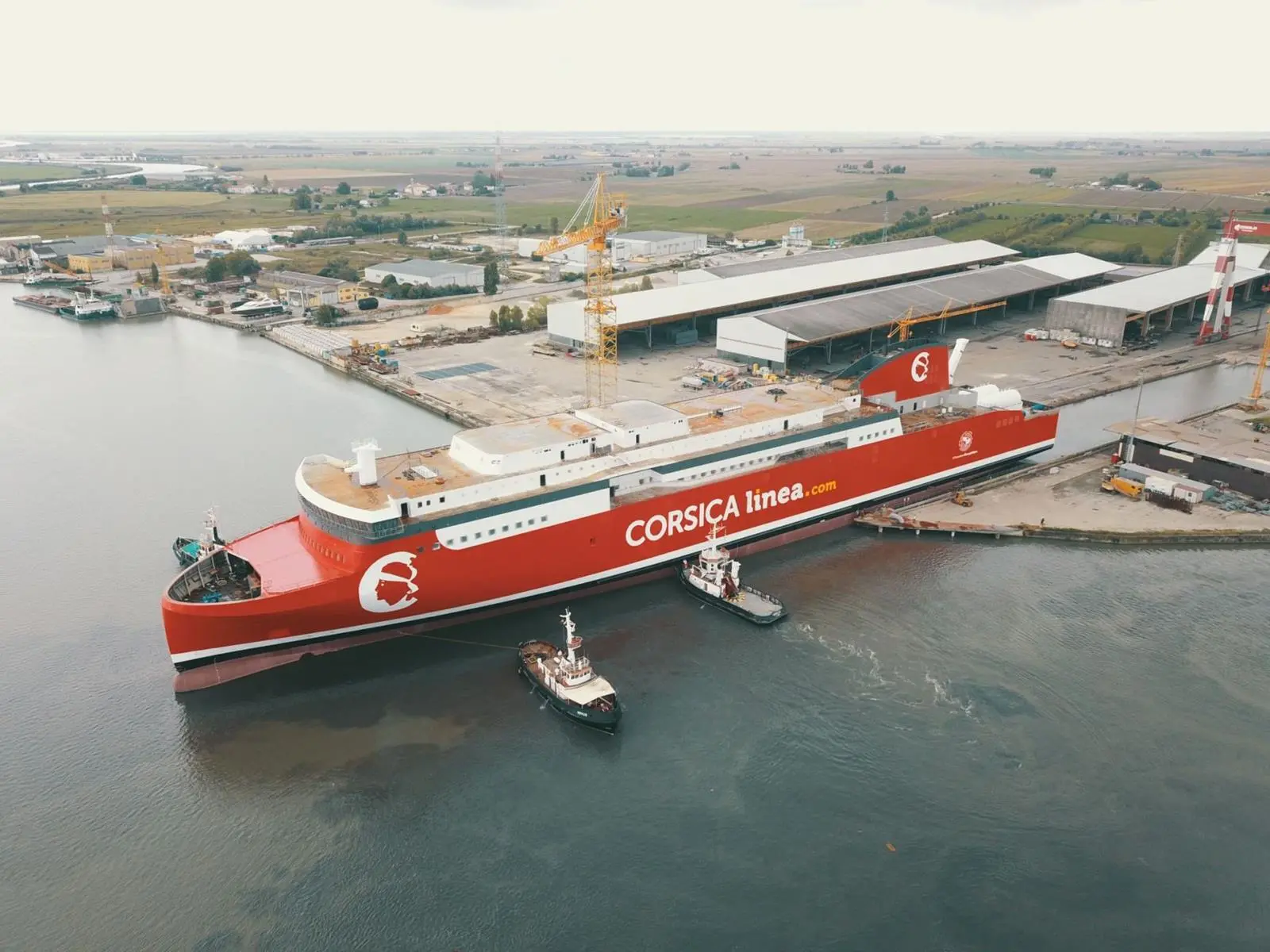
The newbuild is a further iteration of a type produced by the northeast Italian yard for multiple European operators since the mid 1990s, to the extent of having created a ‘brand’ in the short-sea ro-ro and ro-pax charter and shipowning markets. Developed by Trieste consultancy NAOS Ship and Boat Design, the Visentini series has been taken to a new level of hydrodynamic efficiency and environmental standard in the latest project.
With a beam at the maximum for the construction dock at the riverside Porto Viro yard on the Po delta, the ship for Corsica will have capacity for about 900 passengers and will offer 2,560 linear metres of garaging on the trailer decks plus extra deck space for 150 cars.
The Visentini product characteristically offers fast transits in laden condition, and the new vessel is no exception, with a twin main engine plant of some 23,400kW driving controllable pitch propellers for a specified speed of 23 knots. Rotational energy from the drive lines will also be harnessed by two 2,000kW shaft generators to meet the electrical load while under way and when manoeuvring with a pair of bow thrusters.
As on previous Visentini ro-pax ferries, all access and egress is across the stern ramp at main deck level, requiring vehicles to turn within the ship on arrival. Garaging for freight will be primarily on the main and upper decks, at 5.2m headroom, complemented by a certain provision in the lower hold, albeit with less clearance(4.6m), plus a dedicated, fixed car deck.
After a decade of production, the NAOS/Visentini breed had been refined in 2004 with the proprietary FlexBow. The Corsica Linea newbuild hosts an improved FlexBow 2.0 design form, yielding an incremental gain in efficiency.
Credit Agricole, led by its Corsican division, arranged the syndicated loan for the newbuild. Corsica Linea’s position as a signatory to the SAILS charter (‘Sustainable Actions for Innovative and Low-Impact Shipping”), and the nature of the vessel’s engineering design, influenced the financing scheme according to so-called ‘green loan’ principles.
A further vessel of the type is contemplated by the French company, promising continuity of Visentini production.
The yard is no stranger to LNG powering, having completed two 186m ro-pax ferries with Wartsila 46-series dual-fuel propulsion for Spanish operator Balearia in 2019. Compatriot Trasmediterranea received the 203m Ciudad de Valencia in 2020, fitted with twin MaK diesels and signifying the Italian yard’s largest and longest vessel at this stage. A similar ship, GNV Bridge, was commissioned into Barcelona/Valencia-Mallorca-Ibiza service earlier this year under charter to Grandi Navali Veloci of Italy from the Visentini Group’s shipowning affiliate Visemar di Navigazione.
GNV Bridge features a prototype of the Wing Sail Module (WSM) auxiliary propulsion system conceived by a NAOS-led Italian research. consortium