



Korean companies plan vanadium-ion battery by 2023
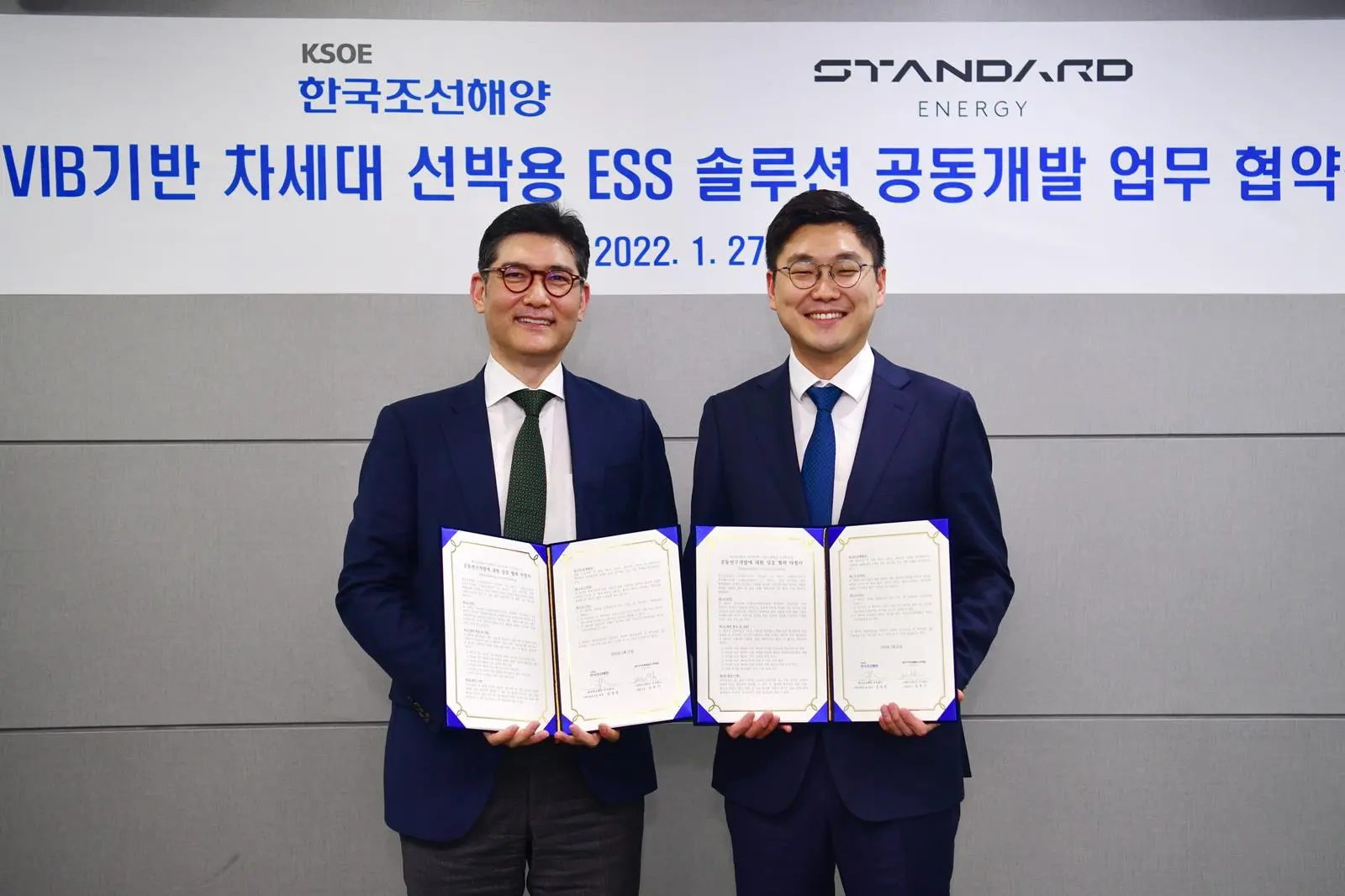
The MoU represents the two companies’ commitment to demonstrate vanadium-ion energy storage systems at megawatt scale on small-sized ships at sea and develop next-generation ships such as electrically powered ships and power transfer vessels.
Vanadium is a soft, grey, plentiful metal mainly produced from magnetite. It has the highest strength to weight ratio of any metal, and it also defies the Wiedemann-Franz Law which states that good conductors of electricity are also good conductors of heat.
Use of vanadium dates back to the third Century BC when high-strength “Damascus steel” was used for forging swords. The first wide-scale industrial use of vanadium occurred in 1905 when Henry Ford used vanadium-enriched steel to make the Model-T stronger and lighter. Today, it continues to be used to strengthen steel rebar, to dissipate heat in engines, computers, robotics and energy storage and as a key component in the manufacture of smart glass, aviation alloys, manufacturing and health formulations.
Vanadium redox flow battery technologies date back to the 1980s, with work led by Professor Maria Skyllas-Kazacos of the University of NSW (UNSW Sydney) in Australia. The first patent for the All-Vanadium Redox Flow Battery was filed in 1986, and this was the start of a 35-year program at UNSW that continues today.
The Motorship covered the technical possibilities of the technology in a feature in January 2021.
Unlike conventional batteries, redox flow batteries have electrolyte liquids stored in separated storage tanks, not in the power cell of the battery system. During operation, the electrolytes are pumped through the stack of power cells to produce electricity.
Vanadium redox flow batteries are non-flammable, reusable over hundreds of thousands of cycles (compared to several thousand for lithium-ion batteries) and last more than 20 years. They can be scaled up to deliver energy for a wide range of applications without generating significant waste heat, and they can extend energy storage time well beyond lithium-ion’s typical four to eight hour operating time.
Related Articles
 BATTERIES, SUPERCAPACITORS, FUEL CELLS AND OTHER ENERGY STORAGE TECHNOLOGY
 BATTERIES, SUPERCAPACITORS, FUEL CELLS AND OTHER ENERGY STORAGE TECHNOLOGY
 BATTERIES, SUPERCAPACITORS, FUEL CELLS AND OTHER ENERGY STORAGE TECHNOLOGY