LNG and bio-methane: A pathway to lower carbon
However, one of the major criticisms aimed at LNG dual-fuel engines is methane slip, the emission into the atmosphere of unburned methane fuel. Methane is a powerful greenhouse gas – believed to be some 30 times more potent than CO2 over a 100-year period.
The industry has gone to great lengths to dispel fears of LNG as fuel turning out to be less ‘green’ than expected; not least the maritime collective SEA-LNG which has commissioned various reports and published numerous papers about the subject. SEA-LNG quotes a GHG reduction in the order of 20% or more compared with fuel oils, even taking into account methane emissions.
Engine builders have been working hard to address methane slip. The first two-stroke gas fuelled engines built by MAN Energy Solutions and its licensees, the ME-GI series, used high-pressure fuel supply systems, running on the Diesel cycle, which offered relatively low methane slip. Wärtsilä, now WinGD, introduced its two-stroke dual-fuel engine operating on the Otto cycle, which offered a much simpler fuel system, and hence lower capital investment, as well as improved NOx performance, being able to meet IMO Tier III limits without exhaust after-treatment. MAN has responded with its lower-cost Otto-cycle ME-GA variant.
The Otto cycle – four-stroke dual fuel engines tend to run on the Otto cycle too in gas mode – mixes gas and air before entering the cylinder, where the mixture is ignited by a pilot flame. This increases the likelihood of unburned fuel being emitted with the exhaust gases, i.e. methane slip. The amount of unburned fuel can be reduced by improvements in combustion chamber design and valve timing, and this is where engine designers have been concentrating their efforts.
Other technologies are being developed to reduce methane slip; such as the SlipPure from Daphne Technology. SlipPure is an exhaust gas after-treatment system based on plasma-catalytic technology which oxidises methane in the exhaust gas, converting it into CO2 and water. The latest version of the technology is said to enable high methane slip reduction at relative low exhaust temperatures, and has received approval in principle (AiP) from both Lloyd’s Register (LR) and DNV.
Panos Mitrou, LR global gas segment director, said: “LR has been working with Daphne Technology for several years and following recent testing, it’s clear that its plasma-catalytic technology is moving the bar in helping companies to meaningfully mitigate methane slip in the maritime and land-based oil and gas industries.”
When used in conjunction with Daphne Technology’s PureMetrics measurement system, shipowners can have accurate quantification and reporting of GHG emissions, including methane.
SEA-LNG is confident that methane slip can be eradicated at sea, as it has been already in smaller gas-fuelled engines on land.
Peter Keller, chairman SEA-LNG said: “It is reassuring to see growing evidence that the challenge of methane slip will be eliminated within this decade. There is universal agreement that the science is understood, and we have the necessary tools and technology to abate methane emissions, it is the final elements of the engineering that are being worked on.”
Wärtsilä has been investing heavily in its dual-fuel four-stroke engine series to reduce methane slip. The latest version of the Wärtsilä 31DF is said to have achieved an average 41% reduction in methane emissions compared to its predecessors. Even that is not always enough – one recent project, undertaken by Wärtsilä in partnership with Chevron Shipping, is to convert one of the three 12V50DF engines on six Chevron-operated LNG carriers from dual-fuel to spark gas (SG) operation running solely on LNG. This uses spark ignition rather than diesel pilot fuel to initiate combustion, enabling a more optimised combustion process.
Roger Holm, president of Wärtsilä Marine and EVP Wärtsilä Corporation said: “This innovative project represents a notable step forward on the road to advancing lower carbon fleets. Wärtsilä has an extensive track-record in reducing methane slip from LNG-fuelled engines, not only as newbuild solutions, but also through retrofitting existing installations.”
Even advocates of LNG as marine fuel regard LNG as an interim fuel, bridging the clean shipping gap between polluting fossil fuels and the true zero-carbon future options. Just as diesel fuel can be synthesised or produced biologically, bio-gas can be produced from waste material.
Biogas is produced from the decomposition of organic agricultural or livestock waste by anaerobic digestion processes. The basic biogas comprises a mix of methane (CH4) and CO2. To make this suitable for ship fuel, and align it more closely to natural gas, this biogas can undergo further treatment to eliminate the CO2 as well as other organic impurities, increasing the ratio of methane content.
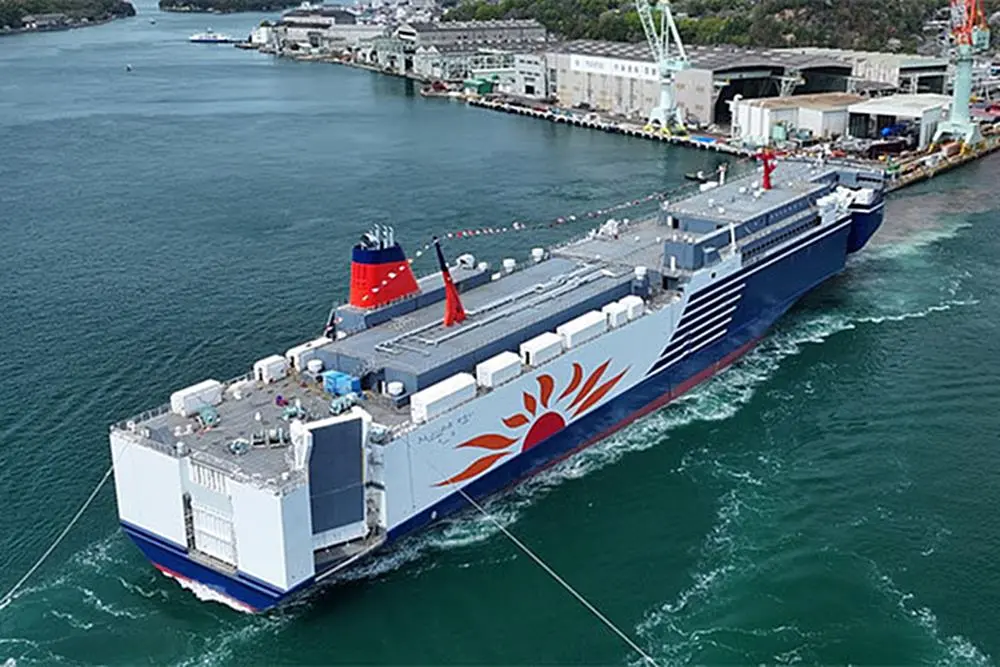
A project is underway in Japan to study production and consumption of bio-methane from animal waste produced by the dairy products industry. Mitsui OSK Lines ferry operating subsidiary MOL Sunflower is one of five local partners evaluating the feasibility of using all or part of the biomethane produced by dairy cattle to fuel vessels. MOL regards biomethane as a potential energy source for the ultimate goal of decarbonisation of MOL Sunflower’s vessels.
Ro-ro operator United European Car Carriers (UECC) and fuel supplier Titan Clean Fuels recently undertook a month-long series of liquefied biomethane (LBM) bunkering operations in the Port of Zeebrugge. During the month of July 2024, Titan bunkered bio-LNG (ISCC-EU certified mass balanced LBM), to all of UECC’s LNG dual fuel car carriers calling at the port. Three of these vessels also feature battery hybrid technology, further enhancing their environmental performance.
The waste feedstock from which the LBM was derived offers significant potential in reduction of , GHG emissions. In this ‘Green Gas Month’ alone, UECC calculated the well-to-wake emissions reductions in excess of 8,000 tonnes of CO2 equivalent.
Daniel Gent, UECC energy and sustainability manager, said: “Through the use of biomethane, ‘Green Gas Month’, and ‘Sail for Change’ more broadly, we are providing our customers with a great springboard to further their own decarbonisation strategies.”
Flip Dankelman, a Titan trader, added: “We are pleased to be working with UECC on these major LBM bunkerings and hope these are the first of many more clean fuel operations with them. The mass balanced LBM via Fluxys’ LNG Terminal in Zeebrugge is a practical, realistic and cost-competitive way to use clean marine fuels today.”
According to Titan, LBM is now being introduced at scale. Depending on the feedstock used, LBM can offer net-zero GHG emissions or even net-negative potential if the avoided emissions of waste processing are taken into account. The next phase is the introduction of e-methane produced using renewable electricity and electrolysis. All of these molecules can be blended at any ratio and used in existing LNG infrastructure without adaptation. The growth in adoption of bio-LNG is seen as timely, with the soon-to-be implementation of the FuelEU Maritime regulation, which is expected to incentivise the use of renewable fuels.
Finland-based Viking Line has carried out a similar exercise by running its vessels, Viking Glory and Viking Grace, on the Turku route for a week, solely on biogas, supplied by Gasum, which reduced GHG emissions by 90%.
Viking Line sustainability manager, Dani Lindberg said: “This is an historic moment for us, the Baltic Sea and maritime transport. Scheduled services have never before been powered solely by biogas. We have invested €450m in our climate-smart vessels Viking Grace and Viking Glory, and one of their most important features is that they can run on LNG, biofuel and future synthetic fuels produced from renewable energy.”
The biogas supplied by Gasum is made in Europe from food and agricultural waste, with the origin of each gas consignment clearly documented.
Viking Line is involved in efforts to develop a green sea corridor between Turku and Stockholm and between Helsinki and Tallinn, where the transport of cargo and passengers can be achieved with carbon neutrality, in line with EU and IMO GHG reduction targets.