LNG debate highlights fuel choice challenge
At the seventieth sitting of IMO’s Marine Environment Protection Committee (MEPC) last week, a global 0.5% cap on fuel sulphur was set for 2020 and two new NOx emission control areas, in the Baltic Sea and North Sea, were designated with effect from 1 January 2021. A mandatory fuel consumption data collection system was also established as the first step towards further measures to reduce CO2 emissions.
The sulphur cap is most pressing, giving ships three years to adopt low-sulphur fuel oil, employ scrubbers to clean heavy fuel oil (HFO) or switch to alternative fuels – of which LNG is the most prominent. But long-range CO2 reduction ambitions are also encouraging ship owners to consider their fuel choices.
In an article on Bernard Schulte Group, news agency Reuters claimed that ‘global efforts to cut carbon dioxide emissions will be key for the adoption of LNG as a marine fuel’. This has prompted a backlash from Ian Adams, CEO of the Association of Bulk Terminal Operators, who described the statement as ‘a complete falsehood’ and expressed dismay that ‘the LNG myth has progressed unchecked’.
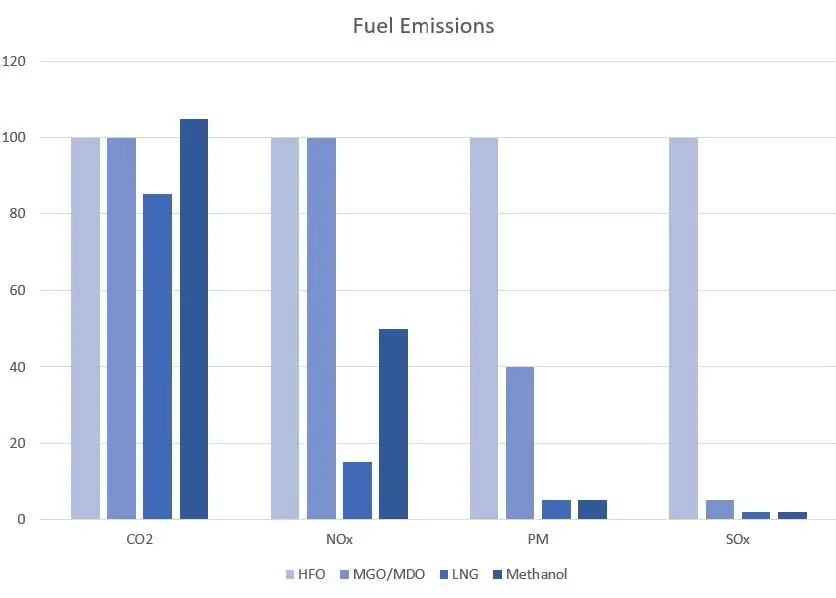
The CO2 emission benefits of LNG over heavy fuel oil are not of ‘a large magnitude’, Adams argued, and when potential slippage of methane is considered the total impact on GHG emissions is negligible. Methane, a major component of LNG, is reported in several well-regarded studies as contributing 25 times more to the greenhouse effect than CO2 over a 100-year period.
Adams said: “If we, rather generously, accept that burning LNG will reduce CO2 emissions by 20% over the current level it would require less than 1% methane slip for there to be no gain from a GHG perspective… I think we would be better looking at technology that will allow the continued use of HFO, marine diesel oil or marine gas oil for a fleet of over 60,000 vessels.”
CONTESTED CLAIMS
Those claims are strongly contested by proponents of LNG. Classification society DNV GL, which classes more than two-thirds of the 86 LNG-fuelled vessels (excluding gas carriers and inland vessels) currently in operation, told The Motorship: “LNG has the potential to reduce GHG emissions by up to 25% if methane leaks can be eliminated in the production and combustion phases. In practice, some leaks should be expected, and best practices and appropriate technologies for minimising them should be utilised. This can lead to realistic reductions of GHG by 10-20% compared with conventional oil-based fuels.”
Designers of both four-stroke and two-stroke LNG engines report ever more effective protection from methane slip. MAN Diesel & Turbo claims its ME-GI models, accounting for nearly all two-stroke LNG engines in operation, suffer from only 0.1% slip. Wärtsilä, the dominant supplier of LNG four-stroke engines, notes that methane slip from its engines (of around 6g/kWh) still means a 5-10% reduction in GHG emissions compared to engines running on HFO.
Operational experience from one early adopter also suggests that LNG can help ship operators achieve big CO2 reductions. Peter Keller, executive vice president of Tote Inc, noted that the company has recorded a CO2 reduction of around 72% since putting two LNG-fuelled containerships – powered by the first two newbuild MAN ME-GI engines – into operation between Jacksonville and Puerto Rico. Of that reduction around 25% is from the use of LNG itself, with the remainder accounted for by the increased efficiency of the new engines.
Speaking in his role as chairman of SEA\LNG coalition, Keller said: “Compared to existing heavy marine fuel oils LNG can, depending on the technology used, emit 90% less nitrous oxides (NOx) and 20-25% less carbon dioxide (CO2). While these numbers are not perfect, they do move the maritime industry aggressively in the right direction.”