LNG POWER FOR COASTAL TANKER SERIES
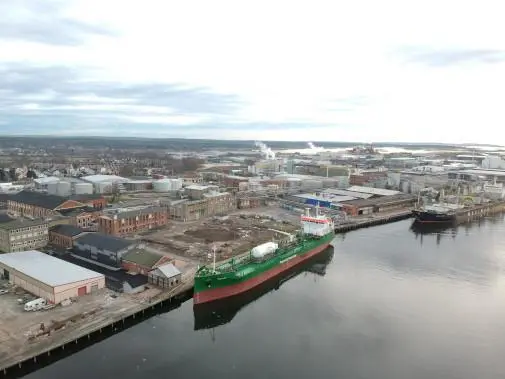
ENCAPSULATING a new commitment to LNG fuel as a means of meeting regulatory controls and as part of a broader ‘green’ agenda, Thun Tankers has commissioned the first in a series of coastal tankers engineered to heightened efficiency and environmental standards.
The 7,999dwt Thun Eos, built to transport oil products and IMO Type 2-designated chemical cargoes in the European distributive traffic, leads a production run of four such tankers entrusted to Ferus Smit at its yard on the Winschoterdiep waterway in the north Netherlands.
The project is testament to a longstanding relationship, whereby the parent Swedish shipowning group, Erik Thun, has received more than 30 dry cargo vessels and tankers from the Dutch shipbuilder over the years. Salient to the adoption of a Wartsila dual-fuel installation in the latest tanker, similar main engines are employed in two modern cement carriers built by Ferus Smit and deployed by Thun in a joint venture with Norwegian group KG Jebsen.
Thun Eos and her upcoming three consorts of the E-class will replace some of Thun’s slightly smaller tankers constructed by the Dutch shipbuilder since the end of the 1990s. The in-house design draws substantially on elements of the existing G-class vessels which have shown their mettle in the intensive and highly competitive north European trade, working from refineries to depots and industrial users and on inter-refinery movements. Strengthened to Ice Class 1A criteria, the trading capability extends to year-round Baltic navigation.
Thun Eos began trading during December. Second-of-class Thun Evolve is scheduled to enter service in March 2019, and will be long-term leased by Swedish fuel company Preem for distributive work around the coasts of Sweden, Norway and Denmark. The third and fourth newbuilds are due to be ready in 2020 and 2021.
Within main hull dimensions of approximately 115m length overall and 15.9m breadth, a revenue-earning volume of some 9,600m3 is provided in nine cargo tanks fitted for five double-valve segregations.
The cargo spaces are treated with Jotun’s Tankguard Flexline coating, to give the requisite chemical resistance and facilitate the short turnaround times demanded in the coastal trade. Each tank is equipped with a Framo stainless steel deepwell pump rated at 350m3 per hour, for a maximum ship discharge of up to 1,500m3/hour where the shoreside facility permits. Purging is by nitrogen, and the loading rate per tank is 400m3/hour.
The main engine is a six-cylinder model of Wartsila’s 34DF dual-fuel medium-speed type, allowing operation on diesel fuel or LNG, or alternatively liquefied biogas. The machinery permits seamless switching between fuels, without power loss. The installation in Thun Eos is rated at 2,999kW, suiting an efficient manning level under Dutch flag registration, and conferring a speed of about 13 knots. Drive is geared down to a controllable pitch propeller mounted in a nozzle ring so as to maximise hydrodynamic efficiency in translating shaft power into propulsive thrust.
The two auxiliary diesel gensets, yielding 280kW/328kVA apiece, are based on Scania prime movers. The Dutch company Eefting Energy provided the fuel and energy efficiency monitoring outfit, covering fuel gas and fuel oil consumption of the main engine, the consumption of the auxiliaries, generator and propeller power, and oversight of various navigational data.
Running the main engine in gas mode will ensure compliance with both SOx and NOx limits in IMO Emission Control Area(ECA) waters, and will also help avoid penalisation where national or local NOx taxes apply. The arrangements also chime well with the heightened expectations of many charterers and customers in the north European energy business.
Wartsila’s scope of supply also embraced the latest version of the proprietary LNGPac fuel gas handling system, including the bunkering station, weatherdeck-mounted LNG storage tank and associated process equipment, plus the control and monitoring system. A notable feature of the ‘package’ is the weight- and power-saving, open-type tank connection space(TCS), housing the process control gear for the gas feed to the engine. The TCS allows natural ventilation, and provides a combined cargo heating medium that controls the temperature both inside the space as well as for evaporating the LNG.
The Erik Thun group is operationally conversant with dual-fuel technology, having specified the same type of Wartsila 34DF machinery for two 7,300dwt cement carriers, Greenland and Ireland, delivered by Ferus Smit in 2015-2016. Greenland was the world’s first-ever dry bulk cargo vessel powered by LNG dual-fuel plant. A third such newbuild has been contracted from the Dutch yard for completion towards the end of 2019.
The switch to LNG fuel is driven in part by access to EU funds. Both Erik Thun and Ferus Smit are participants in the Pilot LNG collaborative project, co-financed by the EU through its Trans-European Transport Network(TEN-T), focused on stimulating development of the LNG bunkering infrastructure and LNG-fuelled ships in the Baltic Sea and Oresund area.
The builder’s proven ‘eco canoe bow’ has been incorporated in the Thun Eos. The bulbless, reduced flair bow form has been designed to enable speed to be maintained at different draughts and reduce speed loss in heavy seas, benefiting fuel consumption and schedule-keeping.
The E-class generation’s green credentials also include a ballast water treatment system, a water- rather than oil-lubricated stern tube, to obviate pollution risks, and provision of a station for ‘cold-ironing’ in port, whereby electricity is drawn from the landside grid rather than running the ship’s generators. Furthermore, various technical measures have been adopted to cut noise and vibration levels, reducing noise transmission both through the air and underwater.
The Thun Eos series has been assigned to the Gothia Tanker Alliance, the Gothenburg-headquartered co-operative venture which holds shipment contracts with oil majors and traders, primarily across northwest Europe. It has seven partners, six of whom are tanker owners with roots in the Baltic and north European coastal and shortsea traffic. Technical management and manning of the E-class ships is in the hands of MF Shipping Group, of Farmsum, near Delfzijl.
The quartet from the Netherlands is part of a major investment programme for Thun Tankers, that also embraces five 17,500dwt oil/chemical product carriers ordered in China at AVIC Dingheng Shipbuilding for delivery over the period between April 2019 and February 2020.
In addition, the fleet was augmented last September by Thun Vanern, one of five 18,200dwt Type 2 tankers booked from the Chinese yard by partners in the Gothia Tanker Alliance. Thun Vanern was the third ship in the series, embodying an FKAB-developed design which employs Wartsila dual-fuel propulsion.
PRINCIPAL PARTICULARS: Thun Eos
|
Length overall |
114.95m |
|
Breadth |
15.87m |
|
Draught |
6.95m |
|
Deadweight |
7,999t |
|
Gross tonnage |
4,923t |
|
Cargo capacity |
9,540m3 |
|
Cargo discharge rate, max |
1,500m3/h |
|
Main engine |
2,999kW |
|
Speed |
13 knots |
|
Class |
LR |
|
Flag |
Netherlands |
E-CLASS ENVIRONMENTAL/ENERGY-CONSERVING FEATURES
· LNG dual-fuel main engine
· Fuel-efficient hull design, with ‘eco canoe’ bow form
· Ballast water treatment
· Water-lubricated stern tube
· Fitted for ‘cold ironing’
· Propeller incorporating nozzle, for improved efficiency
· Reduced noise levels radiated both under and over water
· Fuel and energy monitoring system
THUN TANKERS NEWBUILD PROGRAMME
|
Type |
No. of ships |
Deadweight |
Builder |
Delivery |
|
E-class |
4 |
7,999 |
Ferus Smit |
Nov 2018-Apr 2021 |
|
L-class |
5 |
17,500 |
AVIC Dingheng |
Apr 2019-Feb 2020 |
|
Thun Venern |
1 |
17,999 |
AVIC Dingheng |
Sep 2018 |