



Major Polish Boost To Ferry Network
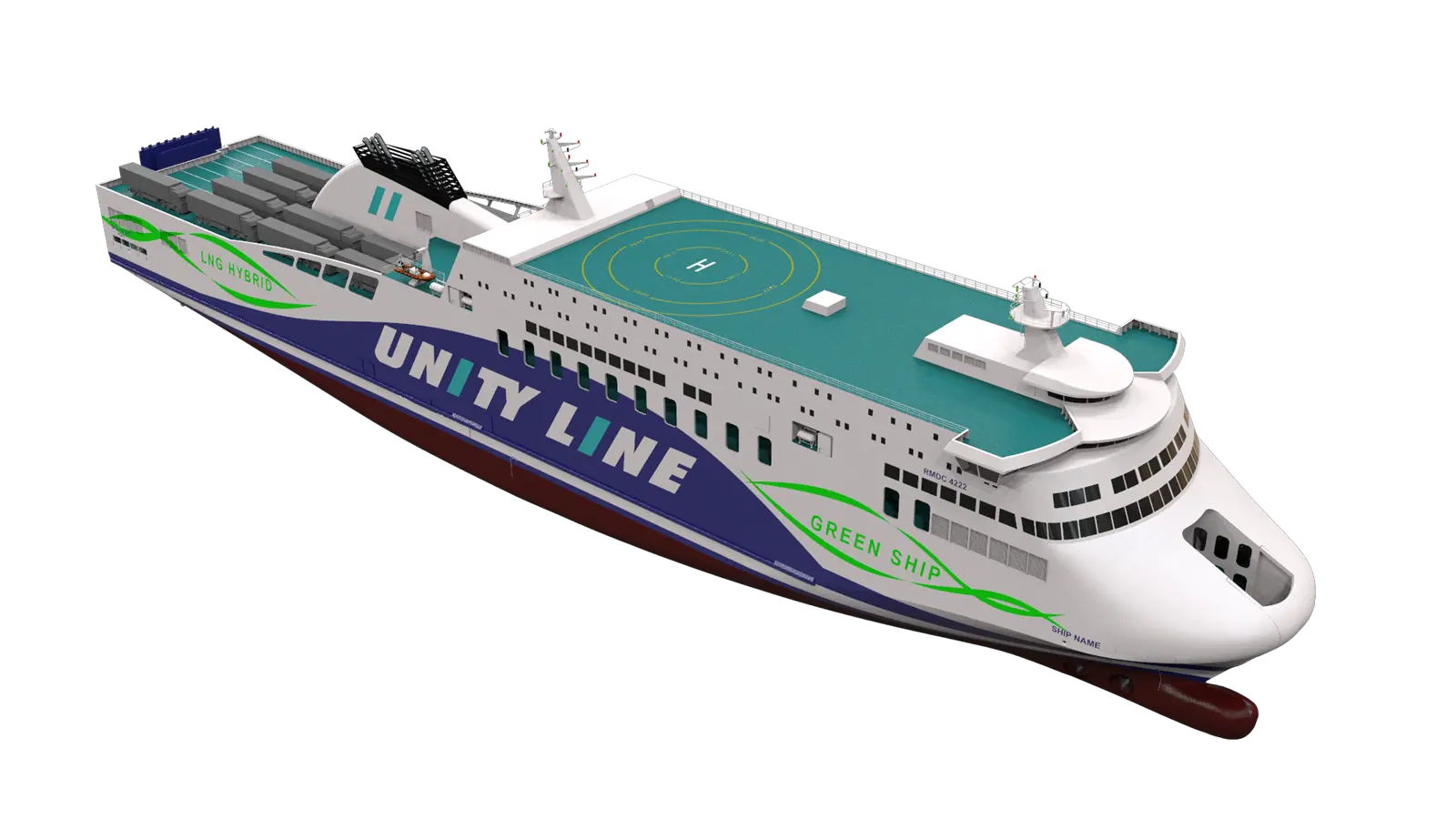
The 196m design central to the fleet development programme draws extensively on Nordic technology while providing a boost to the workload and business scope of the domestic shipbuilding industry.
Three vessels have been ordered from the Remontowa yard at Gdansk through Polskie Promy, a joint enterprise of the State Treasury and Polish Steamship Company (Polsteam/PZM). Two of the newbuilds will be deployed by the PZM subsidiary Unity Line, and one will sail under the Polferries brand of Polish Baltic Shipping Company (PZB). The contract with Remontowa carries an option on a fourth vessel.
Based on a concept drawn up by Remontowa Marine Design & Consulting (RMDC), the nascent class will feature Azipod electric azimuthing propulsion units and an LNG dual-fuel main power plant supplemented by a battery installation. The ferries will operate between Swinoujscie, Poland’s westernmost Baltic port, and Sweden’s southernmost ports of Trelleborg and Ystad.
The ships will play a major role in sustaining and improving the economics both of Poland’s trade with Scandinavia and the ferry lines’ seabridge role for goods moving between central and southern Europe and the Nordic region.
The nature of the power and propulsion arrangements also signifies a step change in environmental standard, so as to meet the growing challenges presented by legislation and the corporate goals of cargo generators and logistic specialists.
Although diesel oil will be needed as pilot fuel for initial ignition of the prime movers, use of LNG will cut CO2 emissions by around 25% compared to a conventional propulsion system, with further CO2 and other emission savings resulting from the hybrid electric power solution and adoption of Azipod main thrusters.
The freight payload in each case will equate to 4,100 linear metres, or about 200 trucks, complemented by capacity for 400 passengers. A drive-through configuration, featuring bow, stern and internal access equipment designed and supplied by MacGregor, with provision for simultaneous two-level loading and unloading, meets the parameters associated with introducing much larger ferries into established schedules.
Model tests to confirm the design’s main elements, such as hull shape, stability, draught, deadweight, speed and manoeuvrability, were carried out at the Gdansk facilities of Maritime Advanced Research Centre (CTO).
Remontowa awarded ABB the contract to supply the integrated power, automation and propulsion arrangements. Each vessel will accordingly be propelled by two 7.5MW Azipod propulsors wherein the electric motors will be energised by a four-genset installation using Wartsila 31DF-series dual-fuel, medium-speed engines. Maximum service speed will be in the order of 19 knots.
Acclaimed for its combustion efficiency, the chosen machinery affords the ferry companies the possibility and long-term environmental advantage of operating the vessels on bio-LNG either on its own or blended with standard LNG.
By melding multi-fuel prime movers with a battery pack, ABB’s Power & Energy Management System (PEMS) will balance use of the different onboard energy sources, achieving further gains in operational efficiency and reduced emissions. The energy storage system obviates the need to engage an extra engine in various situations, notably as a failsafe backup on approach to, or manoeuvring in port. Rather, the hybrid concept uses batteries to provide redundancy, as well as conferring boost power and peak shaving capabilities.
ABB claims that integrated power offers a level of responsiveness that enables large ferries to achieve equivalent performance using lower installed power than in a conventional setup. Furthermore, the scope of the ABB contract embraces the company’s onboard connection system to allow the vessels to draw electrical energy from the shoreside grid when alongside.
Related Articles
 ELECTRIFICATION AND BATTERY HYBRIDS
 ELECTRIFICATION AND BATTERY HYBRIDS
 ELECTRIFICATION AND BATTERY HYBRIDS